

We check what Europe’s launch firms and the spaceports they use promised against what they flew, and who paid for it.
orbital launches from Europe’s spaceports so far (8 in all of 2025)
orbital launches worldwide this year, so Europe flies about 3 in every 100
since the last European launch: Vega C, Sentinel-3C, 15 Sep
new European launch firms we follow has reached orbit (Isar, 5 Sep 2026)
as of 8 Oct 2026
From the launch dates promised by companies, governments and agencies, as recorded on our pages. Only promises whose date has passed are shown.
Next launches from Europe
Launches with a date in the Launch Library feed. We leave out entries the feed has not updated for three months.
Announced by the companies
Dates the companies gave us or the press. Not yet in the launch feed.
Last results: Vega C, 15 Sep success · Spectrum, 5 Sep orbit · Ariane 62, 27 Aug success
Promised vs delivered
First flight: the earliest date each rocket was promised for, and what happened.
As of 7 Oct 2026. Sources and details on each company page and in our 2026 ranking.
Every date, rocket by rocket: European launch dates: every promise and what happened. Sizes side by side: European rockets compared. Who you can buy shares in: European space stocks.
Explore our data
Where each launch firm’s money comes from. Crimson is state money, grey is private. As of 9 Oct 2026.
Isar Aerospace has about €870m in. It passes €1bn only when you add the €198m ESA Launcher Challenge contract, which pays out as work is done up to 2030.
Where the numbers come from
Isar Aerospace: company funding releases (more than €400m of shares by June 2024, €270m Series D, about €100m of the €150m Eldridge bond, €35m Lakestar); grants 2021 to 2025; ESA contract of 27 Aug 2026.
PLD Space: company releases and the Spanish register; COFIDES and Innvierte (state) hold shares, the EIB, CESCE-backed banks and COFIDES lend; CDTI and PERTE grants; ESA contract of 27 Aug 2026.
Rocket Factory Augsburg: OHB annual reports (OHB says €30m of the ESA contract is paid); DLR and ESA Boost! grants.
MaiaSpace: its 2024 accounts: €83.4m paid in by ArianeGroup and €180m of advances, which cover its France 2030 contract with CNES and private orders (split not published). ArianeGroup is 50% Airbus, 50% Safran. France, Germany and Spain hold 26% of Airbus; France holds 11.7% of Safran. So about a fifth of ArianeGroup traces back to states.
HyImpulse, Skyrora, Latitude: company releases and filings. HyImpulse has state regional funds (Bayern Kapital, BW-Capital, NRW.BANK) and DLR as shareholders; their amounts are not published, so they sit with private money.
Sums are money granted, signed or raised, not payments made. Full sources on each company page and in our 2026 ranking.
Public money each rocket has received or been granted, divided by its flights that reached orbit. Money for flights still to come is left out. As of 8 Oct 2026.
€293m has gone to European launch firms that have never reached orbit, plus €346m in contracts for future launches.
For scale: Falcon 9 cost €268m to develop and has reached orbit 678 times, €0.4m of development money per orbit. Part of that money was public: NASA paid USD 396m under its COTS programme for Falcon 9 and the Dragon capsule together, and no split for the rocket alone exists.
How we count
Public money is money from the state: grants, awards, state loans and public development contracts. Equity from state-owned funds sits with the shareholder money and is not counted here. No agency publishes what it has paid out to date, so these are sums granted or signed, not payments.
Money for future flights is left out of the per-orbit figures: the European Launcher Challenge contracts of 27 August 2026, which pay against launches (Isar Aerospace €197.8m, Rocket Factory Augsburg €186.9m, PLD Space €158.9m), and ESA support for Ariane 6 and Vega C flights still to come.
An orbit is a flight that reached orbit, from Jonathan McDowell’s launch log, 7 October 2026.
Ariane 6: €4,618m from the 2015 development and pad contracts and the ESA subscriptions of 2019 and 2022. The 2025 subscription adds €1,952m, mostly for flights from 2026 to 2028. With it, the figure would be €730m per flight. The sums are in the prices of the year each was agreed.
Vega C: €87m per flight counts the 2015 development contract and the Vega C lines of the 2019 and 2022 subscriptions. On the development contract alone it is €58m; with ESA’s support for running the rocket it is €112m.
Sources: ESA contracts and subscription documents; company accounts and the German lobby register; the Orbex administrators’ proposals; Swedish government bills and SSC reports; Jonathan McDowell’s GCAT launch log. Every figure is on the page it comes from.
What changed
European Space Map
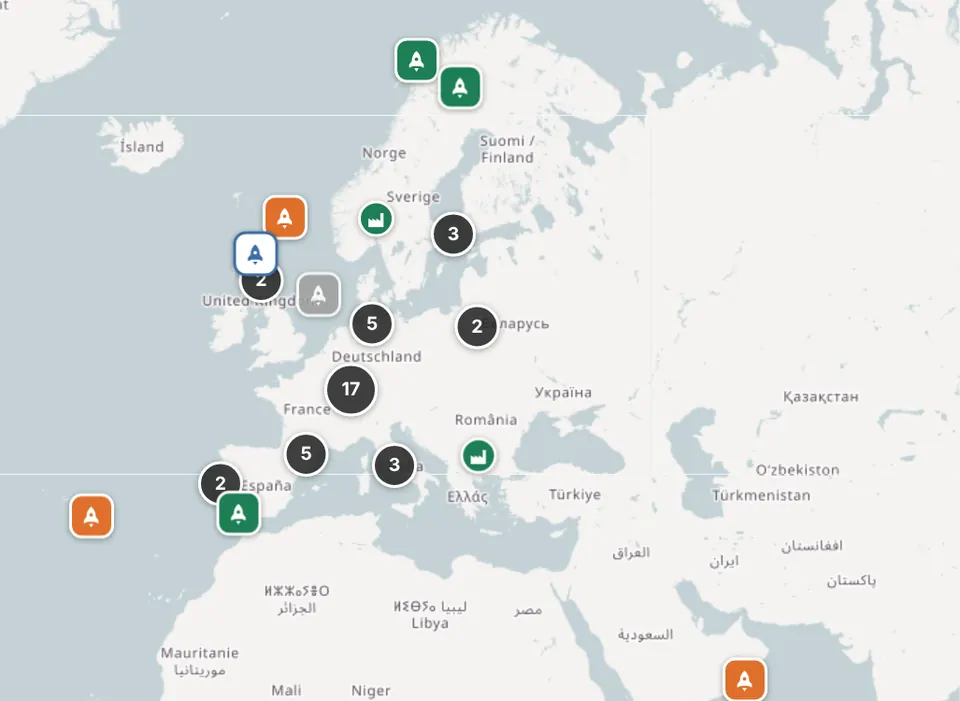
48 places in Europe, French Guiana and Oman: companies, spaceports and agencies. Search them, find what is near you, and open our reviews.
Latest articles and reviews
- Sirius Space Services
 Sirius Space Services, a French small-rocket start-up founded in 2020, has not flown as of October 2026. It holds a France 2030 contract and a pad slot in Kourou, but has announced no funding round, files confidential accounts and has moved its first flight from March 2025 to the end of 2027 or 2028.
 - Middle East launch and Europe
 European rockets launched most of the Middle East’s large satellites until 2019. Since 2020 Europe still builds them, SpaceX launches them, and three European launch firms have signed with Oman’s Etlaq spaceport.
 - Vega C and AvioVega C was ordered in 2014 to fly in 2018 and first flew in July 2022. Eight flights, one failure, 715 days on the ground, EUR 87.4 million of public money per successful flight and never more than three launches a year. How Avio and its rocket compare with Electron, Falcon 9 rideshare and China’s small rockets.
- Santa Maria Spaceport
 Santa Maria in the Azores holds Portugal’s only launch site licence. We look at who runs it, what has flown, who paid and what was promised since 2018.

Browse by topic: Launch companies, Spaceports, Programmes and benchmarks, Countries, or see all articles.
Interested in NewSpace?
We are looking for space enthusiasts, analysts and writers. Write to [email protected], or find us on X or LinkedIn.