

Spaceports › Etlaq Spaceport
Welcome to our in-depth analysis of Etlaq Spaceport, originally published October 6th, 2026 Updated content. Make sure to check out our mission statement and why we do what we do. Look at our New Space guide if you want explanations of terms and concepts used in our research. And follow us on X for updates.
What you should know about Etlaq Spaceport
📰 For space enthusiasts
- First commercial spaceport claim in the Middle East and North Africa, on the Duqm coast of Oman at about 18.8° N (published coordinates near 18.7862° N, 56.8220° E)
- Duqm-1 on 5 December 2024, apogee near 140 km: Weka sounding rocket (Snowdon Consulting), LOX and liquid propane. Suborbital.
- Karman X1 on 2 October 2026, second successful Etlaq launch: Azad Dreamer (~4.3 m, ~26 kg) with Stellar Kinetics MCT and OculloSpace. Range test, not aimed at space.
- Master plan names LC1 (heavy), LC2 (medium), LC3A / LC3B (micro-small and suborbital). Genesis uses about 10% of the plot for temporary campaigns.
- Company target for full commercial orbital operations: end of 2027. Permanent construction language in April 2025 still pointed at work starting in 2026.
- Ocean downrange over the Arabian Sea. Company claim: equatorial, SSO, polar, MEO and GTO access. Published azimuth tables were not found.
💰 For VCs and industry experts
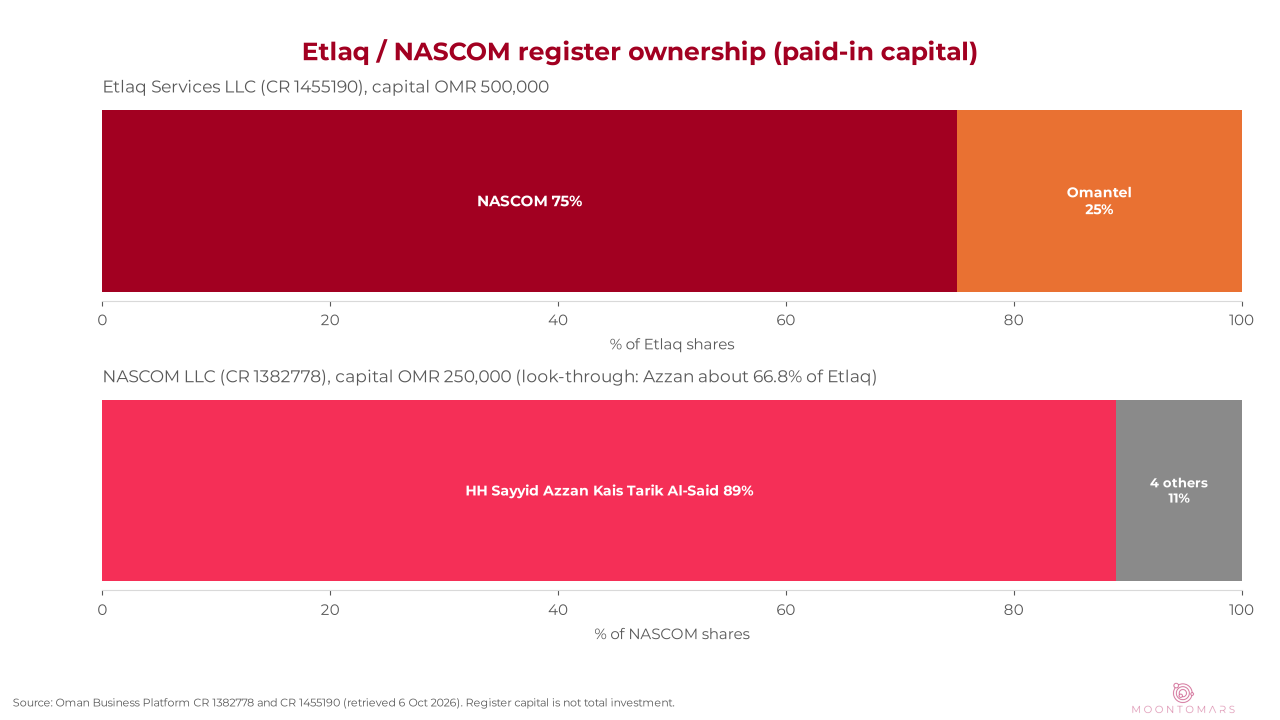
- Operator: Etlaq Services LLC (CR 1455190). Parent on the register: NASCOM LLC (CR 1382778, Muscat). NASCOM 75%, Omantel 25%. HH Sayyid Azzan Kais Tarik Al-Said holds 89% of NASCOM (look-through ~66.8% of Etlaq). Privately controlled company with a state-majority telco minority.
- Combined paid-in register capital NASCOM + Etlaq: OMR 750,000 (OMR 250k + OMR 500k). That is not total investment. Etlaq project CAPEX is not published.
- PLD Space strategic agreement, 20 February 2025: MIURA launch base at Etlaq, first MIURA 5 from Oman targeted for 2027 (second site after Kourou). See our PLD Space review.
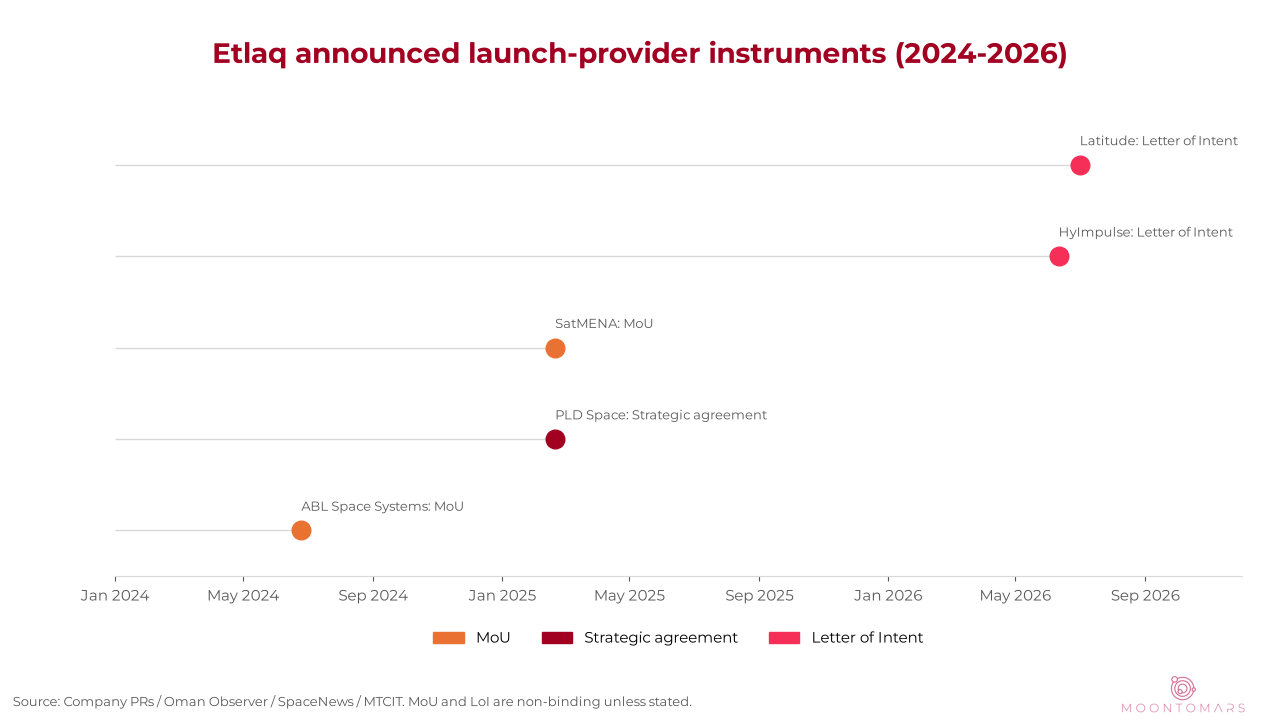
- Latitude (1 July 2026) and HyImpulse (11 June 2026) hold letters of intent only. ABL Space Systems MoU (25 June 2024) explores RS1 and export-control frameworks. MoU and LoI are not pad contracts.
- National Space Program Harvest (ONA, Sep 2026): private space-sector investment RO 20m (2023), RO 65m (2024), RO 74m (2025) for the whole sector, not Etlaq alone. State role: National Space Programme sponsorship and regulation.
- CAD 5-01 (28 Aug 2025): Safety Case and Launching Plan ≥45 days before launch. NASCOM named a “qualified entity” to operate spaceports (MTCIT MoU, February 2025).
👨💻 For potential employees
- Headcount: no filed annual report opened. Etlaq LinkedIn shows about 21 employees (estimate). Founder interview says the workforce is majority Omani.
- Roles a working spaceport will need: range safety, propellant handling, integration technicians, mission control, export-control and licensing staff, hospitality for campaign crews.
- Working language mixes English with Arabic for local authorities. Salary bands for Oman aerospace ops were not published in primary sources. Check Muscat and Duqm market rates yourself.
- Duqm is remote, on the order of 550 km from Muscat by road. Campaign life looks like rotational field work.

Etlaq Spaceport: Oman’s commercial pad on the Arabian Sea
Etlaq Spaceport is Oman’s commercial launch site on the Duqm coast. The operating company is Etlaq Services LLC (Commercial Register 1455190). On the register, National Aerospace Services Company (NASCOM) LLC (CR 1382778, Muscat) owns 75% of Etlaq, and Oman Telecommunications Company (Omantel) owns 25%. His Highness Sayyid Azzan Kais Tarik Al-Said holds 89% of NASCOM and sits as a joint authorised manager of Etlaq. Press materials also style him Sayyid Azzan bin Qais Al Said and name him founder and CEO of the Etlaq / NASCOM stack.
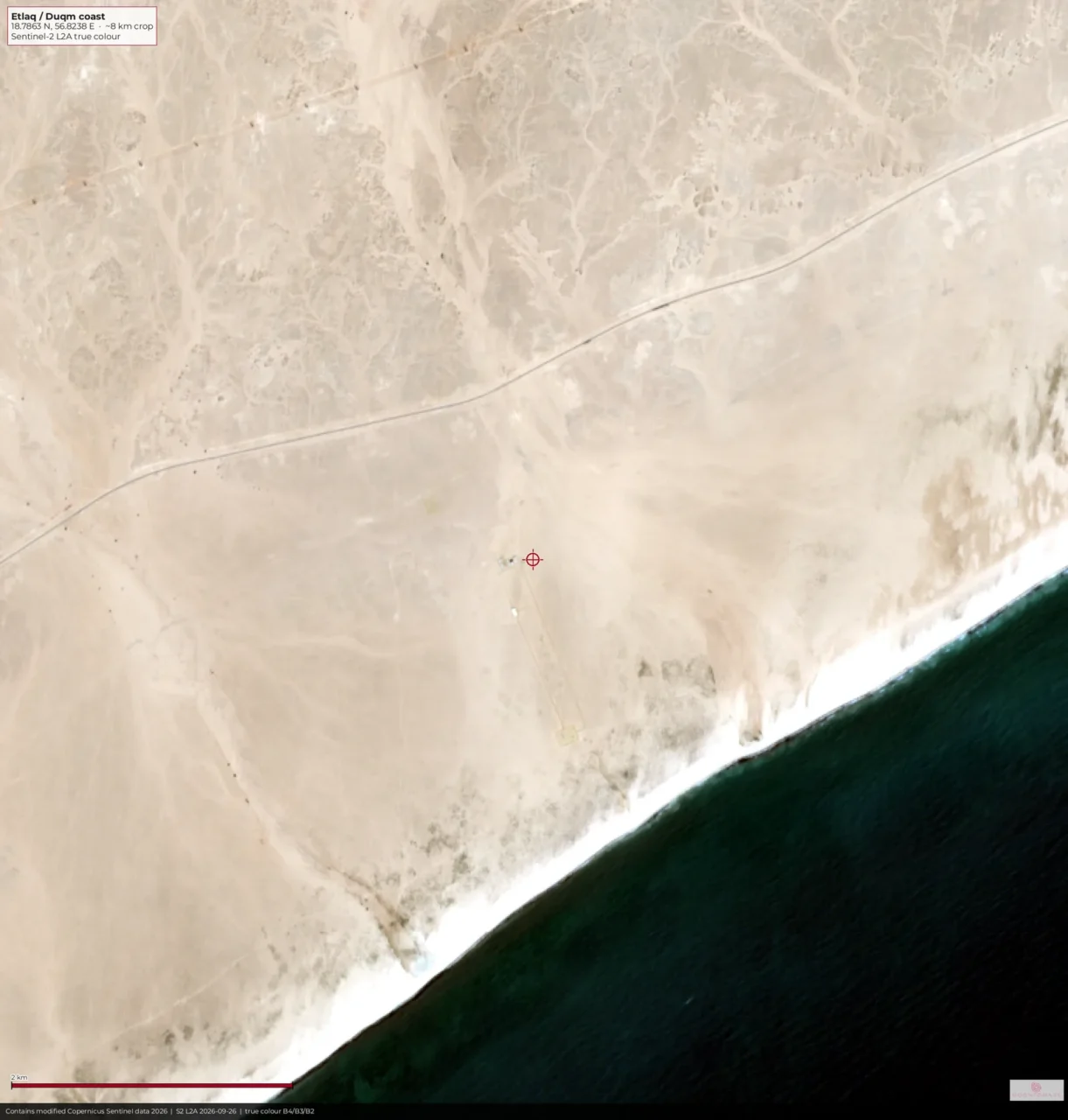
The site sits near 18.8 degrees north, with published coordinates around 18.7862° N, 56.8220° E. That is far south of Andøya, SaxaVord or Esrange, and much closer to the equator than those European NewSpace pads. An early project description placed the plot at Hetam, Al Duqm (Plot 25), about 256,443 square metres, roughly 17 metres above sea level and about one kilometre from the ocean.
This is our first Middle East spaceport page. It sits next to our European launcher reviews for PLD Space, Latitude and HyImpulse, each of which now has a written instrument with Etlaq. Oman already flew a sounding rocket on Duqm-1. The open question is whether Duqm becomes a reliable orbital alternative when Kourou slots or North Atlantic weather are the bottleneck.
History: from NASCOM to Duqm-1 (2021 – 2024)
NASCOM (CR 1382778) was established on 15 February 2021 and registered on 18 February 2021, with paid-in capital of OMR 250,000 cash and foreign investment marked No on the Oman Business Platform extract dated 6 October 2026. Partners on that extract are HH Sayyid Azzan Kais Tarik Al-Said at 89% (sole authorised signatory), plus four Omani partners at 3%, 3%, 3% and 2%.
Etlaq Services LLC (CR 1455190) was established on 1 November 2022 with paid-in capital of OMR 500,000 cash, and its partners are NASCOM at 75% and Omantel at 25%. Authorised managers are Yousuf Nasser Mattar Al-Azizi, HH Sayyid Azzan Kais Tarik Al-Said and Talal Said Marhoon Al Moamari. Neither CR lists a dedicated space-launch activity code. NASCOM’s registered activities cover IT, software, 3D manufacturing, communications installation, trading agencies and management offices. Etlaq’s extract includes a goods-warehouse licence in Hitam, Al-Duqm.
Etlaq’s timeline puts site selection and planning in 2022 and master-plan work with regulators in 2023. A January 2023 project write-up already named the Duqm plot size and a three-year build ambition. UK Launch Services Limited received an early planning contract in November 2023, according to SpaceWatch.Global, which is a planning award and not proof that the permanent orbital complex was finished.
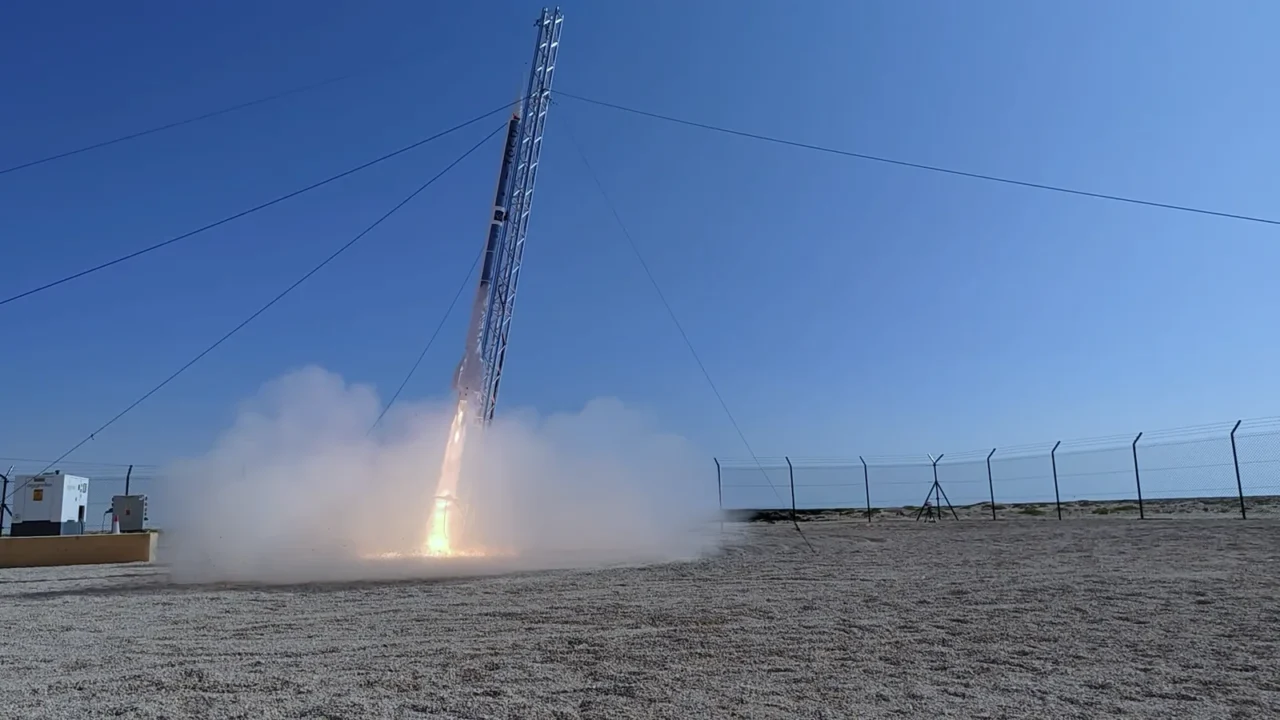
On 5 December 2024 at 10:05 Oman time, Etlaq and NASCOM flew Duqm-1 under MTCIT and Civil Aviation Authority oversight. The vehicle was a Weka sounding rocket from New Zealand’s Snowdon Consulting Limited, burning liquid propane and liquid oxygen. Independent trackers put the apogee near 140 kilometres, above the Kármán line on a suborbital hop. It was the first launch from the site. The Etlaq Duqm-1 page header currently shows a launch date of 5 December 2025, while the page body and the MTCIT release say 2024. We use the ministry date.
Genesis Program and the 2025 – 2026 test cadence
Etlaq launched the Genesis Program in 2024 as the temporary operating layer before a full orbital spaceport. Company copy says campaigns can run from planning to liftoff in about 14 weeks, with facilities sized for suborbital and experimental work. Julanda Al-Riyami, chief commercial officer, told The National in April 2025 that Genesis occupies about 10 percent of the allocated land, with the rest reserved for three launch complexes and four pads. He put commercial orbital operations at the end of 2027, with permanent construction expected to begin in 2026.
In February 2025, at the Etlaq Launch Conference in Muscat, the spaceport talked about five test launches in 2025 with international partners. The public launch list on etlaq.om includes Duqm-1, Unity-1 (Advanced Rocket Technologies / Horus-4), Duqm-2 through Duqm-4 (Stellar Kinetics Kea series) and Ambition-3 (Kuwait Space Rocket).
What flew is thinner than five green checkmarks. Unity-1 was delayed in late April 2025 by strong winds and then by landing-leg issues on the ART vehicle, according to contemporary reporting. No confirmed Unity-1 flight appears through early October 2026. Duqm-2 in July 2025 completed ground operations, propellant load and defuel, then scrubbed before ignition after a commercial valve-actuator fault on Kea-1. Etlaq’s own Duqm-2 page treats the campaign as an operations proof. Times of Oman, Muscat Daily and the National Space Program Harvest record the no-ignition outcome. Ambition-3, Duqm-3 and Duqm-4 stayed on the public list as 2025 plans. No primary confirmation that those three flew was found.
On 2 October 2026, Oman News Agency reported the successful Karman X1 test from Etlaq. The vehicle was Azad Dreamer, about 4.3 metres long and 26 kilograms, flown with Omani operator Stellar Kinetics MCT and Singapore’s OculloSpace, carrying an Orbit2Orbit payload. Official and press accounts say the rocket followed a stable ascent with telemetry to mission control, reached its target altitude inside the test range, and was not intended to reach space. They also call Karman X1 the second successful launch from Etlaq after Duqm-1. Etlaq’s LinkedIn post adds that both stage burns completed and returned telemetry. The NASCOM founder describes Stellar Kinetics as a co-founded launch effort behind Duqm-1 and Duqm-2 test work. Treat that as a company claim until separate corporate filings are public.
Location: why Duqm sits where it sits
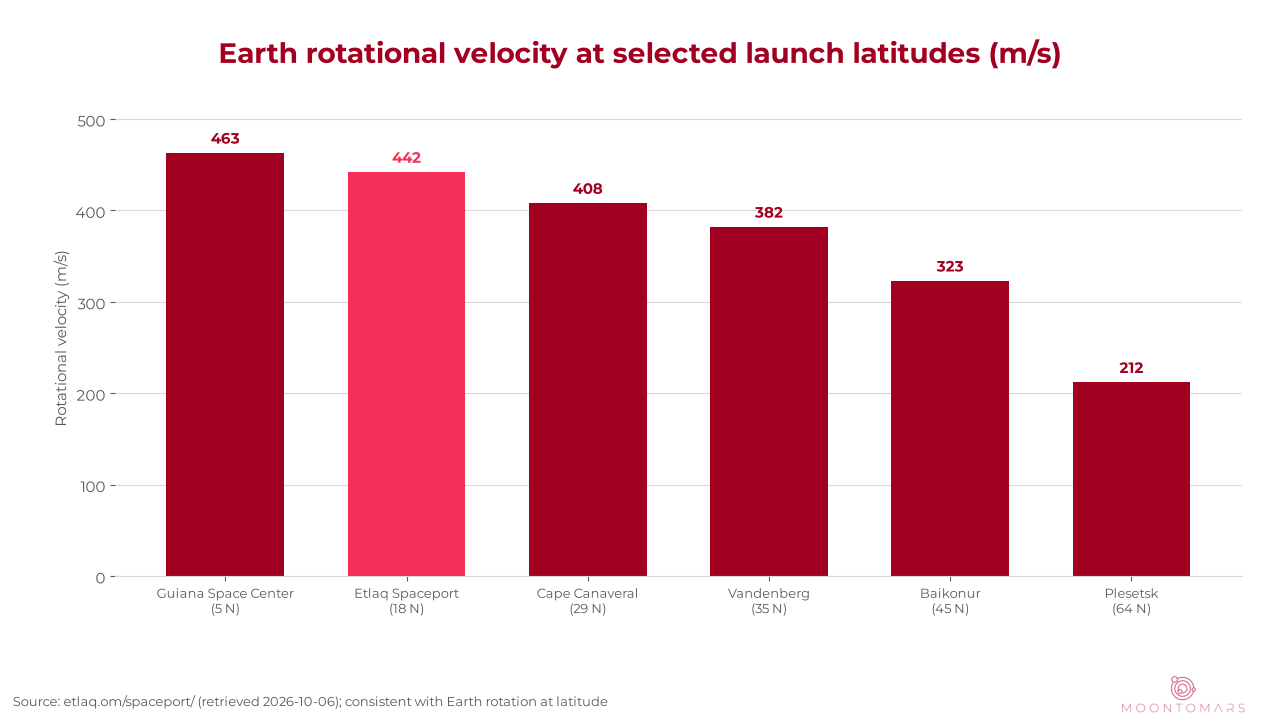
Etlaq’s pad sits in the Wilayat of Duqm, Al Wusta Governorate, on Oman’s southeastern coast, roughly 100 kilometres south-southwest of Duqm town (the SEZ deepwater port and airport sit that far up the coast). For launch geometry the useful facts are latitude and clear ocean downrange. At about 18 degrees north, Earth rotation contributes roughly 442 metres per second of eastward velocity. Etlaq publishes a comparison next to Guiana (about 463 m/s at 5° N), Cape Canaveral (408), Vandenberg (382), Baikonur (323) and Plesetsk (212). Those figures match ordinary Earth-rotation arithmetic at latitude.
That helps low-inclination and geostationary-transfer missions more than it helps classic polar SSO customers, who already have Andøya, SaxaVord, Sutherland and Esrange further north. Etlaq’s commercial pitch is fuel efficiency toward the equator plus a Gulf and Indian Ocean address for Middle East and Asian customers who do not want a Guiana campaign.
No published azimuth table or licensed inclination envelope from the Civil Aviation Authority was found. Company pages claim equatorial, sun-synchronous, polar, MEO and GTO access. Until a licence pack or range manual is public, treat wide orbit access as a company claim.
The site: Genesis on the Duqm coast
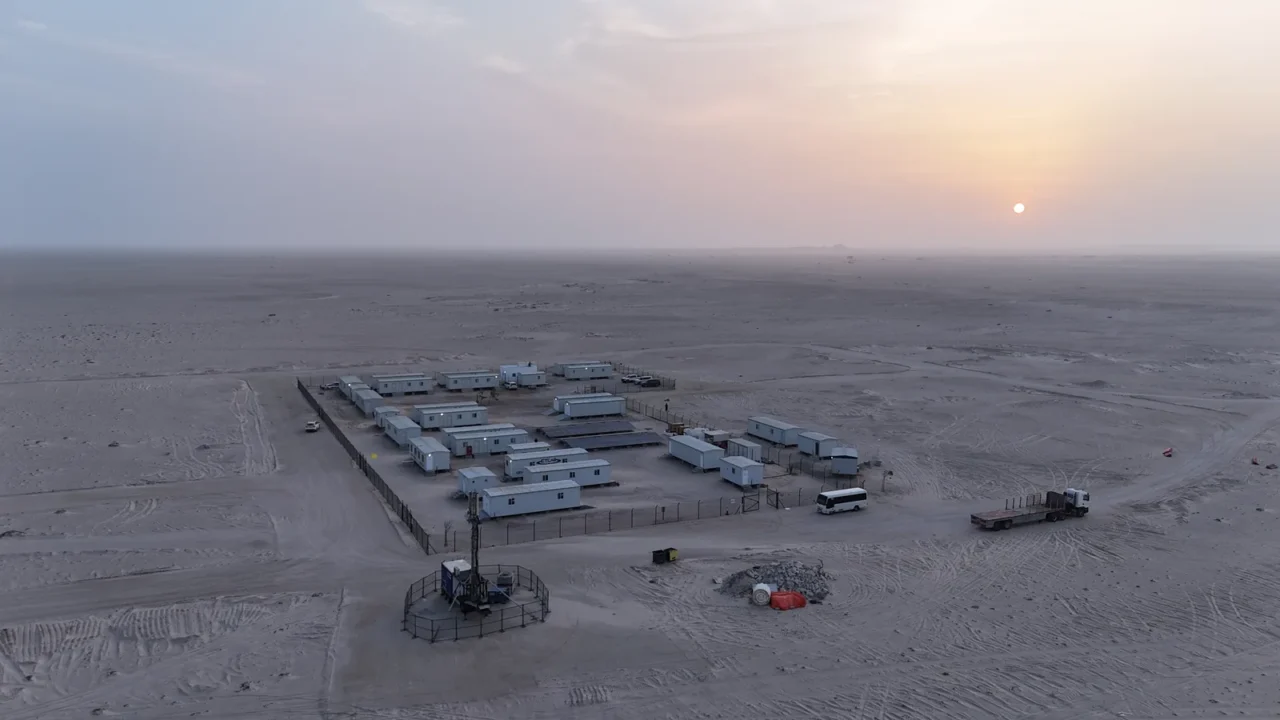
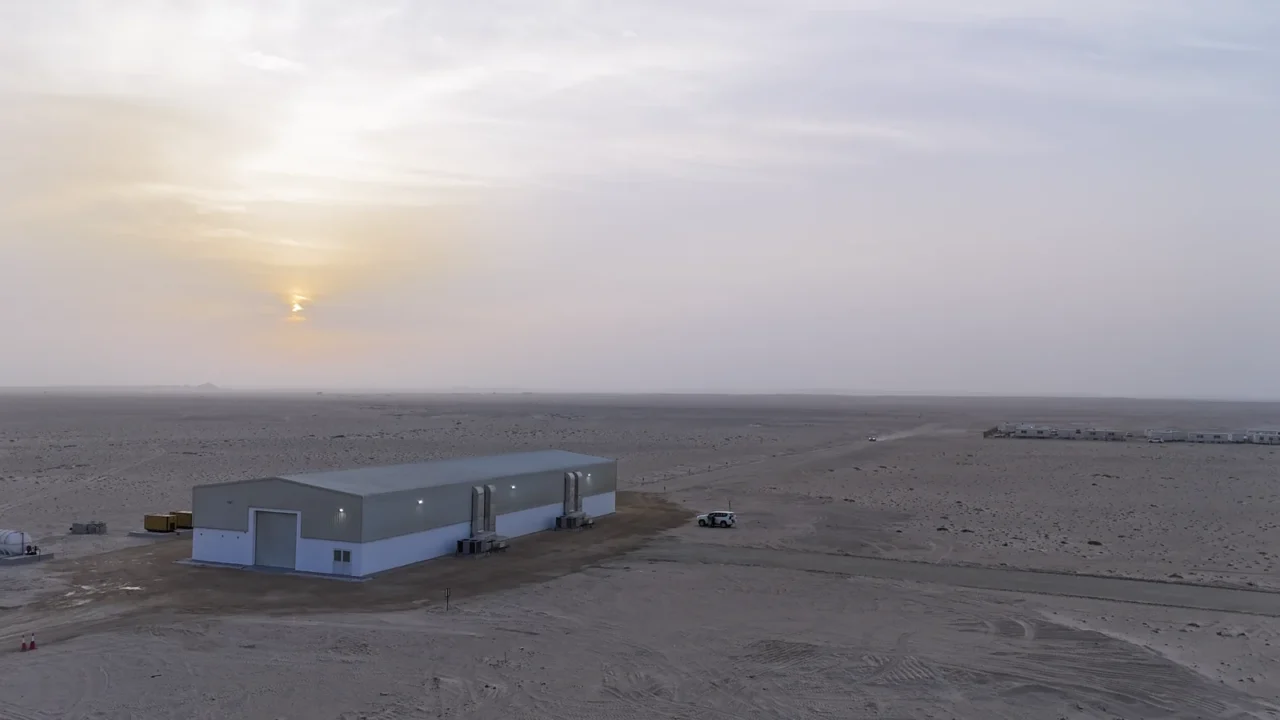
These photos show the temporary Genesis compound as built: modular ops cabins, the vehicle integration hangar, and the lattice rail used for Duqm-1. The Sentinel-2 true-colour frame (~8 km across, 10 m pixels) shows the same footprint on the coast, well south of Duqm town. As of Oct 2026.



Infrastructure: temporary Genesis vs permanent complexes
Site specifications (as published)
| Spec | Figure |
|---|---|
| Location | Hetam / Hitam, Wilayat of Duqm, Al Wusta, Oman (Plot 25 area); ~100 km SSW of Duqm town |
| Coordinates (published) | ~18.7862° N, 56.8220° E |
| Plot size (early project description) | ~256,443 m² |
| Elevation / shore | ~17 m ASL, ~1 km from ocean |
| Genesis footprint | ~10% of allocated land (temporary) |
| Planned complexes | LC1 heavy, LC2 medium, LC3A / LC3B micro-small and suborbital |
| Commercial orbital target | End of 2027 (company / CCO) |
| First launch | Duqm-1, 5 Dec 2024 (suborbital) |
| Second successful | Karman X1, 2 Oct 2026 (range test) |
Etlaq’s website describes three dedicated launch complexes with launch-vehicle integration buildings, mission control and range safety, propellant storage, water and flame suppression, maintenance and exclusion zones, plus static-test stands. Launch Library 2 currently indexes a “Launch Complex 3” pad at the published coordinates.
Parts of the Etlaq site mark facility imagery as AI-generated. Those frames are not evidence of finished concrete. The Genesis phase, by company and press accounts, used temporary pads, hangars and range kits sized for sounding rockets and small guided suborbital vehicles. The permanent orbital civil works were still ahead when Al-Riyami spoke in April 2025.
Customers and agreements: the stamp on the paper
PLD Space (Spain): strategic agreement, 20 February 2025. PLD’s own release says Etlaq becomes its second global launch base for the MIURA family after the Guiana Space Centre complex. Co-founder Raúl Verdú signed with Sayyid Azzan at ELC 2025 in Muscat. The public plan is to design, engineer and build a PLD launch base for a first MIURA 5 flight from Oman in 2027, with later room for larger MIURA vehicles. Neither side published a flight count or a civil-works cost split. SpaceNews noted the same gaps. The agreement is the strongest commercial instrument on the board, and it remains a schedule promise tied to a rocket that has not reached orbit as of October 2026. Full company review: PLD Space.
Latitude (France): letter of intent, 1 July 2026. The LoI was signed around Sultan Haitham bin Tariq’s state visit to France. It sets a framework for Latitude’s first experimental launch from Etlaq in late 2027, plus joint work on ground infrastructure, operations and regulatory steps including export control. European Spaceflight reported Latitude’s line that detailed agreements will follow. An LoI is not a pad lease. Full company review: Latitude.
HyImpulse (Germany): letter of intent, 11 June 2026. The LoI was signed around SmallSat Europe in Amsterdam. The parties will explore launch-related activity and a possible longer operational presence, including assessment of SR75 and SL1 campaigns. That is intent, not a binding manifest. Full company review: HyImpulse.
ABL Space Systems (United States): MoU, 25 June 2024. The MoU was signed at the Oman Civil Aviation Authority with the US ambassador present. It covers exploring RS1 launches, local logistics, site construction, and regulatory plus export-control frameworks with both governments. US launch vehicles and many US-origin components need export authorisations that Oman cannot waive alone.
SatMENA: MoU, February 2025. Ground-station services support around the same Muscat conference that hosted the PLD signing, per MTCIT.
No published Korean or Indian launch-provider contract with Etlaq appeared in open sources reviewed for this page.
Ownership and money: register capital vs pad ambitions
Tenet, stated plainly: Etlaq Services LLC is a privately controlled company. NASCOM owns 75%. Omantel owns 25%. Combined paid-in register capital across both entities is OMR 750,000. That figure is not total project investment. The public master plan still names four pad complexes (LC1, LC2, LC3A, LC3B). The state’s named role in ministry and ONA language is National Space Programme sponsorship and regulation, not a disclosed majority equity line on the Etlaq CR.
Look-through on the private side: Azzan’s 89% of NASCOM times NASCOM’s 75% of Etlaq is about 66.8% of Etlaq. The other NASCOM partners hold 11% of the parent, or about 8.25% of Etlaq on a look-through basis. Omantel’s 25% is the only direct state-linked equity on the Etlaq register.
On Omantel itself, market profiles (Mubasher / MarketScreener) put United International Telecommunication Investment and Projects LLC at about 51% and Oman Investment Authority at about 6% of listed Omantel (OTEL). Omantel’s own IR shareholder page says OIA owns more than 70%. A December 2016 Oman Observer report recorded the transfer of the government’s 51% stake from the Ministry of Finance into the Oman Investment Fund, later absorbed into the OIA system. Either reading leaves Omantel state-majority. Through the 25% Etlaq stake, look-through state-linked interest in Etlaq is at least about 12.75% (0.51 × 0.25) and above about 17.5% if the IR 70%+ figure is used.
Public facts on Sayyid Azzan: the CR styles him H.H. Sayyid Azzan Kais Tarik Al-Said. He is sole authorised signatory of NASCOM and a joint authorised manager of Etlaq. An Oxford Business Group interview (Oman 2023) names him co-founder and CEO of AZD Technologies, a nano-diamond metal-coatings firm. The style His Highness Sayyid plus the Al Said / Al Bu Said family name places him in Oman’s ruling house. Exact genealogical position relative to Sultan Haitham bin Tariq was not verified from sources used here. He is distinct from the nineteenth-century Imam Azzan bin Qais.
Etlaq’s construction budget is not in any primary document verified after English and Arabic searches, and that remains the main financial hole: the register shows paid-in capital, not pad CAPEX.
- Register capital (paid-in): NASCOM OMR 250,000 cash (CR 1382778). Etlaq Services OMR 500,000 cash (CR 1455190). Total OMR 750,000. Foreign investment: No on both extracts.
- Private, sector-wide: the National Space Program Harvest 2023–2025, reported by Oman News Agency on 27 September 2026, puts private space-sector investment at RO 20 million in 2023, RO 65 million in 2024 and RO 74 million in 2025. Company counts rose from 11 to 26 and sector employment from 152 to 400 over the same years. Those numbers cover the whole Omani space market, not a published Etlaq build invoice.
- State role: ONA and Foreign Ministry wording on Karman X1 call Etlaq a strategic project supported and sponsored by the National Space Programme under the infrastructure pillar. That is sponsorship and regulation language, without a disclosed OMR CAPEX line for the Duqm pads.
- MTCIT Undersecretary Dr Ali al Shidhani told the Oman Observer on 6 March 2024 that Oman had attracted roughly RO 20 million of space-sector investment over the previous two years. He named NASCOM’s Duqm spaceport among several recipients, together with local satellite firm ETCO and international arrivals such as SatMENA. That earlier figure matches the Harvest 2023 private-investment starting point and remains a sector aggregate.
- The Oman Space Policy and Executive Program (2023 – 2033) describes a “Launch Site Partnership” project that “relies on a partner’s investment” to attract foreign partners into the first MEA regional spaceport. The policy text leans on FDI and partners, not a fully costed state megaproject.
- The founder’s Business Focus interview says ministry support has been institutional coordination across defence, housing and environment, “beyond funding.” That matches a model where the state clears airspace and land while private capital is supposed to pour concrete.
- On the European launcher side, SOPEF, the Spain–Oman private equity fund associated with COFIDES and Oman Investment Authority capital, joined PLD Space’s September 2026 Series C extension. COFIDES had separately taken a €50 million FOCO minority stake in PLD in March 2026. Omani state-linked capital therefore sits on the PLD cap table while PLD plans a pad in Duqm. That does not publish Etlaq’s own build cost.
Regulation and export control
Royal Decree 90/2020 put space under MTCIT’s mandate and led to the National Space Policy for 2023 – 2033. In February 2025 MTCIT signed an MoU that designates NASCOM a “qualified entity” to establish and operate spaceports. The Civil Aviation Authority’s CAD 5-01, “Airspace Usage for Launch Vehicle Activities,” is effective 28 August 2025 (Issue 1 / Rev. 0). The official scanned PDF requires applicants to contact the CAA with a subject-matter expert and to submit a Safety Case and a Launching Plan at least 45 days before launch. A NOTAM can then reserve temporary airspace in the Muscat FIR. That airspace approval does not replace security, environmental or maritime clearances from other authorities. Press articles that add a “no annual launch cap” or “45 working days” wording go beyond the four CAD pages opened for this review. This page quotes the PDF’s 45 days rule until the separate CAD 5-01 APP form says otherwise.
Export control is the hard gate for several customers. SpaceNews flagged technology-safeguard issues for US vehicles launching from new foreign ports. The ABL MoU names export-control frameworks with both governments as work items, and Latitude’s public LoI comments also name export-control compliance. European rockets with US-origin parts can hit the same wall. Oman can write a fast airspace rule, and it cannot rewrite ITAR.
Oman markets neutrality and logistics. European customers will still price regional conflict risk, shipping routes and insurance when they compare Duqm with Kourou or Andøya.
Etlaq in the EUME map: Europe plus the Gulf
From Dubai and Abu Dhabi the UAE already runs a serious downstream and human-spaceflight stack through Mohammed Bin Rashid Space Centre, national satellites such as MBZ-SAT, and startup routes such as MBRSC Space Ventures and the DIFC soft-landing programmes. The UAE does not operate a domestic commercial orbital spaceport today, and Saudi Arabia has announced space ambitions without a Duqm-class coastal pad in commercial service, which is the regional hole Etlaq is trying to fill.
| Site | Approx. latitude | Main orbit pitch | Status snapshot (Oct 2026) |
|---|---|---|---|
| Etlaq (Duqm) | ~18.8° N | Low inclination + claimed SSO/polar | Suborbital flown, orbital target 2027 |
| Guiana Space Centre | ~5° N | Equatorial / GTO workhorse | Operational institutional port |
| Andøya | ~69° N | Polar / SSO | Orbital pad live for European micros |
| SaxaVord | ~60° N | Polar / SSO | Licensed UK port, cadence still building |
| Space Hub Sutherland | ~58° N | Polar / SSO | Planning and consent history, slower build |
| Esrange | ~68° N | Polar / suborbital heritage | Sweden, strong test heritage |
For PLD, Latitude and HyImpulse, Etlaq is a second or alternative path when Guiana slots, North Sea weather or UK licensing are the bottleneck. For Isar and RFA, the live European pads remain Andøya and SaxaVord. Duqm does not replace Kiruna on polar routes, and a Gulf pad now sits on the same customer shortlists as the North Atlantic sites for a different set of inclinations and customers.
Working at Etlaq: roles and location reality
No public annual report with a filed headcount for Etlaq or NASCOM was opened for this review, and Etlaq’s LinkedIn page shows about 21 employees, which we treat as an estimate. The founder interview states the workforce is majority Omani.
A working spaceport will need range safety, propellant handling, integration technicians, mission control, export-control and licensing staff, and hospitality for campaign crews. Working language on site mixes English with Arabic for local authorities. Salary bands for Oman aerospace operations were not published in the primary sources used here. Duqm sits on the order of 550 km from Muscat by road, so campaign life looks like rotational field work rather than a city campus.
My opinion on Etlaq Spaceport and why you should keep an eye on them
What I like about Etlaq
- Latitude and ocean downrange: 18 degrees north plus Arabian Sea corridors is a product European polar ports cannot copy. The rotational-velocity figures versus Cape or Baikonur are ordinary Earth-rotation arithmetic.
- First launches: Duqm-1 in December 2024 puts Etlaq ahead of spaceport projects that have published renders and no flight. Genesis is a deliberate suborbital learning loop.
- Middle East: With UAE moving forward rapidly in their space endeavors, having a launch site in nearby Oman could support the growth of new space for the countries outside the US and China
- Regulatory paper moved: CAD 5-01 and the NASCOM “qualified entity” MoU are concrete state products, not only vision PDFs.
What I don’t like about Etlaq
- CAPEX opacity: no public build cost, no filed accounts, no clear split of who pays for the PLD pad. OMR 750k of paid-in register capital and RO 20–74 million of sector-wide private investment are not a spaceport budget.
- Promise stack: five test launches for 2025 met friction. Orbital commercial ops at end-2027 is a target, not a finished pad complex today.
- Geopolitical uncertainy: adding another element of friction to launches
- AI facility imagery on the company site: Useful for mood boards.
Things to watch out for
- 2027 clocks: PLD MIURA 5 from Oman, Latitude’s experimental first flight, and Etlaq’s own commercial ops date all cluster on 2027. Slip on the rocket or on the civil works will show up in the same year.
- Export licences: ABL and any US-content European vehicle will depend on technology-safeguard paperwork, not only on Duqm concrete.
- CAPEX vs register capital: the CR extracts settle ownership (NASCOM 75% / Omantel 25%, OMR 750k paid-in). The open money question is who writes the civil-works cheques for four pads when paid-in capital is OMR 750k.
- Cadence proof: Karman X1 adds a second successful ignition after Duqm-1. A third success, or a confirmed Unity-1 / Ambition-3 flight, would say more than another conference MoU.
Where to find more information on Etlaq
- Etlaq site: https://etlaq.om/ (spaceport, Genesis, launches)
- NASCOM: https://www.nascom.om/ (CR 1382778 on the about footer)
- MTCIT Duqm-1 release and NASCOM MoU pages
- Oman Space Policy and Executive Program 2023 – 2033 (PDF)
- PLD Space investor news on the Etlaq agreement (20 February 2025)
- Our related reviews: PLD Space, Latitude, HyImpulse, Isar Aerospace, Rocket Factory Augsburg, Andøya Space Center, SaxaVord Spaceport, Space Hub Sutherland
Structured company information on Etlaq Services LLC / NASCOM LLC
| Type | Information |
|---|---|
| Official spaceport name | Etlaq Spaceport |
| Operating company | Etlaq Services LLC (CR 1455190), established 1 Nov 2022, capital OMR 500,000 cash |
| Parent on register | National Aerospace Services Company (NASCOM) LLC (CR 1382778), established 15 Feb 2021 / registered 18 Feb 2021, capital OMR 250,000 cash, seat Al Seeb, Muscat |
| Ownership (CR, 6 Oct 2026) | Etlaq: NASCOM 75%, Omantel 25%. NASCOM: HH Sayyid Azzan Kais Tarik Al-Said 89%, four partners 3%+3%+3%+2%. Foreign investment: No on both. Combined paid-in capital OMR 750,000 (not total investment) |
| Look-through | Azzan ~66.8% of Etlaq via NASCOM. Omantel 25% is a state-majority telco (UITIP ~51% + OIA ~6% on market profiles, or OIA 70%+ on Omantel IR) |
| Authorised managers (Etlaq) | Yousuf Nasser Mattar Al-Azizi, HH Sayyid Azzan Kais Tarik Al-Said, Talal Said Marhoon Al Moamari |
| Management (press) | Sayyid Azzan styled founder and CEO of Etlaq / NASCOM. Julanda Al-Riyami (CCO, Etlaq, as quoted 2025). Azzan also co-founder and CEO of AZD Technologies (OBG) |
| Location | Plot 25 area, Hetam / Wilayat of Duqm, Al Wusta, Oman; ~100 km SSW of Duqm town. Published pad coordinates ~18.7862° N, 56.8220° E. Etlaq CR warehouse licence: Hitam, Al-Duqm |
| Launch site role | Genesis temporary test / suborbital, planned LC1–LC3 orbital complexes. No launch-specific activity code on either CR |
| First launch | Duqm-1, 5 December 2024 (suborbital). Second successful: Karman X1, 2 October 2026 (range test, not to space) |
| Headcount (estimate) | Etlaq LinkedIn about 21 employees (public page). No filed accounts opened. |
| Contact | Websites: etlaq.om / nascom.om. Public site footer emails only. |
Interested in more spaceports and launch companies?
Read our reviews of Andøya Space Center, SaxaVord Spaceport, Space Hub Sutherland, the German Offshore Spaceport Alliance, PLD Space, Latitude, HyImpulse, Isar Aerospace and Rocket Factory Augsburg.