
Welcome to our in-depth analysis of Esrange Space Center, published October 7th, 2026 Updated content. Make sure to check out our mission statement and why we do what we do. Look at our New Space guide if you want explanations of terms and concepts used in our research. And follow us on X for updates.
October 2026 update: 60 years old, no orbital launch yet
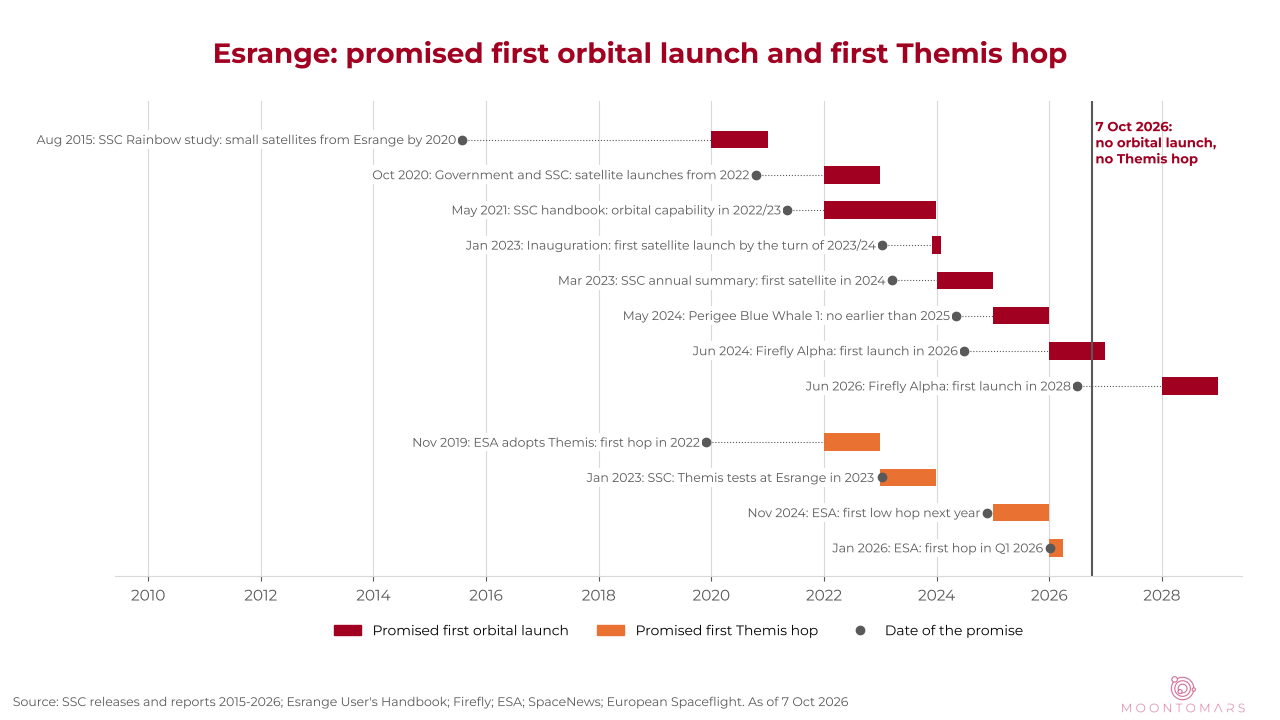
- Launches: No rocket has reached orbit from Esrange as of October 7th, 2026. SSC Space and Firefly Aerospace signed a contract for two Alpha launches on September 9th, 2026, with the first now planned for 2028. In 2020 the Swedish government and SSC had promised satellite launches from 2022.
- Themis: The European reusable rocket demonstrator Themis has stood on its pad at Esrange since September 2025 and has done two fuelling rehearsals, the last on September 29th, 2026, but it has not flown. ESA expected the first hop in 2022, and the EU project paying for the hop tests ends on December 31st, 2026.
- Money: Sweden gave SSC a capital injection of SEK 386 million (about EUR 35 million) in June 2026 for launch capability, and the defence procurement agency FMV signed a SEK 209 million contract in March 2026. The first launches are meant to carry Swedish military satellites, on rockets SSC buys itself.
- Accounts: SSC reported an operating profit of SEK 393 million for 2025. Without two accounting one-offs worth SEK 380 million it was SEK 14 million, and the launch division lost SEK 39 million.
- Rules: Sweden still has no licence for an orbital launch and works under its Space Activities Act of 1982. Norway’s aviation authority called Sweden’s safety data for flights over Norwegian territory insufficient in February 2025.
- Site: The Orbital Launch Control Center opened in February 2026. The pad for Firefly’s Alpha (LC-3C) is still under construction.
What you should know about Esrange Space Center
📰 For space enthusiasts
- Rocket range since 1966, about 45 km east of Kiruna in northern Sweden, about 150 km north of the Arctic Circle
- More than 600 sounding rockets and 700 balloons launched, the 700th balloon in August 2026
- No orbital launch yet. First Firefly Alpha launch planned for 2028 from pad LC-3C
- 5,200 km² impact area of tundra north of the base where rocket stages may come down
- Engine test stands used by Isar Aerospace and RFA
- Themis reusable rocket demonstrator on the pad since September 2025, no flight yet
💰 For VCs and industry experts
- 100% owned by the Swedish state through SSC Space AB (until February 2026: Svenska rymdaktiebolaget)
- SSC group 2025: sales SEK 1,710 million, operating profit SEK 393 million, SEK 14 million without one-offs
- About SEK 1.9 billion of state money into SSC from 2018 to mid-2026, incl. capital, grants and a defence contract
- SEK 880 million of that was capital to cover leaving business against Swedish security interests, mainly in China
- Launch customers: Firefly (two launches for Swedish national security customers). Perigee signed in 2024 and has not reached orbit anywhere
- Clean audits 2019 to 2025 (PwC, then KPMG)
👨💻 For potential employees
- About 750 people at SSC worldwide, 384 on average in Sweden in 2025 (Solna and Kiruna)
- SSC does not publish how many work at Esrange itself
- New orbital launch and rocket test division, run by an interim head since January 2026
- Work on site means Kiruna: on-site hotel, polar nights and northern lights
Esrange Space Center: Sweden’s rocket range waiting for its first orbital launch
Esrange Space Center (Esrange) is a rocket range and research base in the Vittangi river valley, about 45 km east of Kiruna in northern Sweden. It is run by SSC Space AB (SSC), a company the Swedish state owns in full. Since 1966 it has launched sounding rockets (rockets that fly up to a few hundred kilometres and come back down, giving experiments a few minutes of weightlessness) and, since 1974, high-altitude balloons.
The base sits at 67°53′ north, inside the auroral zone and about 150 km north of the Arctic Circle. North of it lies a 5,200 km² impact area of empty tundra where only space activity, reindeer herding and outdoor recreation are allowed. That land is why Esrange works: rocket stages and payloads can come down on Swedish soil and be picked up again. What goes up, must come down.
Since 2020 Sweden has tried to turn Esrange into an orbital spaceport for small satellites. The pads were opened by the King, the Prime Minister and the President of the European Commission in January 2023. As of October 2026 no rocket has reached orbit from Esrange, and the first launch is planned for 2028.
History of Esrange: from ESRO range to Swedish state base
Built for Europe: the ESRO years (1964 – 1972)
Esrange started as a European project: the European Space Research Organisation (ESRO, one of the two forerunners of ESA) needed a range for sounding rockets, and Kiruna already had a geophysics observatory, set up in 1957. The main competitor for the site was Andøya in Norway. In March 1964 the ESRO Council approved Kiruna, and the name ESRANGE stood for ESRO Sounding Rocket Launching Range.
The first rocket, a French Centaure 1 carrying Belgian experiments, lifted off in November 1966 (SSC gives November 20th). About 150 rockets followed under ESRO until mid-1972. When ESRO reorganised, Sweden used the range as a bargaining chip and took it over on July 1st, 1972.
Swedish operator: balloons, satellites and microgravity (1972 – 2017)
The new state company, Rymdbolaget (Swedish Space Corporation, now SSC Space AB), ran Esrange from 1972. Balloon launches started in 1974, and in 1978 the first satellite antenna received images from Landsat 2. The ground station grew into one of Europe’s largest stations for polar-orbiting satellites, with more than 40 antennas in 2026.
Sounding rockets became the core business: programmes such as TEXUS and MAPHEUS (German, with DLR), MASER (SSC’s own, now sold as SubOrbital Express) and the student programme REXUS fly from Esrange. Five countries (Sweden, Norway, Germany, France and Switzerland) pay a base fee for using Esrange and Andøya through the Esrange Andøya Special Project (EASP) at ESA.
Always a bridesmaid, never the bride: the orbital plans (2013 – 2023)
SSC first studied satellite launches from Esrange in 2013. In August 2015 its project “Rainbow” promised a “no-nonsense” launch service for small satellites of 1 to 150 kg, with the goal “to launch small satellites from Esrange by 2020”.
The Swedish government followed with money: in July 2018 it put SEK 60 million into a test bed for reusable rockets and engines, and SSC added SEK 20 million. In October 2020 minister Matilda Ernkrans added SEK 90 million for satellite launch capability and promised launches “from 2022”. The Nordic Investment Bank lent SSC EUR 12 million in October 2021 for the spaceport, again for launches “as early as 2022”.
On January 13th, 2023, King Carl XVI Gustaf, Prime Minister Ulf Kristersson and Commission President Ursula von der Leyen opened “Spaceport Esrange”, called the first orbital launch site in mainland Europe. SSC promised the first satellite launch “by the turn of the year 2023/24”. There was one small detail: no launch company had signed up to fly from it.
Customers, delays and the military (2024 – 2026)
The first launch customer came in May 2024: Perigee Aerospace from South Korea, with its Blue Whale 1 rocket, “no earlier than 2025”. Blue Whale 1 has not reached orbit from anywhere, and SSC’s 2026 releases no longer mention Perigee. In June 2024 Firefly Aerospace agreed to fly its Alpha rocket from pad LC-3C “starting in 2026”.
In June 2026 SSC and Firefly moved the first launch to 2028. The contract signed on September 9th, 2026 covers two Alpha launches for “Sweden national security customers”, with room for rideshare payloads. SSC buys the rockets itself and calls the model “launch as a franchise”. The money comes from the state: a SEK 209 million contract from the defence procurement agency FMV and a SEK 386 million capital injection, both in 2026.
The Esrange site: what is there today
The fenced main base covers about 4 km², and the orbital pads sit outside it, about 4 km to the south-east. This is the site in October 2026:
| Area | What it is | Status (October 2026) |
|---|---|---|
| Sounding rocket launch area | Blockhouse, preparation halls, launch rails and towers, about 1 km east of the main building | In use. MAPHEUS-17 flew on October 1st, 2026 |
| Balloon launch area | Pad and four buildings for balloons of more than 1,000,000 m³ | In use. 700th balloon on August 26th, 2026 |
| Satellite station | More than 40 antennas on “Radar Hill” for polar-orbiting satellites | In use |
| Test beds | Horizontal and vertical stands for rocket engines and stages | In use by Isar Aerospace (second test site opened February 2026) and RFA |
| LC-3A | Small pad for orbital and suborbital rockets | Used for a suborbital DART rocket in February 2024. Was meant for Perigee’s Blue Whale 1 |
| LC-3B | Pad for testing reusable rockets | Themis on the pad since September 2025, no flight |
| LC-3C | Pad for medium rockets such as Firefly Alpha (about 1,000 kg to low Earth orbit) | Under construction. First launch planned for 2028 |
| Orbital Launch Control Center | Control room for orbital launches | Completed February 2026 |
Esrange also flies drones: above the impact area lies a restricted airspace of about 6,100 km², from the ground to unlimited height, which SSC activates for rockets, balloons and unmanned aircraft. Kind of like the Mojave Desert, but greener (and colder).
How Esrange compares: years and money against other launch sites
Sweden decided to build launch capability in 2020, and six years later it has pads, a control centre and a signed launch contract, but no launch. Other sites show what the same years bought elsewhere:
| Site | Owner | Build start or decision | First orbital launch | Public money (known) |
|---|---|---|---|---|
| Esrange (Sweden) | Swedish state (SSC Space) | 2018 test bed, 2020 orbital decision | None. Planned 2028 | SEK 536 million in grants and capital for launch and test, plus a SEK 209 million defence contract |
| Andøya (Norway) | Norwegian state (90%), Kongsberg (10%) | 2021 funding decision | Isar Spectrum, September 5th, 2026 | NOK 365.6 million (2021) |
| SaxaVord (UK) | Private majority (Wild Ventures) | Licensed 2023 | None yet | About GBP 100 million committed to site and tenants |
| Rocket Lab Launch Complex 1 (New Zealand) | Private (Rocket Lab) | Opened September 2016 | Electron, January 21st, 2018. More than 80 Electron launches by September 2026 | None known for the pad |
| Hainan commercial launch site (China) | State-backed company (HICAL) | Construction from July 2022 | Long March 12, November 30th, 2024 | More than CNY 4 billion total investment (about USD 550 million) |
The Chinese site cost more, but it went from the start of construction to its first orbital launch in under two and a half years. Rocket Lab built its pad as a private company and reached orbit from it 16 months after opening it. Andøya needed about five years from its funding decision and a private launch company that wanted to fly from there. Esrange has the land, the range and 60 years of launch experience. What it never had was a launch company that chose to fly from Sweden with its own money.
Funding Esrange: public money in, promised vs delivered
SSC is a state company, so every krona of capital comes from the taxpayer. The table lists the state money that went into SSC and Esrange from 2018 to mid-2026, with what was promised when it was paid:
| Public money in | Programme and date | Promised | Delivered by October 2026 |
|---|---|---|---|
| SEK 60 million grant (about EUR 5.9 million), plus SEK 20 million from SSC | Test bed for reusable rockets and engines, July 2018 | Testing from summer 2019 | Opened October 14th, 2020. Used by Isar Aerospace and RFA since 2020 |
| SEK 90 million grant (about EUR 8.7 million) | Satellite launch capability, October 2020 | Satellite launches from 2022 | Pads opened January 2023. No orbital launch |
| EUR 12 million loan from the Nordic Investment Bank (repayable) | Spaceport construction, October 2021 | Launches as early as 2022 | No orbital launch |
| SEK 880 million capital (about EUR 79 million), paid 2022 to 2026 | Exit from business against Swedish security interests, mainly China, Riksdag decision June 2022 | Cover the costs of the exit | Exit done. SSC released SEK 251 million of its SEK 403 million provision in 2025 as not needed |
| SEK 60 million a year (about EUR 5.5 million), since 2023 | Operating grant for Esrange’s public mission | Keep Esrange open for research, at least 70% use | 86% use in 2025 |
| SEK 26.9 – 35.7 million a year (Sweden’s share only) | EASP base fee for using Esrange and Andøya, via ESA | Range access for member states | Delivered. Other states’ fees are not public |
| SEK 209 million contract (about EUR 19.4 million) | FMV, launch systems and infrastructure for the Armed Forces, March 2026 | Launch capability operational in 2028 | Control centre and buildings done. Pad under construction |
| SEK 386 million capital (about EUR 34.8 million) | Spring amending budget, March 2026, paid June 2026 | Swedish launch capability for military and civil satellites | Money received. First launch planned 2028 |
| EUR 1.9 million EU grant to SSC (EUR 39 million to the whole project) | SALTO, Themis hop tests, December 2022 to December 2026 | First European fly, recover and fly again tests of a reusable stage | Two fuelling rehearsals, no hop |
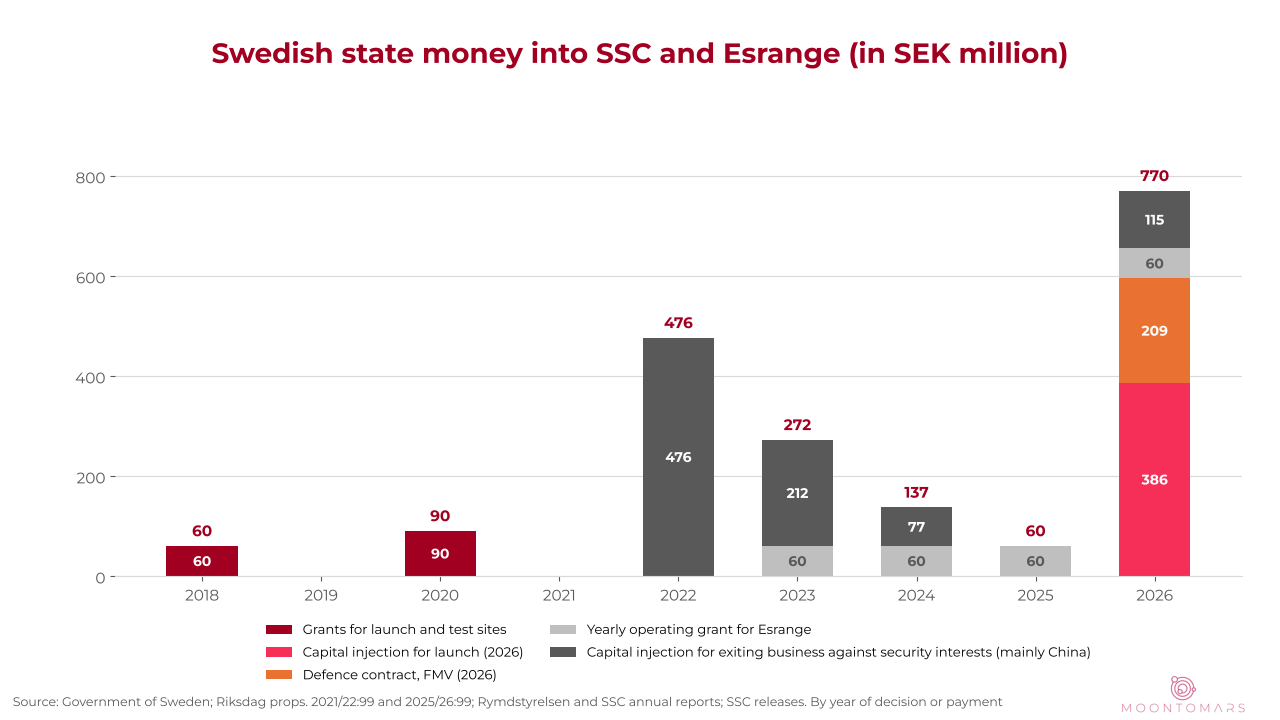
Added up, the Swedish state put about SEK 1.9 billion into SSC from 2018 to mid-2026, counting the defence contract. SEK 536 million in grants and capital went to launch and test sites, plus the SEK 209 million defence contract. The largest single part, SEK 880 million, paid for leaving customers that Sweden no longer wanted SSC to serve. The European Commission President cut the ribbon in 2023, but we found no EU money for the orbital pads themselves.
ESA pays ArianeGroup for the Themis vehicle (EUR 33 million in 2020 and about EUR 230 million in 2024 for Themis and the Prometheus engine). That money goes to the rocket, not to Esrange, so it is not in the table. The total cost of the orbital pads has never been published.
SSC Space AB: accounts and audits
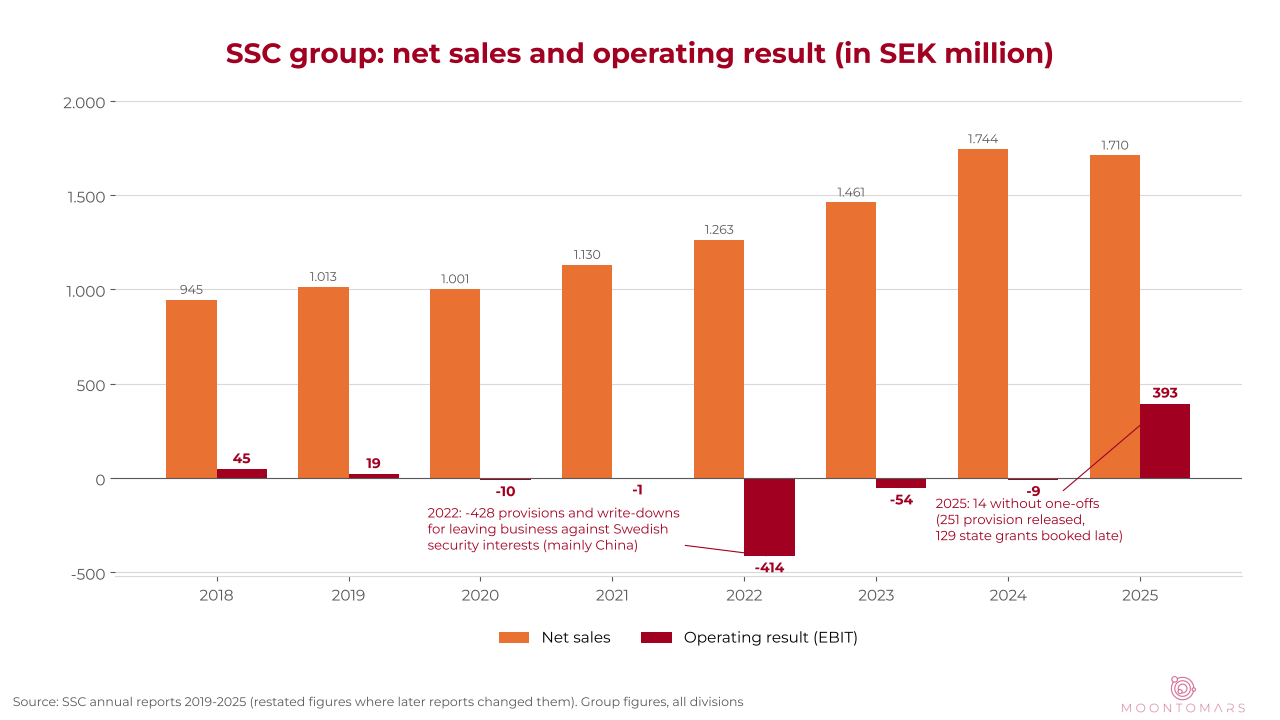
SSC is not a launch startup but a ground station and space services group with about 750 staff and offices from Chile to Japan, and Esrange is its main site. The group files full annual reports, and every audit opinion from 2019 to 2025 is clean (PwC until 2021, KPMG from 2022). There is no going-concern note and no write-down of the orbital pads.
| Year | Net sales (SEK m) | Operating result (SEK m) | Net result (SEK m) | Average staff |
|---|---|---|---|---|
| 2019 | 1,013 | 19 | -1 | 488 |
| 2020 | 1,001 | -10 | -36 | 530 |
| 2021 | 1,130 | -1 | -24 | 576 |
| 2022 | 1,263 | -414 | -405 | 695 |
| 2023 | 1,461 | -54 | -92 | 677 |
| 2024 | 1,744 | -9 | -28 | 713 |
| 2025 | 1,710 | 393 | 201 | 741 |
In 2022 SSC booked SEK 428 million of provisions and write-downs for leaving business that the owner’s directive no longer allowed, mainly with Chinese customers. In 2025 it released SEK 251 million of that provision and SEK 129 million of state grants it had held back, which turned a SEK 14 million operating profit into SEK 393 million. The orbital launch and rocket test division lost SEK 39 million in 2025.
What has to happen before the first orbital launch
Four things stand between Esrange and its first orbital launch, and none of them is in SSC’s hands alone:
- A licence. Sweden grants launch permits under a law from 1982. The government is building a new permit office at the space agency (SEK 14 million in 2026) and calls it “a first and necessary step towards a new Swedish space act”. No orbital launch licence has been granted.
- Norway. Rockets heading north from Esrange cross Norwegian territory at about 80 km altitude, and first stages fall into the sea south-west of Svalbard. Norway’s aviation authority said in February 2025 that the information from Sweden was “insufficient to evaluate the actual risk” and estimated that shutting down offshore oil and gas fields could cost at least NOK 1.7 billion per launch. We found no Norwegian approval.
- A finished pad. LC-3C is still being built. The control centre, payload hall and integration building are done.
- A rocket that works. Firefly’s Alpha returned to flight in March 2026 after two mishaps in 2025. The first Esrange launch depends on Alpha flying reliably from California first.
Themis has its own deadline: the EU-funded SALTO project that pays for the hop tests ends on December 31st, 2026.
My opinion on Esrange and why you should keep an eye on it
What I like about Esrange
- It delivers what it was built for: More than 600 sounding rockets and 700 balloons in 60 years, with several rocket and balloon campaigns every year. In 2025 the range was booked 86% of the time.
- The test beds work: Isar Aerospace tested its engines at Esrange from 2020, opened a second test site there in February 2026, and reached orbit from Andøya in September 2026. Part of that orbit was built in Kiruna.
- The land: A 5,200 km² impact area on home soil is something no other launch site in Europe has. Stages and payloads can come down and be recovered without crossing a border.
- Open books: SSC publishes full annual reports with clean audits. We could check every krona in this review against filed documents.
What I don’t like about Esrange
- Eight first-launch dates: 2020, 2022, 2022/23, the turn of 2023/24, 2024, 2025, 2026 and now 2028. Each one came from SSC, the government or a launch partner.
- No private customer: Isar and RFA tested in Kiruna and chose Andøya and SaxaVord to launch. Perigee has not reached orbit. The only firm launches are two Alphas that SSC buys itself for Swedish military satellites. That is a state launch programme with a commercial label.
- The missing price tag: Nobody has published what the orbital pads cost in total. Grants, a loan, two capital injections and a defence contract all went into them.
- The ribbon came before the customer: The King, the Prime Minister and the Commission President opened a spaceport in January 2023 that had no rocket to launch.
Things to watch out for
- Themis before New Year’s Eve: If the first hop does not happen by December 31st, 2026, the EU project paying for it ends without a flight.
- Norway: Norway has not said yes to rockets crossing its territory, and its aviation authority wants better data first.
- The Swedish space act: A new law and the first orbital licence are preconditions for 2028.
- Set your alarm for 2028: In 2015 SSC said 2020. In 2020 the government said 2022. In 2026 SSC says 2028. We will check.
Structured company information on SSC Space AB
| Type | Information |
|---|---|
| Official Company Name | SSC Space AB (until February 19th, 2026: Svenska rymdaktiebolaget, Swedish Space Corporation) |
| Organisation number | 556166-5836 (Bolagsverket) |
| Founded in | 1972 (Esrange in operation since 1966) |
| Owner | Swedish state, 100%, through the Ministry of Finance |
| Management | Charlotta Sund (CEO), Joakim Westh (chair), Lennart Poromaa (head of Esrange Space Center) |
| Headquarter | Torggatan 15, Solna, Sweden (registered seat: Kiruna) |
| Launch Site | Esrange Space Center, about 45 km east of Kiruna, Sweden |
| Latest accounts | Annual and sustainability report 2025, published March 2026 |
| Website | sscspace.com |
| SSC Space |
More information on Esrange Space Center
- Read SSC’s annual reports and interim reports
- Read the Norwegian Civil Aviation Authority’s report on orbital launches from Esrange (February 2025)
- Read the government’s press release on the 2026 money for SSC (in Swedish)
- Look up the SALTO project that pays for the Themis hop tests
- Read ESA’s history of Swedish space, “A Short History of Swedish Space Activities” (2007)
Update from October 2026 on Esrange Space Center
- First published review of Esrange, with the October 2026 status: no orbital launch, first Firefly Alpha launch planned for 2028
- Public money into SSC and Esrange from 2018 to 2026, and SSC’s accounts and audits from 2019 to 2025
- Themis on the pad since September 2025, no hop yet
Interested in more spaceports? Read our other reviews and analysis
Read our reviews of Andøya Space Center, SaxaVord Spaceport, Space Hub Sutherland, the German Offshore Spaceport Alliance and Etlaq Spaceport, and of the launch companies that test in Kiruna: Isar Aerospace and Rocket Factory Augsburg. All sites are on our European Space Map.
- Esrange Space Center
 Esrange near Kiruna has launched more than 600 sounding rockets but no orbital rocket. The first orbital launch, promised for 2020, is now set for 2028, paid for by the Swedish state.
 - MaiaSpace
 MaiaSpace, ArianeGroup’s 100% subsidiary, has not flown as of October 2026. Its accounts show EUR 85 million of losses against EUR 83 million paid in, negative equity and EUR 180 million of customer advances, while the first flight moved to the second half of 2027.
 - European Launcher ChallengeESA’s European Launcher Challenge pays private rocket firms for launches and upgrades once they reach orbit. EUR 902 million pledged, EUR 543.6 million signed, one orbit so far. Who got what, how it compares with NASA’s COTS, and what to watch before the end-2027 deadline.
- 2026 Update on OrbexOrbex entered administration in February 2026 after raising GBP 138.5 million, of which GBP 76.7 million was public money, and never launching. Omnidea bought the Forres assets in September 2026.
- Etlaq SpaceportEtlaq Spaceport in Duqm is Oman’s commercial launch site under NASCOM. Ownership, Duqm-1, Karman X1, PLD and Latitude instruments, CAD 5-01, and how Duqm sits next to Andøya, SaxaVord and Kourou.

For any questions, feedback or information on sources, feel free to contact us at [email protected] or on X.