

Programmes and benchmarks › European Launcher Challenge
Short answer, as of 17 October 2026: The European Launcher Challenge is ESA’s scheme to pay private European rocket firms for launches and upgrades once they reach orbit. Member states pledged EUR 902 million in November 2025, and on 27 August 2026 ESA signed EUR 543.6 million of contracts with Isar Aerospace, Rocket Factory Augsburg and PLD Space. Only Isar has reached orbit, and the deadline is the end of 2027. ESA had announced no contract with MaiaSpace by 17 October.
Welcome to our in-depth analysis of the European Launcher Challenge, originally published October 7th, 2026. Make sure to check out our mission statement and why we do what we do. Look at our New Space guide if you want explanations of terms and concepts used in our research. And follow us on X for updates.
The European Launcher Challenge in October 2026
- Orbit: One of the four remaining challengers has reached orbit. Isar Aerospace’s Spectrum rocket did it from Andøya in Norway on September 5th, 2026, nine days after Isar signed its contract. Rocket Factory Augsburg, PLD Space and MaiaSpace have not flown to orbit, and the deadline is the end of 2027.
- Money: ESA member states pledged EUR 902.16 million at the CM25 ministerial council in Bremen in November 2025. On August 27th, 2026 ESA signed EUR 543.6 million of contracts: Isar EUR 197.8 million, Rocket Factory Augsburg EUR 186.9 million and PLD Space EUR 158.9 million.
- MaiaSpace: The ArianeGroup subsidiary has EUR 184.3 million pledged and no signed contract. ESA said on August 27th that the award was “nearing completion”, and no signature had been announced by October 7th.
- Home teams: France put all of its EUR 179 million into MaiaSpace and Spain all of its EUR 169 million into PLD Space. Germany gave 98% of its EUR 363.5 million to its own two companies, Isar and RFA.
- Orbex: The British company entered administration in February 2026 and withdrew from the challenge. The UK still had EUR 112.3 million of its EUR 144 million pledge unassigned in August 2026.
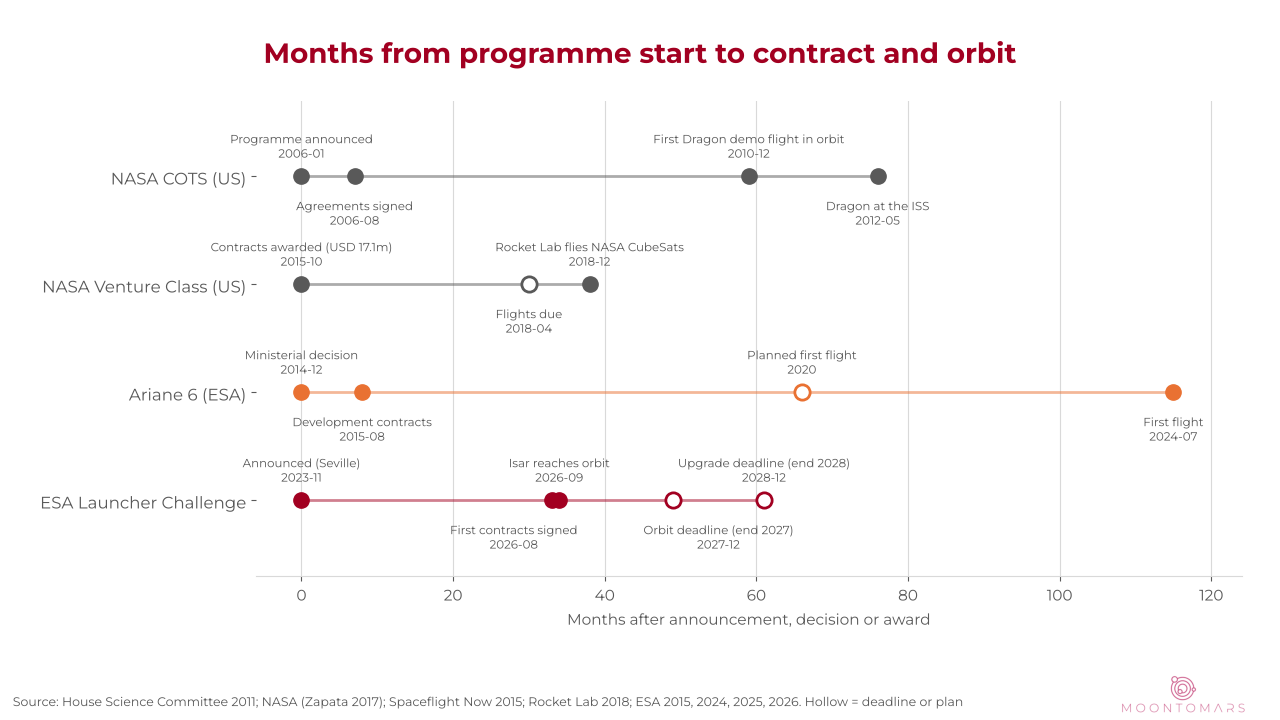
- Speed: It took 33 months from the announcement in Seville in November 2023 to the first signed contract. NASA needed seven months from announcing its COTS cargo programme to signing with SpaceX in 2006.
| Challenger | Rocket | Launch site | ELC money | Orbit by end 2027 | Status on October 7th, 2026 |
|---|---|---|---|---|---|
| Isar Aerospace (Germany) | Spectrum, up to 1,000 kg to low Earth orbit | Andøya, Norway | EUR 197.8 million, signed | Met on September 5th, 2026 | Second flight reached orbit. The first flight ended about 30 seconds after lift-off in March 2025 |
| Rocket Factory Augsburg (Germany) | RFA One, up to 500 kg to a 500 km sun-synchronous orbit | SaxaVord, Shetland, UK | EUR 186.9 million, signed | Open | No launch. First stage lost in a test fire in August 2024, rocket taken off the pad after a pad issue in July 2026, no new date |
| PLD Space (Spain) | MIURA 5, up to 540 kg to sun-synchronous orbit | Kourou, French Guiana | EUR 158.9 million, signed | Open | No MIURA 5 flight. Suborbital MIURA 1 flew in October 2023. First launch planned for the first half of 2027 |
| MaiaSpace (France) | Maia, up to 1,500 kg to sun-synchronous orbit when expended | Kourou, former Soyuz pad | EUR 184.3 million pledged, not signed | Open | No flight. First launch moved from late 2026 to 2027, then to the second half of 2027 |
| Orbex (UK) | Prime | (none left) | EUR 34.9 million pledged, lapsed | Withdrew | Administration in February 2026. Omnidea of Portugal bought the UK assets in September 2026 |
What you should know about the European Launcher Challenge (ELC)
📰 For space enthusiasts
- ESA buys launches from private rocket companies, first announced in Seville in November 2023
- Five challengers preselected on July 7th, 2025 from about a dozen applicants: Isar Aerospace, MaiaSpace, Orbex, PLD Space and Rocket Factory Augsburg
- Gate 1: an orbital launch by the end of 2027
- Gate 2: an upgraded rocket in orbit by the end of 2028
- ESA missions fly on the winners’ rockets until 2030
- One orbit so far: Isar’s Spectrum, September 5th, 2026
💰 For VCs and industry experts
- EUR 902.16 million pledged at CM25 in Bremen, November 2025
- EUR 543.6 million signed on August 27th, 2026 with Isar, RFA and PLD Space
- Paid against milestones, with no lump sum up front
- At least 40% private money for the upgrade part (Component B)
- ESA “target” of EUR 169 million per challenger. Isar and RFA signed above it
- MaiaSpace unsigned with EUR 184.3 million pledged, and the UK’s EUR 112.3 million unassigned
👨💻 For launch companies and their teams
- Open to rockets built in ESA or EU member states and launched from European territory
- Scored on business case and price (30%), technical approach and staff (30%) and the institutional market (20%)
- Firms left out, such as Skyrora and Latitude, bid for ESA missions without the ELC contribution
- Contracts run to about 2029–2030. RFA’s runs to mid-2029, according to OHB

European Launcher Challenge: ESA as a paying customer
The European Launcher Challenge (ELC) is a programme of the European Space Agency (ESA) that pays private European launch companies for launches and rocket upgrades once their rockets have reached orbit. ESA describes its new role as that of a “customer providing funding and stability without defining service characteristics and performances”. For Ariane 6, ESA ordered the rocket itself and in 2015 signed a EUR 2.4 billion development contract with Airbus Safran Launchers, today ArianeGroup.
The money comes in two parts. Component A covers launches for ESA missions from 2026 to 2030: after a company’s first successful orbital launch, ESA contributes to each of its operational launches. European Spaceflight reported that the tender set this contribution at 25% of the launch price, with the rest paid by the ESA mission that flies. Component B co-funds an upgrade the company has not flown before, such as more payload or a reusable first stage. The company has to find at least 40% of the cost privately and fly the upgrade by the end of 2028.
ESA calls the orbital launch by the end of 2027 the step that confirms a company’s selection, and the contracts let companies “secure and unlock funds as milestones are met”. To enter, a rocket had to be built in an ESA or EU member state and launch from European territory. ESA set a “target” of EUR 169 million per challenger, which was the EUR 150 million announced in 2023 plus inflation, and two of the three signed contracts are above it.
How the European Launcher Challenge came about
Seville: a challenge next to an Ariane 6 subsidy (2023)
ESA’s council met in Seville in November 2023 and announced a “European Launcher Challenge” for new launch companies, with up to EUR 150 million per winner. At the same meeting France, Germany and Italy agreed to pay ArianeGroup up to EUR 340 million a year to operate Ariane 6, which had not yet flown. They added EUR 21 million a year for Vega C. Both promises still needed money from the next ministerial council in 2025.
Request, tender and shortlist (2024 – 2025)
ESA asked companies for information in June 2024 and opened the tender on March 24th, 2025, with proposals due on May 5th. Toni Tolker-Nielsen, then ESA’s director of space transportation, said in January 2025 that he expected two or three winners. Each would match the ESA money with private funding “in the same order of magnitude”. He also presented the process as a test of a new rule: ESA would rate the proposals first and then ask member states to fund the companies that passed. That was meant as a departure from georeturn, the ESA practice of giving each country contracts in proportion to what it pays in.
On July 7th, 2025 ESA preselected five of about a dozen applicants: Isar Aerospace, MaiaSpace, Orbex, PLD Space and Rocket Factory Augsburg. Skyrora and Latitude were among the companies left out.
Bremen: EUR 902 million, mostly for home teams (November – December 2025)
At the CM25 ministerial council in Bremen in November 2025, member states subscribed EUR 902.16 million to the challenge. ESA’s “Document 100” of December 2nd, 2025, the list of every country’s subscriptions, shows who paid for which company and for which part. European Spaceflight and Payload published the breakdown, and we show it in the next section.
One orbit, three contracts, one exit (2026)
Orbex entered administration in February 2026 and withdrew from the challenge, which left most of the UK’s pledge without a company to go to. The four remaining companies sent their final proposals by April 2026. ESA signed the first three contracts on August 27th, 2026, worth EUR 543.6 million in total. ESA said the award to MaiaSpace was “nearing completion and expected to resume in the coming weeks”. Nine days later, on September 5th, Isar’s second Spectrum rocket reached orbit from Andøya, and ESA named Isar the first company to meet the challenge’s orbital milestone.
Who paid for whom
| Challenger | Germany | France | Spain | UK | Norway | Others | Total pledged | of which upgrades (B) | Signed |
|---|---|---|---|---|---|---|---|---|---|
| Isar Aerospace | 176.9 | 25.0 | 3.8 (Austria) | 205.7 | 173.8 | 197.8 | |||
| Rocket Factory Augsburg | 180.5 | 10.0 | 190.5 | 175.2 | 186.9 | ||||
| PLD Space | 0.1 | 169.0 | 169.1 | 132.2 | 158.9 | ||||
| MaiaSpace | 4.3 | 179.0 | 1.0 (Switzerland) | 184.3 | 0.1 | not signed | |||
| Orbex | 1.8 | 21.7 | 11.4 (Denmark, Portugal, Czechia) | 34.9 | 20.4 | withdrew | |||
| Not assigned | 112.3 | 4.8 | 0.7 | 117.8 | |||||
| Total | 363.5 | 179.0 | 169.0 | 144.0 | 29.8 | 16.9 | 902.2 | 543.6 |
Germany was the only large contributor to spread its money, with EUR 180.5 million for RFA, EUR 176.9 million for Isar and small amounts for the other three. France put its whole EUR 179 million into MaiaSpace, and Spain its whole EUR 169 million into PLD Space. Norway gave EUR 25 million to Isar, which launches from Andøya in Norway. The UK assigned EUR 21.7 million to Orbex and EUR 10 million to RFA, which plans to launch from SaxaVord in Shetland, and left EUR 112.3 million unassigned.
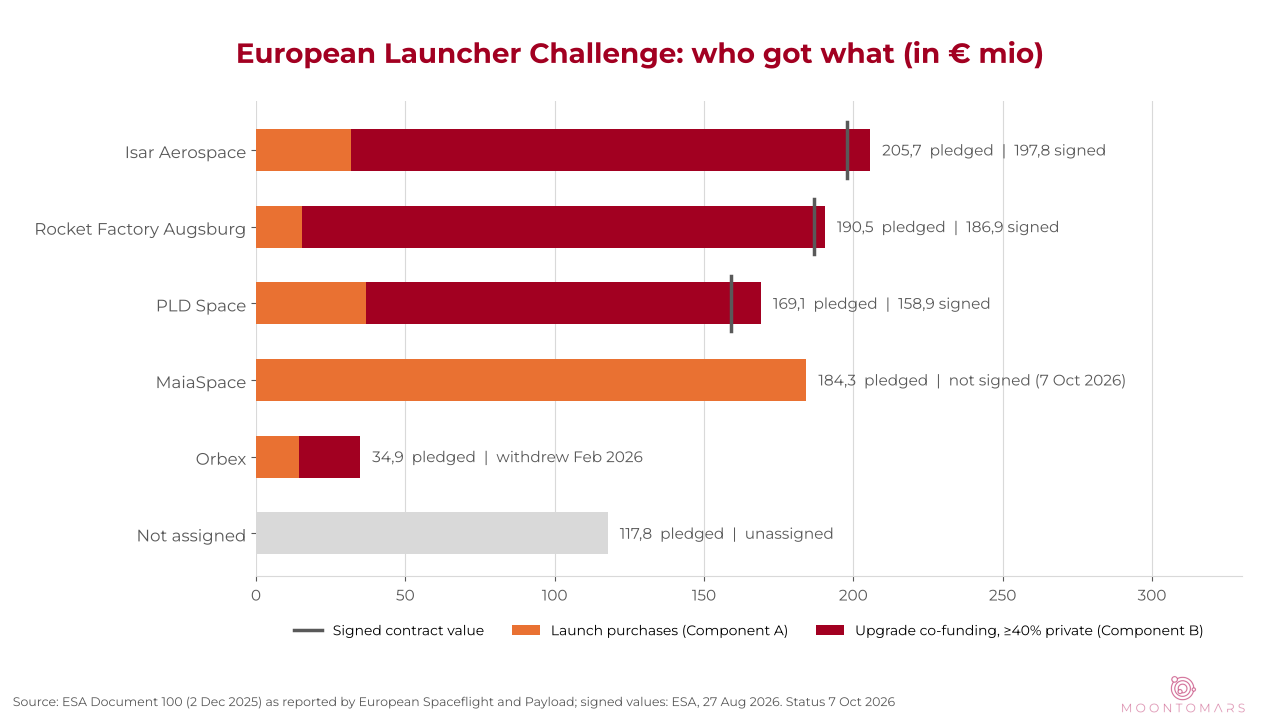
The split between the two parts differs by company. At Isar, RFA and PLD Space between 78% and 92% of the pledge is upgrade money under Component B, which needs at least 40% private co-funding. MaiaSpace’s EUR 184.3 million is almost all Component A, ESA’s contribution to launches, with EUR 0.1 million for upgrades. MaiaSpace is a subsidiary of ArianeGroup, the Ariane 6 prime contractor, and had neither flown nor signed a contract by October 7th, 2026.
ESA had promised to rate first and fund second. ESA did rate the proposals first, and then the three largest contributors funded their own companies: France and Spain only theirs, Germany 98% to its two.
The challengers, gate by gate
Isar Aerospace: The Munich company’s two-stage Spectrum has ten engines and is built for up to 1,000 kg to low Earth orbit. Its first flight on March 30th, 2025 ended about 30 seconds after lift-off, and the second reached orbit from Andøya on September 5th, 2026. Before the ELC contract Isar had raised roughly EUR 820 – 855 million in equity and convertible loans, by our estimate in the Isar Aerospace review. The ELC money arrived after most of the private money.
Rocket Factory Augsburg: RFA One has three stages and targets up to 500 kg to a 500 km sun-synchronous orbit in its current version, according to ESA. RFA lost a first stage in a test fire at SaxaVord in August 2024. In July 2026 it took a rebuilt rocket off the pad after a problem found during pad tests. OHB, which owns most of RFA, said the contract runs to mid-2029 and focuses on RFA ONE Block 2, a version with a reusable first stage.
PLD Space: The Spanish company flew its suborbital MIURA 1 in October 2023. MIURA 5 is built for up to 540 kg to sun-synchronous orbit and will launch from Kourou in French Guiana. Our PLD Space review has the first launch planned for the first half of 2027.
MaiaSpace: ArianeGroup founded MaiaSpace in 2022 to build Maia, a two-stage rocket with a reusable first stage. Maia is built for up to 1,500 kg to sun-synchronous orbit when the first stage is not recovered and will launch from the former Soyuz pad in Kourou. In February 2026 MaiaSpace moved its first flight from late 2026 to 2027. In July 2026 it dropped a planned suborbital test and now aims for a first orbital attempt in the second half of 2027.
Orbex: The Scottish company was preselected in July 2025 and entered administration in February 2026. Omnidea of Portugal bought its UK assets on September 30th, 2026, and Omnidea’s chief executive said the 2028 target was “not at all viable”, as we report on our Orbex page.
How it compares: COTS, Venture Class, China and Ariane 6
NASA COTS (2006 – 2012)
NASA announced its Commercial Orbital Transportation Services (COTS) programme in January 2006 and signed agreements with SpaceX and Rocketplane Kistler in August 2006. NASA paid fixed sums against milestones, and the companies owned their rockets and capsules and added their own money. SpaceX was awarded USD 278 million for three demonstration flights. With milestones added later, NASA paid it USD 396 million from 2006 to 2011, and SpaceX put in USD 454 million of its own, according to a NASA cost study.
The milestones had teeth. Rocketplane Kistler could not raise its share of the money, and NASA replaced it with Orbital Sciences in February 2008. The schedule slipped as well: the demonstrations were planned from 2008, SpaceX’s Dragon flew its first COTS mission on December 8th, 2010 and reached the space station in May 2012. NASA’s cost model had put the development of Falcon 9 by traditional methods at USD 1.7 to 4.0 billion. SpaceX said it spent about USD 300 million, a figure NASA verified.
The ELC uses the same frame: fixed amounts, milestone gates, private co-funding and the agency as a customer. Two differences stand out. COTS took seven months from announcement to signature and the ELC took 33. And NASA picked its partners from one budget, while in the ELC each country decided which company its money backs.
NASA Venture Class (2015 – 2018)
In October 2015 NASA paid USD 17.1 million for three demonstration launches on small rockets that had not flown yet, with flights due by April 2018. Rocket Lab got USD 6.9 million, Firefly USD 5.5 million and Virgin Galactic USD 4.7 million. Rocket Lab launched NASA’s CubeSats on December 16th, 2018, eight months late. Each signed ELC contract is worth about ten times what NASA paid all three companies together, or more.
China
LandSpace, a private Chinese company, put the world’s first methane-fuelled rocket into orbit with Zhuque-2 on July 12th, 2023. Maia, which also burns methane, plans its first orbital flight for the second half of 2027.
Ariane 6 as the benchmark
ESA ordered Ariane 6 at the ministerial council in December 2014 and signed the development contracts on August 12th, 2015. They were worth EUR 2.4 billion for the rocket and EUR 600 million for its launch base in Kourou, for a first flight in 2020. Ariane 6 first flew on July 9th, 2024. From its 16th flight on, member states pay ArianeGroup up to EUR 340 million a year to operate it. The whole ELC, EUR 902 million for five companies over five years, is less than three years of that operating support.
Left out: Skyrora, Latitude and the others
Payload counted about a dozen applicants in July 2025, and seven or so were not preselected. Two of them said they did not need the money. “It’s kind of a poison chalice,” said Derek Harris of Skyrora. “If you win it, you’ve got the money, but then comes all of these little boxes you need to check to actually get any money down the line.” Stanislas Maximin, founder of Latitude, said: “We did not need it, financially speaking. It is what it is, so we’ll just fund it ourselves.”
Maximin also objected that the challenge steers ESA contracts to the winners: “I think every contract should be open to anyone.” Under Component A the ESA contribution goes only to the challengers’ launches, so a company outside the challenge bids for an ESA mission without it. Matthew Archer of the UK Space Agency said at the time that the ELC would “help create a warmer environment for investors”, and added: “Some of them will be successful. Some of them won’t.”
Public money in the European Launcher Challenge, promised and delivered
| Recipient | Public money | Type | Promised | Delivered by October 7th, 2026 |
|---|---|---|---|---|
| Isar Aerospace | EUR 197.8 million (signed August 2026) | Contract paid against milestones | Orbit by end 2027, upgrade flight by end 2028 | Orbit on September 5th, 2026 |
| Rocket Factory Augsburg | EUR 186.9 million (signed August 2026) | Contract paid against milestones | Orbit by end 2027, upgrade flight by end 2028 | No launch |
| PLD Space | EUR 158.9 million (signed August 2026) | Contract paid against milestones | Orbit by end 2027, upgrade flight by end 2028 | No MIURA 5 flight |
| MaiaSpace | EUR 184.3 million (pledged November 2025) | Pledge, 99.9% for launch purchases | Contract “in the coming weeks” (ESA, August 27th, 2026) | No contract, no flight |
| Orbex | EUR 34.9 million (pledged November 2025) | Pledge, lapsed | Same gates | Administration and withdrawal, February 2026 |
| Not assigned | EUR 117.8 million, of which UK EUR 112.3 million | Pledge | (none) | Not assigned |
| For comparison: Ariane 6 | EUR 2.4 billion development (2015), up to EUR 340 million a year to operate | Development contract and operating support | First flight in 2020 | First flight July 9th, 2024 |
My opinion on the European Launcher Challenge and why you should keep an eye on it
What I like about the European Launcher Challenge
- Money after orbit: Launch money only flows to companies that reach orbit, and upgrade money needs 40% private funding. That is how NASA bought its first cargo flights from SpaceX, and it is the first time ESA has done it for launch.
- ESA as a customer: ESA no longer defines the rocket. For Ariane 6 it ordered one, paid EUR 2.4 billion for its development and waited four years longer than planned.
- One gate met: Isar reached orbit nine days after signing, with a rocket that private investors had paid for in large part.
- Small next to Ariane: EUR 902 million for five companies is less than three years of Ariane 6 operating support.
What I don’t like about the European Launcher Challenge
- 33 months to sign: From Seville to the first contract took 33 months. NASA’s COTS took seven.
- Home-team money: ESA rated on merit, and then France and Spain funded only their own company and Germany gave 98% of its money to its two. That looks a lot like georeturn.
- The MaiaSpace split: ArianeGroup’s subsidiary has EUR 184.3 million pledged, almost all of it as launch contributions and EUR 0.1 million in the part that needs private co-funding. It has no contract and no flight.
- A target that bends: ESA’s EUR 169 million per challenger was exceeded by Isar and RFA.
- Little public detail: ESA has not published the milestone amounts or what it has paid so far.
Things to watch out for
- December 31st, 2027: RFA, PLD Space and MaiaSpace need an orbital launch by then. RFA has no new date after July 2026, and PLD and MaiaSpace both plan first flights in 2027.
- What ESA does after a miss: NASA dropped Rocketplane Kistler when it missed its financing milestones in 2008. If a challenger misses the 2027 gate and keeps its money, the ELC becomes a subsidy. Let’s talk again in January 2028.
- The MaiaSpace contract: when it is signed, and whether its terms match the other three.
- The UK’s EUR 112.3 million: still unassigned after Orbex left.
- Upgrades by 2028: each signed company has to fly an upgraded rocket by the end of 2028, a year after its first orbital deadline.
Where to find more information on the European Launcher Challenge
- ESA: European Launcher Challenge, the programme page with the rules and timeline
- ESA: preselected challengers (July 7th, 2025) and first contracts (August 27th, 2026)
- European Spaceflight: Document 100 breakdown and the call for proposals
- Payload: Skyrora and Latitude after the shortlist and the funding breakdown
- The Space Review: Europe’s launch challenge (March 2025)
- NASA: cost study of COTS and commercial cargo (2017)
- ESA: Ariane 6 and Vega C development contracts (August 2015)
Updates on the European Launcher Challenge
- October 2026: Page published with the status after the first contracts (August 27th, 2026) and Isar’s orbital launch (September 5th, 2026).
Structured information on the European Launcher Challenge
| Type | Information |
|---|---|
| Official name | European Launcher Challenge (ELC) |
| Run by | European Space Agency, Directorate of Space Transportation |
| Announced | November 2023, ESA Council, Seville |
| Funded | November 2025, CM25 ministerial council, Bremen: EUR 902.16 million |
| Signed so far | EUR 543.6 million (August 27th, 2026): Isar Aerospace, Rocket Factory Augsburg, PLD Space |
| Pending | MaiaSpace (EUR 184.3 million pledged) |
| Withdrawn | Orbex (February 2026) |
| Component A | ESA contribution to the challengers’ launches, 2026 – 2030, after a first orbital launch |
| Component B | Co-funding of an upgrade, demonstrated in orbit by the end of 2028, at least 40% private money |
| Deadlines | Orbital launch by the end of 2027, upgrade by the end of 2028 |
| Website | esa.int |
Interested in more space companies? Read our other reviews and analysis
The challengers and the companies left out have their own pages: Isar Aerospace, MaiaSpace, Rocket Factory Augsburg, PLD Space, Orbex, Skyrora, Latitude and HyImpulse. So do the launch sites: Andøya Space Center, SaxaVord Spaceport, Space Hub Sutherland, German Offshore Spaceport Alliance and Etlaq Spaceport. Our European Space Map shows them all. European launch dates follows every first-launch date the challengers have given, and European rockets compared draws their rockets to one scale.
- HyImpulse Technologies
 HyImpulse Technologies builds hybrid paraffin/LOX rockets. SR75-1 flew from Koonibba on 3 May 2024; a UK CAA licence covers SaxaVord for spring 2027. Series A and a Series A Extension above EUR 50 million equity arrived in 2025–26. SL1 targets 600 kg to LEO; HyMOVE is a separate OTV.
 - Andøya Space Center
 Andøya Space Center is a spaceport in northern Norway. Spectrum reached orbit from Andøya on 5 September 2026. Pad 1 is operational and Isar-exclusive; Pad 2 is proposed. Operator Andøya Space AS is 90% Norwegian state and 10% Kongsberg.
 - SkyroraSkyrora is a Scottish new space company developing the Skyrora XL, a three-stage rocket for up to 315 kg to orbit. Our 2026 analysis covers its owners, accounts, public money and launch plans.
- OrbexOrbex (Orbital Express Launch Ltd): UK microlauncher Prime, 180 kg LEO. In administration since 18 February 2026 after GBP 138.5m raised (GBP 76.7m public). Zero launches. Omnidea bought the Forres assets.
- LatitudeLatitude (formerly Venture Orbital Systems) is a French NewSpace company developing a LOX/RP-1 microlauncher (formerly Zephyr). As of October 2026 it has not flown; Series B raised EUR 27 million; an Etlaq Oman LoI targets an experimental late-2027 inaugural that we treat as optimistic. In-depth analysis on moontomars.space.


All information in this analysis was obtained from public sources and we encourage you to do your own due diligence. Feel free to contact us for corrections or share our content. Attribution is always welcome.