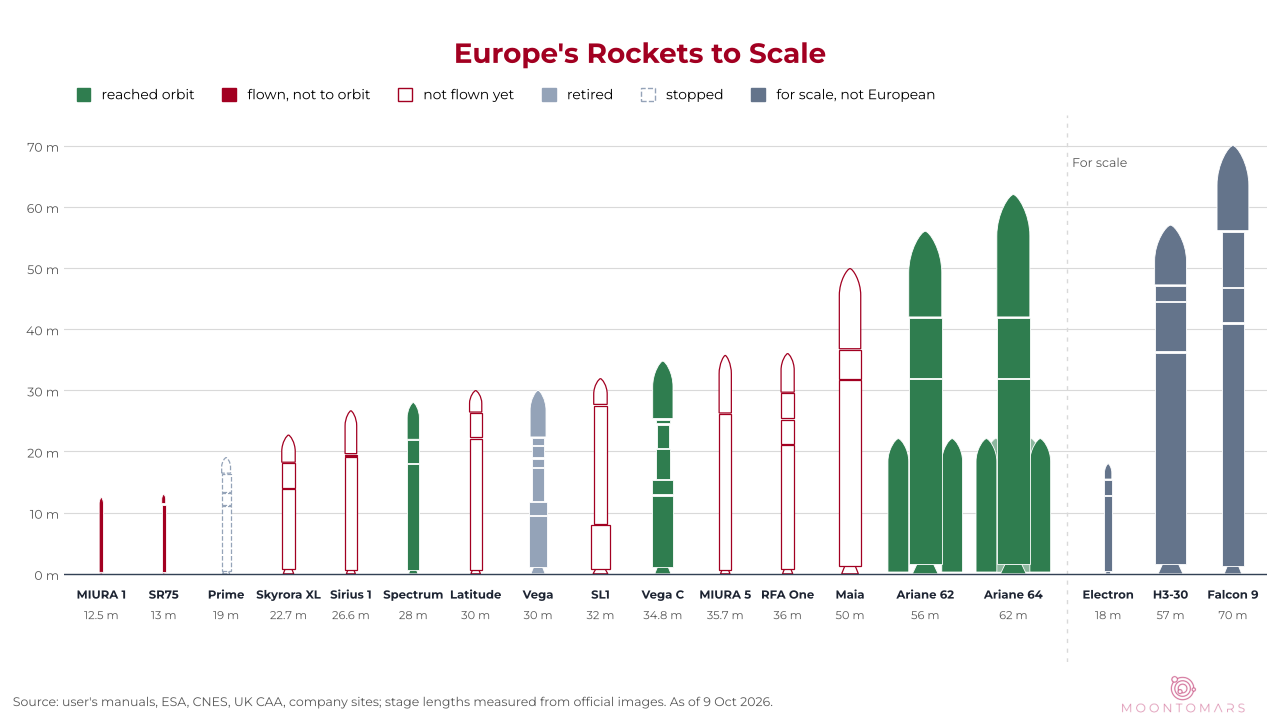

We drew Europe’s rockets to one scale, using the sizes their makers and agencies publish. SpaceX’s Falcon 9, Japan’s H3 and Rocket Lab’s Electron stand beside them for scale. Tap a rocket for its figures, or pick two or more to compare them in the table below.
Short answer, as of 9 October 2026: four of the 14 European rockets here have reached orbit: Ariane 6, Vega C, the retired Vega and, since 5 September 2026, Isar Aerospace’s Spectrum. Ariane 64 is the largest, with 22,000 kg to low orbit. Spectrum carries 1,000 kg and is the only rocket from a European startup to reach orbit so far. No European rocket has flown a used stage a second time. The data sheet below gives height, width, mass, engines, thrust and payload for each rocket.
Figures as of 9 October 2026.
European rockets on one scale, with Ariane 6 in both versions and 3 rockets from elsewhere beside them
of them have reached orbit: Ariane 6, Vega C, the retired Vega and, since September 2026, Isar’s Spectrum
to low orbit for Spectrum. Ariane 64 lifts 22 times as much.
European rockets have flown a used stage a second time. Falcon 9 does it routinely.
Swipe or scroll the drawing sideways to see every rocket.
Data sheet
Tap rockets in the drawing to compare only those.
| Rocket | Flights to orbit | Height | Width | Mass at liftoff | Stages | Fuel | First-stage engines | Liftoff thrust | To low orbit | To sun-synchronous orbit | Reuse |
|---|---|---|---|---|---|---|---|---|---|---|---|
| MIURA 1PLD SpaceSuborbital only | n/a | 12.5 m | 0.7 m | 2.62 t | 1 | LOX / kerosene | 1 x TEPREL-B | 30 kN | not published | not published | Recovery tried, not reused |
| SR75HyImpulseSuborbital only | n/a | 13 m | 0.64 m | 2.6 t | 1 | Hybrid (paraffin / LOX) | 1 x HyPLOX-75 hybrid motor | 75 kN | not published | not published | Recovered at sea, reflight not stated |
| PrimeOrbexCompany in administration | 0 | 19 m | 1.45 m | 18 t | 2 | LOX / propane (LPG) | 6 x Orbex engine | 211 kNest. | 180 kg | 180 kg | None, never flew |
| Skyrora XLSkyroraNot flown | 0 | 22.7 m | 2.2 m | 55.8 t | 3 | Peroxide / kerosene | 9 x Skyforce | 630 kN | not published | 315 kg | not published |
| Sirius 1Sirius Space ServicesNot flown | 0 | 26.6 m | 1.9 mest. | 34.9 t | 2 | LOX / methane | 9 x STAR-1 | 495 kNest. | 300 kg | 180 kg | Planned, method not published |
| SpectrumIsar AerospaceFirst orbit 5 Sep 2026 | 1 of 2 | 28 m | 2 m | not published | 2 | LOX / propane | 9 x Aquila | 675 kNest. | 1,000 kg | 700 kg | None |
| LatitudeLatitudeNot flown | 0 | 30 m | 2 m | not published | 2 | LOX / kerosene | 7 x Navier Sea Level | not published | 200 kg | 300 kg | None |
| VegaAvioRetired in 2024 | 20 of 22 | 30 m | 3 m | 137 t | 4 | Solid + liquid upper stage | 1 x P80 FW solid motor | 3,040 kN | 1,430 kg | not published | None |
| SL1HyImpulseNot flown | 0 | 32 m | 2.2 m | 54 t | 3 | Hybrid (paraffin / LOX) | Hybrid motors, count not published | not published | 600 kg | not published | Planned, no details |
| Vega CAvioFirst orbit 13 Jul 2022 | 7 of 8 | 34.8 m | 3.4 m | 210 t | 4 | Solid + liquid upper stage | 1 x P120C solid motor | 4,650 kN | 2,550 kg | 2,423 kg | None |
| MIURA 5PLD SpaceNot flown | 0 | 35.7 m | 2 m | not published | 2 | LOX / kerosene | 5 x TEPREL-C | 950 kNest. | 1,040 kg | 540 kg | Stage 1 sea recovery planned |
| RFA OneRocket Factory AugsburgNot flown | 0 | 36 m | 2.15 m | 70 t | 3 | LOX / kerosene | 9 x Helix | 900 kNest. | 500 kg | 500 kg | None, planned for Block 2 |
| MaiaMaiaSpaceNot flown | 0 | 50 m | 3.5 m | not published | 2 | LOX / methane | 3 x Prometheus | 2,940 kNest. | 4,000 kg | 1,500 kg | Stage 1 reuse planned |
| Ariane 62ArianeGroupFirst orbit 9 Jul 2024 | 6 of 6 | 56 m | 5.4 m | 540 t | 2 | LOX / hydrogen + solid boosters | 1 x Vulcain 2.1 + 2 x P120C solid boosters | 8,400 kN | 10,300 kg | 7,200 kg | None |
| Ariane 64ArianeGroupFirst orbit 12 Feb 2026 | 3 of 3 | 62 m | 5.4 m | 870 t | 2 | LOX / hydrogen + solid boosters | 1 x Vulcain 2.1 + 4 x P160C solid boosters | 15,400 kN | 22,000 kg | 15,500 kg | None |
| ElectronRocket Lab, US / NZFlying | 83 of 87 | 18 m | 1.2 m | 13 t | 2 | LOX / kerosene | 9 x Rutherford Sea Level | 224 kNest. | 300 kg | 200 kg | Recovery tried, no routine reuse |
| H3-30JAXA / MHI, JapanFlying | 7 of 9all H3 versions | 57 m | 5.2 m | 270 t | 2 | LOX / hydrogen | 3 x LE-9 | 4,416 kNest. | not published | 4,000 kg | Noneest. |
| Falcon 9SpaceX, USFlying | 678 of 680 | 70 m | 3.66 m | 549 t | 2 | LOX / kerosene | 9 x Merlin 1D | 7,605 kN | 22,800 kg | not published | Stage 1 and fairing re-flown routinely |
How we draw and count
We draw each rocket as a flat side view from the height and width its maker or agency publishes. Most stage lengths are our own measurements from official images, scaled to the official height. Ariane 62 has two boosters, one on each side, and Ariane 64 has four. PLD Space has not published the MIURA 5 fairing, so we draw its second stage and fairing as one part.
We show rockets that have not flown in the design their makers show today. Several have changed size before. Where sources disagree we show the figure the maker gives for the version we draw. RFA’s operations chief gave 36 m for the first RFA One in May 2026, which fits the rocket’s proportions in RFA’s own images. ESA and the UK Civil Aviation Authority still write about 30 m. Latitude’s website gives 30 m, while a June 2026 press report gave 19 m.
Payload figures are each maker’s own, at the orbit height it quotes, so they are close but not exact matches. “Liftoff thrust” adds up the first-stage engines and boosters. Values marked “est.” are our own calculation, for example engine count times thrust per engine. Flights to orbit count successful launches out of all orbital launch attempts, from Jonathan McDowell’s launch log of 2 October 2026. We split Ariane 6 flights by version: every flight in 2024 and 2025 was an Ariane 62, and Ariane 64 first flew on 12 February 2026.
Sources: the user’s manuals for Ariane 6, Vega C, Falcon 9 and Electron, and figures from ESA, CNES, DLR and JAXA. We also used UK Civil Aviation Authority licence papers for SaxaVord, filed company accounts, company websites and press kits, and named press where nothing firsthand exists.
How far each first flight slipped is on European launch dates: every promise and what happened. The 2026 ranking of European launch companies scores each firm on delivery. Public money per orbit reached sets the money against the result, and our Isar Aerospace review carries the chart of launch cost per kilogram. ESA’s plan to buy launches from new European firms is on our European Launcher Challenge page. Our reviews of Rocket Factory Augsburg, PLD Space, MaiaSpace, Sirius Space Services, HyImpulse, Latitude, Skyrora and Orbex give the background to each rocket, as do our pages on Ariane 6 and Vega C.