

Welcome to our in-depth analysis of Vega C and its builder Avio, originally published October 8th, 2026. Make sure to check out our mission statement and why we do what we do. Look at our New Space guide if you want explanations of terms and concepts used in our research. And follow us on X for updates.
Vega C and Avio in October 2026
- Flights: Vega C has flown eight times since July 2022, and seven flights reached their orbit. The second flight failed on December 21st, 2022, and the rocket did not fly again for 715 days.
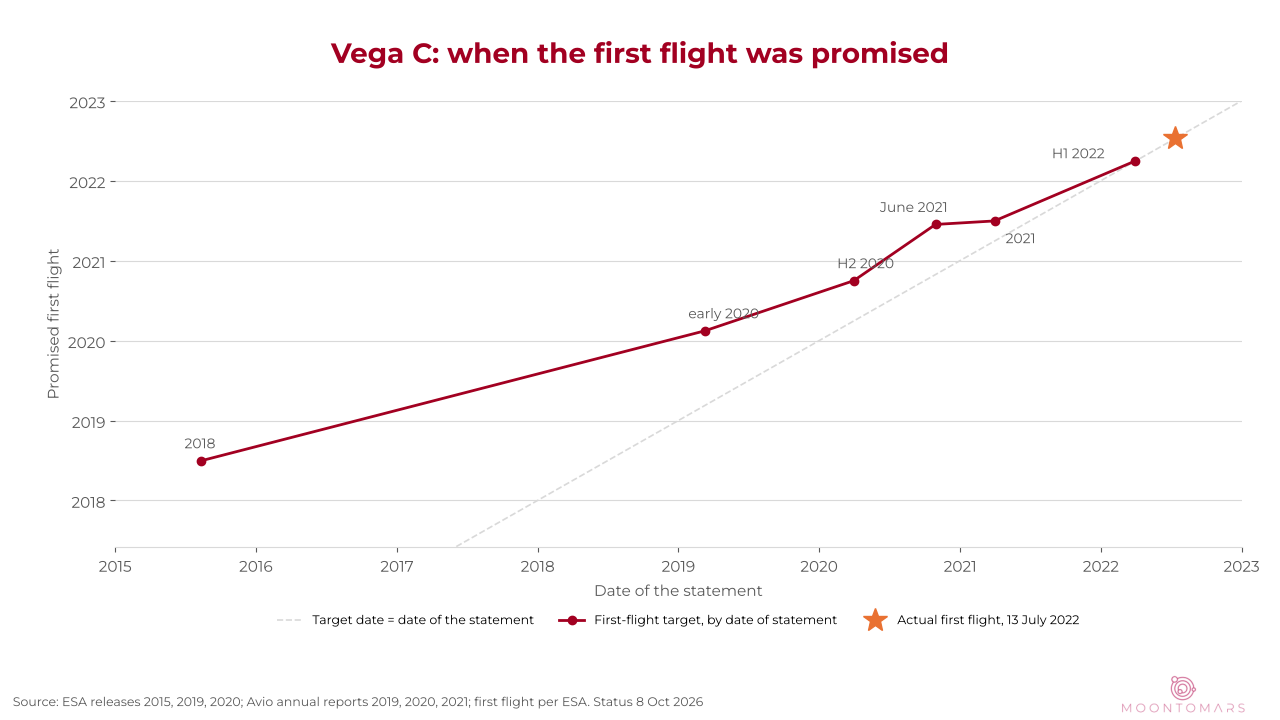
- Delay: ESA ordered Vega C in 2015 for a first flight in 2018. It flew on July 13th, 2022, about four years late, after at least six target dates had passed.
- Cadence: Avio promised four to five launches a year in 2019 and six a year in 2024. Vega and Vega C together have never flown more than three times in one year. In 2025 Rocket Lab’s Electron flew 18 times.
- Public money: The development contract was worth EUR 395 million. Counting the later Vega C lines, ESA member states paid EUR 87.4 million for each successful flight up to the 2022 ministerial council, by our sum.
- Price: No list price has been published. The Sentinel-1C launch contract was worth EUR 48.62 million, which works out at about three times the Falcon 9 rideshare price per kilogram.
- Avio: The Italian company became Vega C’s launch operator in May 2026. It raised EUR 400 million from shareholders in November 2025, mostly to build a solid rocket motor plant in Virginia for the US military.
- Ukraine: The fourth-stage engine is still made in Ukraine. Avio has ordered 20 more for delivery by the end of 2027.
What you should know about Vega C and Avio
📰 For space enthusiasts
- Europe’s light rocket, about 35 m tall, launched from Kourou in French Guiana
- Four stages: three solid motors (P120C, Zefiro 40, Zefiro 9) and the liquid AVUM+ upper stage
- About 2,300 kg to a 700 km polar orbit, according to ESA
- Eight flights from July 2022 to October 2026, one failure
- Shares its first stage with the boosters of Ariane 6
- Fully expendable, no reuse planned
💰 For VCs and industry experts
- EUR 395 million development contract (2015), for a first flight in 2018
- About EUR 1.8 billion committed by ESA states to Vega, Vega C and their successors from 2015 to 2025 (our sum)
- Up to EUR 21 million a year of operating support for flights 26 to 42
- Avio is listed in Milan, worth about EUR 1.45 billion on October 8th, 2026
- Leonardo holds 18%, and the Italian state owns 30% of Leonardo
- Avio’s profit: EUR 77 million on EUR 2.7 billion of revenue, 2019 – 2025
👨💻 For potential employees
- 1,426 staff at the end of 2025, 1,297 of them in Italy and 109 in French Guiana
- Main site: Colleferro near Rome, where all open jobs were posted in October 2026
- Languages: job ads are mostly in Italian, ask for good English and prefer French for work in Kourou
- Tools named in ads: MSC Nastran, HyperMesh, MATLAB/Simulink, CATIA V5, DOORS, C and Ada
- Pay: wages and salaries averaged about EUR 58,000 per employee in 2025, by our calculation
- Coming: a US plant in Virginia with about 1,500 jobs from 2029
Vega C: Europe’s light rocket, measured against its promises
Vega C is the light launch vehicle of the European Space Agency (ESA), designed and built by Avio S.p.A. in Colleferro near Rome. It replaced the original Vega, which flew 22 times from 2012 to 2024. Vega C is a four-stage rocket (three solid motors and a small liquid upper stage that can restart in space) and carries about 2,300 kg to a 700 km polar orbit, the kind of orbit used by Earth observation satellites such as Europe’s Copernicus Sentinels.
This page does not rank Vega C among Europe’s NewSpace launch companies. Vega C is a programme ordered and paid for by ESA member states, with Italy as the largest contributor, and we use it as a benchmark for the newer rockets. We look at what was promised for the original Vega in 2000 and for Vega C in 2014 and 2015, what it cost the taxpayer, what was delivered by October 2026, who Avio is, and how the rocket compares with rivals from the US, China, India and Japan.
How Vega and Vega C came about
The original Vega: five years late, then 22 flights (1998 – 2024)
Vega began as a programme of the Italian space agency ASI. ESA took it over in June 1998, and in December 2000 seven member states approved its development, with Italy paying 65%. In November 2001 ESA put the budget at EUR 463 million, including EUR 45 million for the launch pad, and planned the first launch for the end of 2005.
The development contracts followed in February 2003: EUR 221 million to ELV, a company owned 70% by FiatAvio (today’s Avio) and 30% by ASI, and EUR 40 million for the P80 first-stage motor. ESA then promised a first flight in mid-2006 and “3 to 4 launches a year”. Vega first flew on February 13th, 2012, about six years after the date ESA gave in 2001. On the day, the Italian news site Il Post put the cost of the programme at EUR 710 million, about half again the 2001 budget, and Vega officials gave the price of a launch as about EUR 32 million.
Over the next twelve years Vega flew 22 times and failed twice. In July 2019 the second stage (Zefiro 23) broke up, which an inquiry put down to “a thermo-structural failure in the forward dome area” of the motor. In November 2020 the upper stage tumbled because two cables had been connected the wrong way round during assembly at Avio. Vega flew three times a year at best, in 2015, 2017 and 2021, and made its last flight on September 5th, 2024.
Vega C: ordered for 2018, flown in 2022 (2014 – 2022)
ESA ministers decided on Vega C together with Ariane 6 in Luxembourg on December 2nd, 2014, with EUR 3.8 billion for both rockets. In August 2015 ESA signed a EUR 395 million development contract with ELV for “a 2018 debut”, and with industry “committing to deliver” the rockets “at specified competitive prices”. The new P120C first stage would also serve as the booster of Ariane 6.
The date then moved at least five more times. ESA said early 2020 in March 2019, Avio said the second half of 2020 in its 2019 annual report, ESA said June 2021 in October 2020, and Avio said 2021, then the first half of 2022. The two Vega failures of 2019 and 2020 held the new rocket back, and Vega C was also pushed behind the last French military CERES satellites on the old Vega. Vega C first flew on July 13th, 2022 and put the LARES 2 satellite into orbit.
Failure and 715 days on the ground (2022 – 2024)
On its second flight, on December 21st, 2022, Vega C lost two Airbus Pléiades Neo satellites. ESA’s inquiry found an “unexpected thermo-mechanical over-erosion” of the nozzle throat of the Zefiro 40 second stage, a carbon-carbon part “procured by Avio in Ukraine”. The commission said the acceptance tests for this part were “not sufficient to demonstrate its flightworthiness”, and ESA banned the Ukrainian material. In March 2023 ESA announced EUR 30 million of support for the return to flight and expected it by the end of 2023.
On June 28th, 2023 a Zefiro 40 with the new nozzle insert from ArianeGroup failed in a ground test in Sardinia. A second inquiry asked for a redesign of the nozzle and two more test firings, which ESA’s director of space transportation put at EUR 25 to 30 million. The return to flight moved to the end of 2024. Avio itself booked EUR 28.7 million of net costs for the failure and the return to flight from 2022 to 2024, after the compensation it expected from ESA.
During the 715 days on the ground, customers left. ESA moved its EarthCARE satellite, first planned on Soyuz, from Vega C to Falcon 9, and it launched in May 2024. Italy’s space agency had already moved its COSMO-SkyMed radar satellite CSG-2 from Vega C to Falcon 9 in 2022, and its successor CSG-3 also flew on Falcon 9 in January 2026. Luxembourg’s military satellite NAOS went to a Falcon 9 rideshare “following the failure of the VV22 mission”.
Back in service, under Avio (2024 – 2026)
Vega C flew again on December 5th, 2024 with Sentinel-1C. It flew three times in 2025 (Biomass, MicroCarb with four CO3D satellites, and Korea’s KOMPSAT-7) and twice in 2026 up to October 8th (SMILE in May, Sentinel-3C with FLEX in September). In September 2024 ESA and Arianespace had planned four Vega C flights for 2025 and five for 2026.
Arianespace sold Vega C until 2025, but in November 2023 ESA member states agreed in Seville that Avio would sell and operate the rocket itself. France, Germany and Italy also agreed to pay up to EUR 21 million a year for flights 26 to 42 and buy at least three Vega C launches a year for European institutions. France gave Avio a ten-year operator licence in August 2025, and the SMILE flight on May 19th, 2026 was the first one Avio ran. One flight sold by Arianespace (VV31) is left and is now planned for the end of 2026.
Public money in Vega and Vega C, promised and delivered
| Decision | Who pays | Amount | Type | Promised | Delivered by October 8th, 2026 |
|---|---|---|---|---|---|
| Vega approval, December 2000 | 7 ESA member states, Italy 65% | EUR 463 million | Development budget, incl. launch pad | First launch at the end of 2005 | First launch February 13th, 2012 |
| Vega contracts, February 2003 | ESA | EUR 221 million (rocket) and EUR 40 million (P80 motor) | Development contracts | First flight mid-2006, 3 to 4 launches a year | 1.7 launches a year on average, never more than 3 |
| CM14, Luxembourg, December 2014 | ESA member states | EUR 3.8 billion for Ariane 6 and Vega C together | Development budget | Vega C in 2018 | First flight July 13th, 2022 |
| Vega C contract, August 2015 | ESA | EUR 395 million | Development contract | “2018 debut”, “specified competitive prices” | Flew in 2022, no list price published |
| CM19, Seville, November 2019 | ESA member states | EUR 345.0 million | Vega C upgrades, Vega return to flight, operating support 2020 – 2022, Vega E preparation | Vega C in early 2020 | First flight 2022 |
| ESA contract to Avio, December 2021 | ESA | EUR 51 million (from the 2019 money) | Cut the cost of the rocket by 10% | Vega C at “a similar cost to the current Vega” | Sentinel-1C launch bought for EUR 48.62 million, against about EUR 32 million for a Vega in 2012 |
| CM22, Paris, November 2022 | ESA member states | EUR 510.9 million | Vega C upgrades, Vega E development, operating support 2023 – 2025 | (none on flight dates) | Vega C grounded from December 2022 to December 2024 |
| Return to flight, 2023 | ESA, from the 2022 money | EUR 30 million announced in March 2023, plus EUR 25 to 30 million for the nozzle redesign (as reported) | Support after the VV22 failure | Back in flight by the end of 2023 | Back in flight December 5th, 2024 |
| Seville summit, November 2023 | France, Germany, Italy | Up to EUR 21 million a year | Operating support for flights 26 to 42 | At least 3 European institutional launches a year | 3 launches in 2025, 2 in 2026 up to October 8th |
| PNRR, March 2023 | Italian state (EU recovery fund) | EUR 285.3 million, plus EUR 55 million from ASI | New methane engine and a flight demonstrator, a replacement for the Ukrainian upper-stage engine | Demonstrator and engine test “by 2026” | Avio reports “schedule delays”, no flight |
| CM25, Bremen, November 2025 | ESA member states | EUR 538.5 million | Vega C upgrades, operating support to 2028, a new engine, Vega E | Up to 6 launches a year (Avio) | Not yet due |
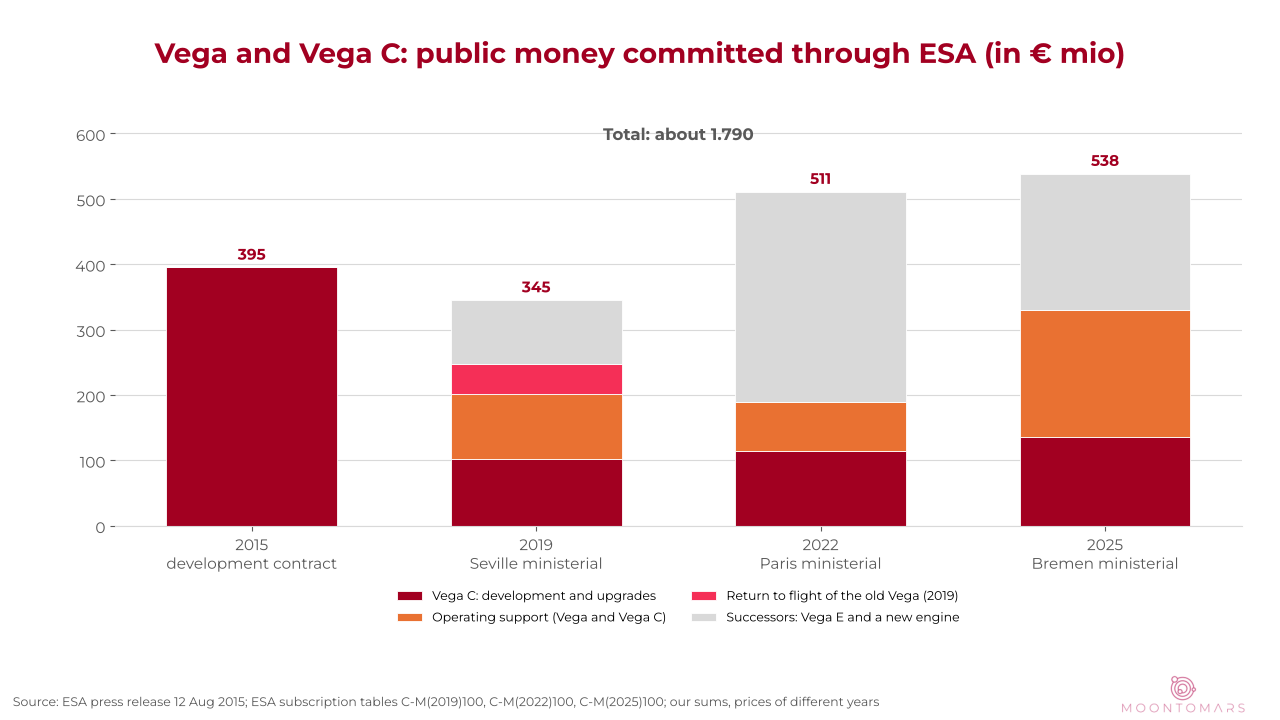
Added up, the 2015 contract and the Vega lines of the three ministerial councils since 2019 come to about EUR 1.8 billion of public commitments by our calculation. EUR 748 million of that went to Vega C itself (development and upgrades), EUR 368 million to support for operating Vega and Vega C, and EUR 627 million to successors that have not flown: the Vega E upper stage and a new high-thrust engine. Avio’s 2019 annual report gave 2025 for the first flight of Vega E, the 2021 report 2026, the 2023 report 2027, and the 2024 and 2025 reports no date at all.
Per flight, the money for Vega C itself up to the 2022 council (the development contract plus the Vega C upgrade lines) comes to EUR 87.4 million for each of the seven successful flights. With the operating support it is EUR 112.2 million, although part of that support also paid for seven flights of the original Vega. Our page on public money per orbit uses the same method for other rockets.
Italy also helps Avio outside ESA: a 2022 law cut the royalties Avio owed the state on a loan for the old P80 motor to EUR 1.9 million, and Avio booked the rest of the debt, EUR 30.8 million, as income. Without it, Avio would have made a loss of about EUR 29 million before tax in 2022.
Who builds and sells Vega C: Avio
Avio S.p.A. is based in Rome, with its main plant and propellant production in Colleferro, about 50 km south-east of the city. Its roots go back to the explosives maker BPD, founded at Colleferro in 1912. Fiat sold its aerospace arm FiatAvio to Carlyle and Finmeccanica (now Leonardo) in 2003, Cinven bought Avio in 2006, and General Electric bought the aircraft engine business in 2013 for USD 4.3 billion. The space business stayed behind and was listed on the Milan stock exchange in April 2017 through a merger with the investment vehicle Space2. Giulio Ranzo is the CEO, and Roberto Italia is the chair of the board.
Besides Vega C, Avio makes the P120C and P160C solid boosters of Ariane 6 through Europropulsion, its 50/50 company with ArianeGroup, and the liquid oxygen turbopumps of its engines. It owns 70% of Spacelab (formerly ELV), with ASI holding the other 30%. Until early 2026 Avio also held a small share in Arianespace and left it when it took over Vega C sales.
| Year | Net revenue | Net profit | Net cash at year end | Staff at year end | Order backlog |
|---|---|---|---|---|---|
| 2019 | EUR 368.7 million | EUR 27.0 million | EUR 57.9 million | 935 | EUR 669 million |
| 2020 | EUR 322.0 million | EUR 14.9 million | EUR 62.6 million | 950 | EUR 736 million |
| 2021 | EUR 311.6 million | EUR 9.1 million | EUR 57.2 million | 991 | EUR 877 million |
| 2022 | EUR 357.3 million | EUR 1.3 million | EUR 74.5 million | 1,147 | EUR 1,014 million |
| 2023 | EUR 338.7 million | EUR 6.6 million | EUR 76.1 million | 1,256 | EUR 1,359 million |
| 2024 | EUR 441.6 million | EUR 6.4 million | EUR 90.1 million | 1,355 | EUR 1,724 million |
| 2025 | EUR 541.7 million | EUR 11.6 million | EUR 591.7 million | 1,426 | EUR 2,166 million |
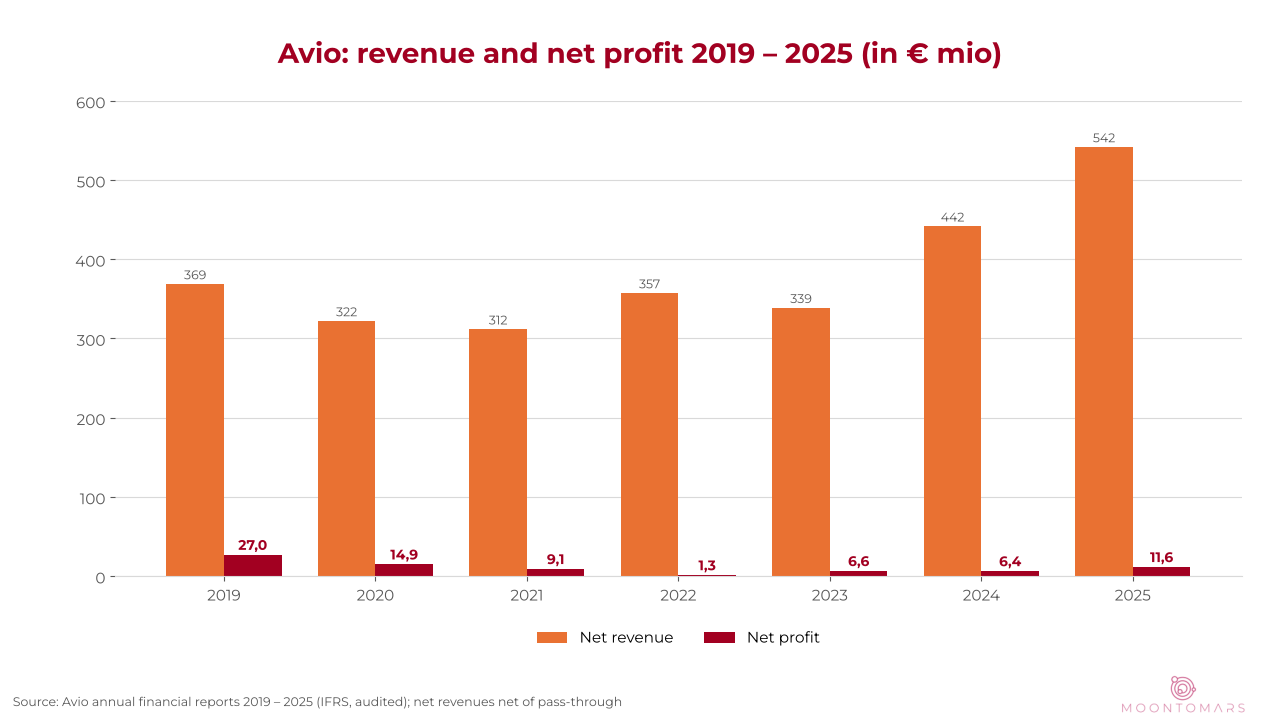
Over seven years Avio made EUR 77 million of profit on EUR 2.7 billion of revenue, a margin of about 2.9%. In 2025 about 84% of its revenue came from Vega, Ariane and Italy’s recovery-fund projects, all of them paid for by ESA, the EU or the Italian state, and most of the rest from defence. The 2022 profit of EUR 1.3 million exists because of the royalty write-off described above.
In the last year the owners changed. Leonardo, about 30% owned by Italy’s Ministry of Economy and Finance, held 28.75% of Avio until October 2025. It then sold shares for about EUR 100 million, bought new ones for about EUR 79 million in the November 2025 rights issue, and now holds 18.04%. The rights issue raised EUR 400 million, and in September 2026 the US fund Advent paid EUR 109 million for 6.54% at EUR 33.40 a share. On October 8th, 2026 the share closed at EUR 29.00, 13% below Advent’s price and 34.5% lower than a year before.
Most of the new money goes to the United States, where Avio USA is building a plant for solid rocket motors for air-defence missiles in Pittsylvania County, Virginia, for more than USD 500 million. Virginia approved incentives of up to about USD 97 million. Avio said in December 2025 that the plant would be working by the end of 2028, and at the groundbreaking in September 2026 it gave early 2029 for production. Avio’s defence revenue was EUR 81.7 million in 2025, 15% of the total.
How Vega C compares with rockets from the US, China, India and Japan
Late, by the same margin as Ariane 6
Vega C first flew about four years after its 2018 target and 7.6 years after the ministers’ decision of December 2014. Ariane 6 was also about four years late. Falcon 9 flew 4.7 years after SpaceX announced it, China’s Long March 8 flew 3.6 years after it was approved, and India’s small SSLV took about 4.8 years from the start of development. Late rockets are common: Rocket Lab’s larger Neutron was expected “as early as 2024” and had not flown by October 2026, and Japan’s Epsilon S was due in the 2024 fiscal year and has not flown either.
Launch rate
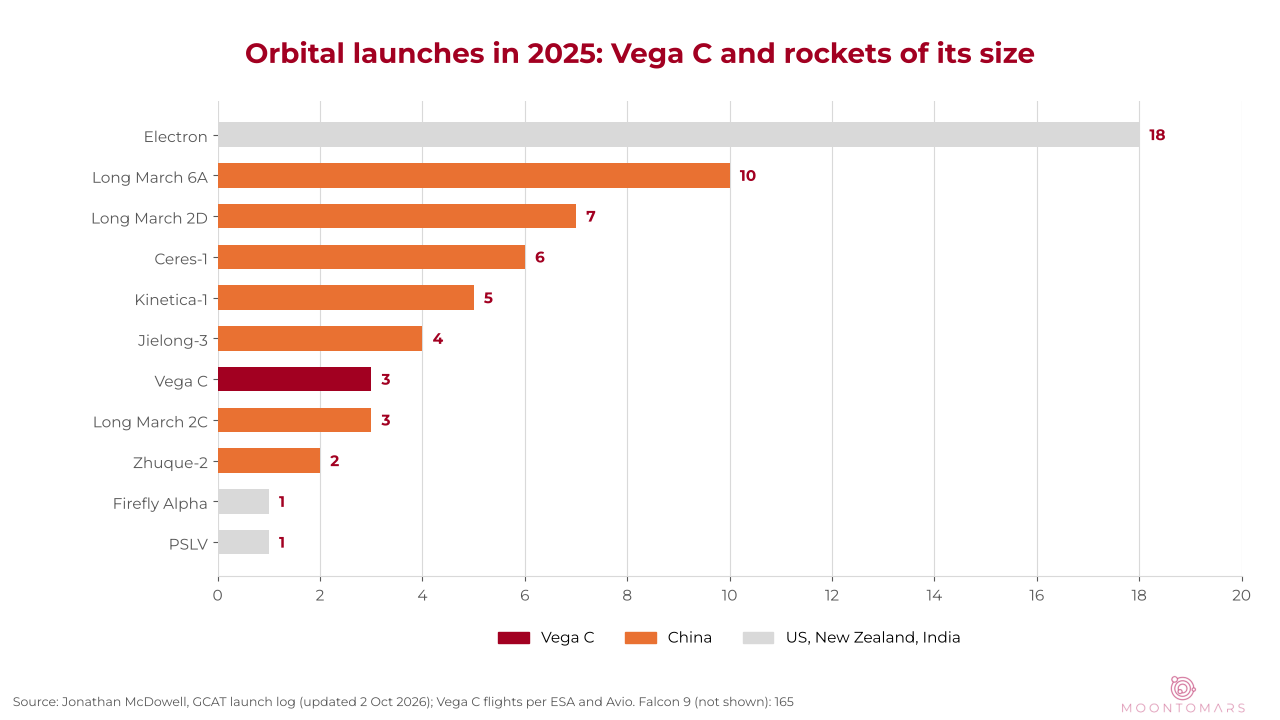
Vega C launched three times in 2025, while Rocket Lab’s Electron flew 18 times and Falcon 9 flew 165 times. Chinese rockets of Vega C’s size flew 43 times in total, led by Long March 6A with ten launches and Long March 2D with seven. Since its return to flight Vega C has flown at a rate of about 3.3 launches a year, which is more than the two a year ESA planned for European institutions in 2021 and short of the four to six Avio and ESA have announced.
Price per kilogram
| Rocket | Country | Payload to sun-synchronous orbit | Launches in 2025 | Price per kg |
|---|---|---|---|---|
| Vega C | Europe (Italy) | 2,300 kg (700 km polar) | 3 | about USD 23,900 |
| Electron | US / New Zealand | 200 kg | 18 | about USD 46,000 |
| Firefly Alpha | US | 630 kg | 1 | about USD 23,800 |
| Falcon 9 rideshare | US | from 50 kg | 165 (Falcon 9) | USD 7,000 (list price 2026) |
| PSLV | India | 1,750 kg | 1 (failed) | about USD 12,100 |
| Ceres-1 | China | 300 kg | 6 | about USD 13,300 |
| Kinetica-1 | China | 1,500 kg | 5 | about USD 7,500 (company claim) |
| Long March 2D | China | 1,300 kg | 7 | not published |
Based on the EUR 48.62 million launch contract for Sentinel-1C, Vega C costs about USD 23,900 per kilogram to a 700 km polar orbit, or about USD 16,600 per kilogram to low Earth orbit, the figure in our cost per kilogram chart. That is level with Firefly Alpha, about half of Electron, about twice India’s PSLV and about three times the price SpaceX asks per kilogram on its Falcon 9 rideshare flights. SpaceX raised that price from USD 5,000 per kilogram in 2019 to USD 7,000 in 2026, and it is still about a third of Vega C’s. ESA had promised in 2021 that Vega C would fly at “a similar cost to the current Vega”. Per kilogram it does, at about EUR 21,000 per kilogram for both, but the price of a launch rose by half, from about EUR 32 million to EUR 48.62 million.
Reliability
Seven of eight Vega C flights succeeded, which is better than Firefly Alpha (four of seven) and in line with China’s Ceres-1 (21 of 23) and Kinetica-1 (15 of 16). India’s PSLV failed on its only flight in 2025 and its only flight in 2026, and Japan’s Epsilon has not flown since a failure in October 2022. According to ESA’s inquiry boards, two of the three Vega and Vega C failures since 2019 trace back to Avio: wrong assembly of the upper stage in 2020 and a nozzle part Avio bought in Ukraine in 2022.
Who launches Europe’s satellites
Vega C’s customers since its return to flight are almost all European institutions: ESA, the European Commission’s Copernicus programme and the French space agency CNES, plus one Korean satellite. Italy’s own space agency ASI launched two COSMO-SkyMed radar satellites on Falcon 9 after they had been planned for Vega C, and it has put 39 satellites of its IRIDE Earth observation programme on six Falcon 9 rideshare flights since January 2025.
Europe’s new light rockets
Vega C’s class is where Europe’s private launch companies want to compete. Isar Aerospace reached orbit with Spectrum on September 5th, 2026, while RFA One, PLD Space’s MIURA 5 and ArianeGroup’s MaiaSpace have not flown. ESA’s European Launcher Challenge signed EUR 543.6 million of launch contracts with Isar, RFA and PLD in August 2026, paid against flights. Vega C’s development contract alone was EUR 395 million, paid against development milestones, four years before the rocket flew.
My opinion on Vega C and Avio and why you should keep an eye on them
What I like about Vega C and Avio
- It flies, and mostly works: Seven of eight Vega C flights reached orbit, and six in a row since December 2024. That is a better record than several newer rockets of its size in the US, India and Japan.
- Open inquiries: ESA published the findings of every failure and named the faulty part and where Avio bought it, and Avio wrote the costs into its audited accounts.
- A company that reports: Avio is listed, publishes audited accounts every year and lists the public grants it receives line by line.
- Defence customers who pay: The US air-defence motor contracts and the Virginia plant are business Avio won outside the ESA system.
What I don’t like about Vega C and Avio
- Late, twice: The original Vega flew about six years after its first target, and Vega C about four years after its own. Both rockets were built from ESA money with Italy as the main payer.
- Three a year: Avio promised four to five launches a year in 2019 and six a year in 2024. In fourteen years Vega and Vega C have never flown more than three times in one year.
- Dearer, not cheaper: ESA promised Vega C at a similar cost to Vega and paid Avio EUR 51 million to cut the cost by 10%. The only published launch price is half again the price of a Vega in 2012.
- Ukraine, still: ESA set out in 2016 to reduce Europe’s reliance on the Ukrainian upper-stage engine. Ten years later Avio has ordered 20 more of them, for delivery until 2027.
- Vega E without a date: EUR 627 million of public money is committed to Vega E and a new engine, and Avio’s annual reports moved the first flight from 2025 to 2026 to 2027 before dropping the date.
- Italy’s own satellites fly American: ASI moved two COSMO-SkyMed satellites from Vega C to Falcon 9 and launches its IRIDE constellation on SpaceX rideshares.
Things to watch out for
- VV31 and the rest of 2026: Arianespace’s last Vega C flight is planned for the end of 2026. Three flights in 2026 would match 2025, and five were planned in 2024.
- Six a year: ESA is paying for a second integration building in Kourou for up to six launches a year. Let’s count again in January 2028.
- The Seville support: France, Germany and Italy can pay up to EUR 21 million a year from flight 26 on. How much has been drawn is not public.
- The replacement engine: Avio says an Italian engine to replace the Ukrainian one is being tested under a EUR 55 million contract from ASI. No flight date has been given.
- Virginia: Production was first due at the end of 2028 and is now planned for early 2029. The state incentives require at least USD 537.5 million of investment and 1,546 jobs.
- Advent and Leonardo: Advent bought in at EUR 33.40 a share and is locked in for 12 months. Leonardo cut its stake from 28.75% to 18.04% in a year.
Where to find more information on Vega C and Avio
- ESA: Ariane 6 and Vega C begin development (August 2015), the contracts and the promises
- ESA: Loss of flight VV22, inquiry conclusions (March 2023)
- ESA: Zefiro 40 test, inquiry conclusions (October 2023)
- ESA: subscriptions at the 2025 ministerial council (PDF, via the Swedish National Space Agency)
- Avio: annual financial report 2025 (PDF)
- European Spaceflight: what a Sentinel-1C launch cost (April 2026)
- Our pages on Ariane 6, Europe’s heavy rocket, and the Guiana Space Centre, where both fly from
Updates on Vega C and Avio
- October 2026: Page published with eight Vega C flights, the public money from 2000 to 2025, Avio’s accounts and the comparison with US, Chinese, Indian and Japanese rockets.
Structured information on Vega C and Avio
| Type | Information |
|---|---|
| Official name | Vega C (Vega-C) |
| Ordered by | European Space Agency, ministerial council in Luxembourg, December 2nd, 2014 |
| Prime contractor and launch operator | Avio S.p.A., Via Leonida Bissolati 76, 00187 Rome, Italy |
| Main plant | Via Ariana km 5.2, 00034 Colleferro (Rome), Italy |
| Listing | Euronext Milan, since April 10th, 2017 |
| Main shareholders | Leonardo 18.04%, Advent International 6.54% (October 2026) |
| CEO | Giulio Ranzo |
| Launch site | Vega launch complex (ZLV), Guiana Space Centre, Kourou, French Guiana |
| First flight | July 13th, 2022 (VV21) |
| Flights to October 8th, 2026 | 8, of which 7 successful |
| Payload | About 2,300 kg to a 700 km polar orbit |
| Stages | P120C, Zefiro 40, Zefiro 9 (solid), AVUM+ (liquid) |
| Reusable | No |
| Websites | esa.int, avio.com, LinkedIn |
Interested in more space companies? Read our other reviews and analysis
Europe’s new light rockets have their own pages: Isar Aerospace, Rocket Factory Augsburg, PLD Space, MaiaSpace, Orbex, Skyrora, Latitude and HyImpulse. Our ranking of European launch companies uses Vega C and Ariane 6 as the benchmark. The launch sites: Guiana Space Centre, Andøya Space Center, Esrange Space Center, SaxaVord Spaceport, Space Hub Sutherland, Santa Maria Spaceport, German Offshore Spaceport Alliance and Etlaq Spaceport. Our European Space Map shows them all.
- HyImpulse Technologies
 HyImpulse Technologies builds hybrid paraffin/LOX rockets. SR75-1 flew from Koonibba on 3 May 2024; a UK CAA licence covers SaxaVord for spring 2027. Series A and a Series A Extension above EUR 50 million equity arrived in 2025–26. SL1 targets 600 kg to LEO; HyMOVE is a separate OTV.
 - Andøya Space Center
 Andøya Space Center is a spaceport in northern Norway. Spectrum reached orbit from Andøya on 5 September 2026. Pad 1 is operational and Isar-exclusive; Pad 2 is proposed. Operator Andøya Space AS is 90% Norwegian state and 10% Kongsberg.
 - SkyroraSkyrora is a Scottish new space company developing the Skyrora XL, a three-stage rocket for up to 315 kg to orbit. Our 2026 analysis covers its owners, accounts, public money and launch plans.
- OrbexOrbex (Orbital Express Launch Ltd): UK microlauncher Prime, 180 kg LEO. In administration since 18 February 2026 after GBP 138.5m raised (GBP 76.7m public). Zero launches. Omnidea bought the Forres assets.
- LatitudeLatitude (formerly Venture Orbital Systems) is a French NewSpace company developing a LOX/RP-1 microlauncher (formerly Zephyr). As of October 2026 it has not flown; Series B raised EUR 27 million; an Etlaq Oman LoI targets an experimental late-2027 inaugural that we treat as optimistic. In-depth analysis on moontomars.space.



All information in this analysis was obtained from public sources and we encourage you to do your own due diligence. Feel free to contact us for corrections or share our content. Attribution is always welcome.