
Welcome to our ranking of European space launch companies. The first edition went online on April 5th, 2024 as our Top 10 European Space Launch Companies, and this edition was updated on October 7th, 2026 Updated content. Make sure to check out our mission statement and why we do what we do. Look at our New Space guide if you want explanations of terms and concepts used in our research. And follow us on X for updates.

🔥 Our October 2026 update on Europe’s launch companies:
- 🚀 Isar Aerospace reached orbit on 5 September 2026 with the second Spectrum flight from Andøya in Norway. It is the only company in this ranking with an orbital rocket, and ESA called it the first launch to orbit from continental Europe.
- 💰 ESA signed European Launcher Challenge contracts worth EUR 543.6 million on 27 August 2026 with Isar (EUR 197.8 million), Rocket Factory Augsburg (EUR 186.9 million) and PLD Space (EUR 158.9 million). The money follows milestones, and the launch purchases pay out only after an orbital flight by the end of 2027.
- 🏛 MaiaSpace had lost EUR 85.1 million by the end of 2025 against EUR 83.4 million paid in by its owner ArianeGroup, and ArianeGroup voted on 25 June 2026 not to dissolve it. Its EUR 184.3 million launcher challenge pledge, almost all from France, was still unsigned on 7 October 2026.
- 🛑 Orbex has been in administration since 18 February 2026 without a launch. Portugal’s Omnidea bought its UK manufacturing assets, IP and brand on 30 September 2026.
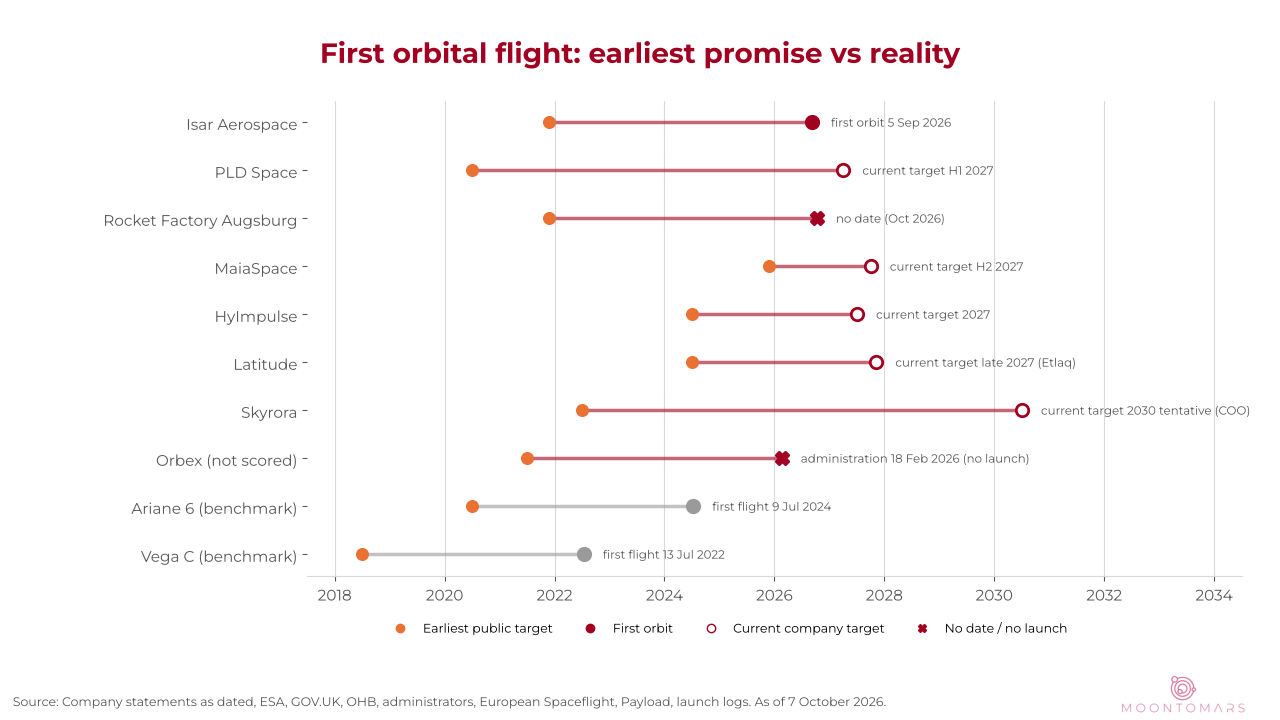
- ⏳ Six of the seven scored companies have not reached orbit. Their earliest public targets for a first orbital flight ran from 2020 to 2025. Current targets run from the first half of 2027 (PLD Space) to a tentative 2030 (Skyrora), and RFA has no date.
- 📏 Ariane 6 and Vega C left the scored list and are now our benchmark. Ariane 6 needed 9.6 years from the ministers’ decision to its first flight, against 4.7 years for Falcon 9 from announcement to orbit.
- 📊 About 76% of Isar’s documented money came from investors. At RFA about 71% of the documented money is public.
What you should know about Europe’s launch companies
📰 For space enthusiasts
- One NewSpace rocket reaches orbit: Isar’s Spectrum, from Andøya. Ariane 6 and Vega C fly from Kourou as ESA programmes.
- Next first flights: PLD’s MIURA 5 in the first half of 2027 and MaiaSpace’s Maia in the second half of 2027 (company targets).
- No orbital launch from the UK yet: RFA took its rocket off the pad at SaxaVord in July 2026, Orbex is in administration and Skyrora talks of 2030.
- New names: Sirius Space Services, HyPrSpace, Omnidea with PrimeNEO, The Exploration Company and, in the UAE, Aspire Space.
💰 For VCs and industry
- European Launcher Challenge: EUR 543.6 million signed for Isar, RFA and PLD. EUR 184.3 million pledged for MaiaSpace, unsigned.
- Largest 2026 rounds: Isar Series D EUR 270 million, The Exploration Company USD 450 million, PLD EUR 119.6 million in January plus EUR 108 million in September (company figure), HyImpulse more than EUR 50 million.
- Public share of documented money: Isar about 24%, HyImpulse about 35%, Latitude about 28%, RFA about 71%. At PLD the Spanish government counts more than EUR 170 million on top of ESA’s EUR 158.9 million.
- Orbex: GBP 76.7 million of public money went in, according to the administrators, and creditors face a GBP 54.1 million shortfall.
👨💻 For potential employees
- Largest teams: Isar 418 (2024 average) and PLD Space 351 (2025 average, more than 500 by September 2026 according to the Spanish government).
- Mid-size: RFA 249 (2024 average) and MaiaSpace close to 220 (end of 2025).
- Smaller: Latitude 100 to 199 (INSEE band, 2024), HyImpulse 52 (2024 average, the company says more than 100) and Skyrora 48 at its rocket company (2024 average).
How we rank Europe’s launch companies
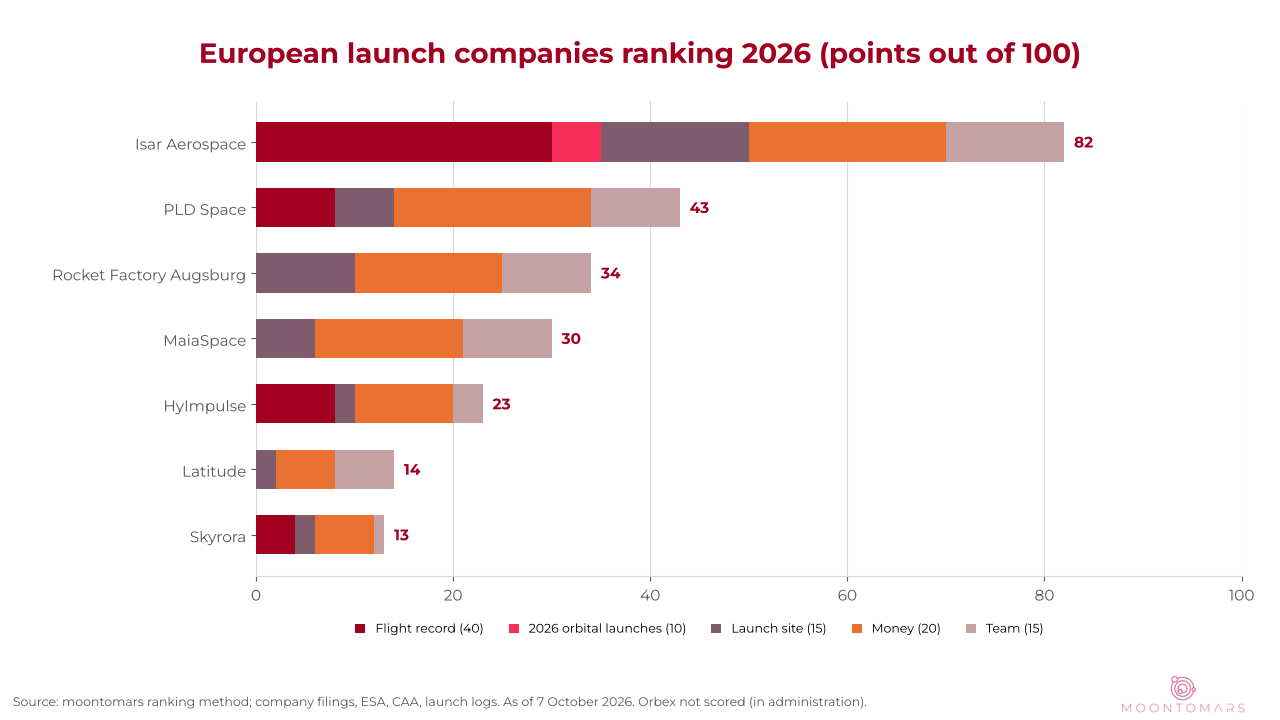
We score every company on five numbers that can be checked against company filings, regulators, ESA or launch logs, for a maximum of 100 points. Company announcements count where a document or a flight backs them, and public money counts only once a contract is signed. Flight record carries the most weight because orbit is the milestone a customer pays for, while money and team measure how long a company can keep going until it gets there.
| Criterion | Points | How we score |
|---|---|---|
| Flight record | 40 | Most advanced vehicle flown: 40 for five or more orbital successes, 35 for two to four, 30 for one, 15 for an orbital attempt without success, 8 for a completed suborbital flight, 4 for a failed suborbital attempt, 0 for no flight |
| 2026 orbital cadence | 10 | 10 for four or more orbital launches in 2026, 7 for two or three, 5 for one, 0 for none |
| Launch site | 15 | 15 for a pad used for an orbital flight, 10 for a pad built with the vehicle stacked, 6 for a pad allocated or under construction, 2 for a letter of intent or no named orbital pad, 0 for none |
| Money | 20 | Equity, convertibles, debt, grants, customer advances and signed public contracts as documented: 20 for EUR 500 million or more, 15 for EUR 250 to 499 million, 10 for EUR 100 to 249 million, 6 for EUR 50 to 99 million, 3 for EUR 10 to 49 million, 0 below |
| Team | 15 | Latest filed headcount from registers or annual reports: 15 for 1,000 or more, 12 for 400 to 999, 9 for 200 to 399, 6 for 100 to 199, 3 for 50 to 99, 1 below 50 |
Two more numbers sit next to the score and do not change it: how many years a company is behind its earliest public target for a first orbital flight, and how much of its documented money came from public sources. Money counts the same whoever pays it, so the public money column is where state-carried projects show. A company in insolvency proceedings stays in the list without a score.
This ranking covers NewSpace launch companies: private firms and ventures sold as startups. Ariane 6 and Vega C are ESA programmes built by ArianeGroup and Avio, so they are not scored. They are the benchmark further down, measured on years and public money against American and Chinese rockets. All figures are as of 7 October 2026, and GBP amounts are converted at the ECB reference rate of 30 September 2026 (EUR 1 = GBP 0.85463).
European space launch companies ranking 2026 at a glance
| # | Company | Country | Rocket | Orbit | Score | Behind first target | Public money (documented) |
|---|---|---|---|---|---|---|---|
| 1 | Isar Aerospace | Germany | Spectrum | Yes, since 5 September 2026 | 82 | About 5 years | About EUR 265 million, 24% |
| 2 | PLD Space | Spain | MIURA 5 | No, suborbital MIURA 1 in 2023 | 43 | About 7 years (target H1 2027) | Spain more than EUR 170 million, ESA EUR 158.9 million, EIB EUR 30 million |
| 3 | Rocket Factory Augsburg | Germany | RFA One | No | 34 | 5 years or more, no date | About EUR 222 million, 71% |
| 4 | MaiaSpace | France | Maia | No | 30 | About 2 years (target H2 2027) | France 2030 contract (amount not published), EUR 184.3 million pledge unsigned |
| 5 | HyImpulse | Germany | SL1 | No, suborbital SR75 in 2024 | 23 | About 3 years (target 2027) | About EUR 35 million, 35% |
| 6 | Latitude | France | Launcher (Zephyr name dropped) | No | 14 | About 3 years (target late 2027) | At least EUR 15 million, about 28% |
| 7 | Skyrora | UK | Skyrora XL | No, suborbital Skylark L failed in 2022 | 13 | About 8 years (tentative 2030) | About EUR 4.4 million, 8% |
| – | Orbex | UK | Prime | No, company in administration | Not scored | No launch | GBP 76.7 million (administrators) |
The leader: the only NewSpace rocket in orbit
1. Isar Aerospace (Germany): 82 points
Isar Aerospace reached orbit with the second Spectrum flight on 5 September 2026 from its own pad at Andøya. The first flight on 30 March 2025 ended less than a minute after liftoff. In December 2019 Isar said it was on track for a first launch in late 2021, so orbit came about five years after that target. A second pad in Nova Scotia, Canada, is planned for 2028, according to Isar and its partner there.
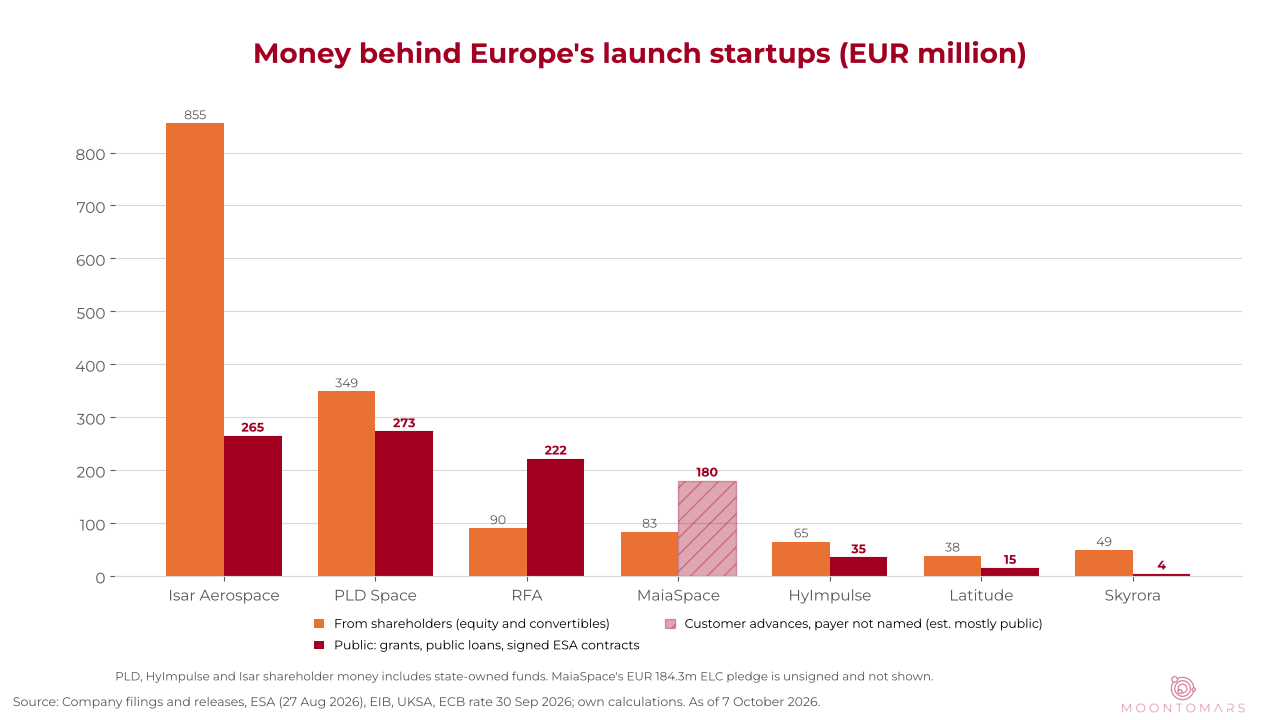
Isar said it had raised more than EUR 400 million by June 2024 and signed a EUR 270 million Series D in June 2026. Convertibles of EUR 150 million from Eldridge and EUR 35 million from Lakestar come on top. Grants and awards from 2021 to 2025 come to about EUR 67 million in the accounts and the German lobby register, mostly from ESA Boost!, the German microlauncher competition and the EU’s EIC Horizon award. Isar’s 2024 management report gives more than EUR 60 million. The EUR 197.8 million launcher challenge contract was signed nine days before the orbital flight. The 2024 group accounts show an average of 418 employees, a loss of EUR 77 million and EUR 29.7 million in cash at the end of that year.
Score: flight record 30, cadence 5, launch site 15, money 20, team 12. Our full Isar Aerospace review has the funding and valuation details.
Funded contenders: money and pads, no orbit yet
2. PLD Space (Spain): 43 points
PLD Space flew its suborbital MIURA 1 on 7 October 2023 from El Arenosillo to about 46 km. The orbital MIURA 5 is due to make its first demonstration flight from Kourou in the first half of 2027, according to the company. PLD’s first orbital target was 2020, followed by 2021, 2024, 2025 and 2026. A second launch site at Etlaq in Oman is planned for 2027.
Shareholders put in EUR 240.6 million by March 2026, according to the filed accounts, and the company announced another EUR 108 million in September 2026. State funds sit among them: Innvierte, the vehicle of Spain’s CDTI, held 23.41% at the end of 2025, and the state lender COFIDES put in EUR 50 million in March 2026. The Spanish government says it has given PLD more than EUR 170 million, without ESA’s EUR 158.9 million launcher challenge contract. The January 2026 share price implies about EUR 430 million after the round (our estimate). The 2025 accounts show an average of 351 employees and sales of EUR 0.65 million against EUR 81 million of operating costs.
Score: flight record 8, cadence 0, launch site 6, money 20, team 9. More in our PLD Space review and 2026 Update on PLD Space.
3. Rocket Factory Augsburg (Germany): 34 points
Rocket Factory Augsburg has not flown. In August 2024 a first stage was destroyed during a static fire at SaxaVord. In 2026 a new RFA One stood on the same pad and was taken down on 28 July, and SaxaVord dropped the August to September launch window. OHB had named the end of 2021 for a first flight in August 2019, and on 7 October 2026 RFA had no new date.
OHB reports a stake of about 65% at equity with restricted voting rights and says it does not control RFA. Private money came as convertible bonds, about EUR 90 million drawn, and no priced equity round has been filed. Public money promised since 2020 comes to about EUR 222 million, of which EUR 186.9 million is the launcher challenge contract. Every audited year from 2021 to 2024 carries a going-concern warning, and the 2024 accounts show an average of 249 employees.
Score: flight record 0, cadence 0, launch site 10, money 15, team 9. More in our Rocket Factory Augsburg review.
4. MaiaSpace (France): 30 points
MaiaSpace is a 100% subsidiary of ArianeGroup, the Airbus and Safran joint venture that builds Ariane 6. It was set up at the end of 2021 to build Maia, a partly reusable methane rocket for 1.5 tonnes to sun-synchronous orbit when expended and 500 kg with the first stage recovered, according to the company. In June 2023 MaiaSpace aimed for a first orbital flight before the end of 2025. The target then moved to late 2025, the second half of 2026, April 2027 and now the second half of 2027, after the company dropped a suborbital test in July 2026. Its pad is ELM2, the former Soyuz complex in Kourou, which is being converted.
ArianeGroup paid in EUR 83.4 million, and losses to the end of 2025 came to EUR 85.1 million. Equity was negative at the end of 2025, and on 25 June 2026 ArianeGroup decided not to dissolve the company. Most of the cash came from EUR 180 million of customer advances at the end of 2024, and the accounts don’t name the payer. France picked MaiaSpace in March 2024 for its France 2030 launch demonstration purchase and has not published the amount. In the launcher challenge France pledged EUR 179 million to MaiaSpace, EUR 184.3 million with Germany and Switzerland. Almost all of it sits in launch purchases, not in the co-funded part that requires 40% private money, and the contract was still unsigned on 7 October 2026.
Maia’s payload class matches LandSpace’s Zhuque-2, a methane rocket from a Chinese private company that reached orbit in July 2023. Falcon 9 first landed a booster in December 2015. The 2025 accounts count close to 220 staff at the end of the year, and the company said more than 400 in September 2026. Eutelsat signed a multi-launch agreement on 16 January 2026, and the Altair-NextGen consortium named Maia its preferred launcher on 9 September 2026.
Score: flight record 0, cadence 0, launch site 6, money 15, team 9. The money points count ArianeGroup’s equity and the customer advances. More in our MaiaSpace review.
Furthest behind in Europe’s microlauncher race
Three companies score below 25 points, and Orbex is not scored. Each has moved its first orbital flight by at least three years from its earliest public target, and none holds a launcher challenge contract. The most recent flights in the group are a completed HyImpulse SR75 flight in 2024 and a failed Skyrora Skylark L attempt in 2022.
5. HyImpulse (Germany): 23 points
The hybrid-fuelled SR75 sounding rocket from HyImpulse flew from Koonibba in South Australia on 3 May 2024. On 28 September 2026 the UK Civil Aviation Authority licensed SR75 launches from SaxaVord, and the next flight is planned for spring 2027. The orbital SL1, rated by the company at about 600 kg to low Earth orbit, is expected to fly in 2027. In July 2022 the company had named 2024.
HyImpulse announced EUR 45 million in October 2025, of which about EUR 15 million was equity and the rest public financing, and more than EUR 50 million in a Series A extension in September 2026. State-linked funds such as Bayern Kapital, BW-Capital and NRW.BANK are among the investors. The grants and contracts from ESA Boost! and the UK Space Agency that we can document add up to about EUR 35 million, and the company puts its total above EUR 125 million. The 2024 accounts show an average of 52 employees, and the company now says it has more than 100.
Score: flight record 8, cadence 0, launch site 2, money 10, team 3. More in our HyImpulse review and 2026 Update on HyImpulse.
6. Latitude (France): 14 points
Latitude has not flown, and its homepage says first launch 2027. A letter of intent with Etlaq in Oman, signed on 1 July 2026, covers an experimental first flight in late 2027. Latitude committed EUR 8 million to its own section of the shared Diamant complex in Kourou, holds a pre-contract there and paused its works in July 2026. From at least December 2020 the company targeted a first launch in 2024.
Equity raised is about EUR 38.25 million: seed EUR 0.75 million, Series A EUR 10 million and Series B USD 30 million (EUR 27.5 million) in January 2024. France 2030 added EUR 15 million in June 2024 on top of earlier aid, and the company puts its total above EUR 50 million. INSEE places Latitude in the 100 to 199 employee band for 2024, and the company website says 160.
Score: flight record 0, cadence 0, launch site 2, money 6, team 6. More in our Latitude review and 2026 Update on Latitude.
7. Skyrora (UK): 13 points
The suborbital Skylark L from Skyrora failed shortly after liftoff from Langanes in Iceland on 8 October 2022. The UK Civil Aviation Authority licensed Skylark L launches from SaxaVord in 2025. In September 2026 Skyrora fired a scaled-down Skyrora XL for 45 seconds, and in October its COO said the first orbital launch was tentatively planned for 2030, a day after a company release had said 2027. In 2021 the UK government said Skyrora XL would make a test launch from the UK in 2022.
Shareholders paid GBP 41.6 million into Skyrora Ltd by the end of 2024, according to Companies House filings. Public money is about EUR 4.4 million from ESA Boost!, which in 2021 was meant to pay for that 2022 test launch. The wider group earned GBP 24.4 million of its GBP 36.1 million revenue in 2024 from reselling online ad traffic. Founder Volodymyr Levykin and director Laura Edison left all group boards in May 2026, and Skyrora Ltd averaged 48 employees in 2024.
Score: flight record 4, cadence 0, launch site 2, money 6, team 1. More in our Skyrora review.
Orbex (UK): not scored
Orbital Express Launch Ltd, the company behind Orbex, entered administration on 18 February 2026. The administrators report GBP 138.5 million raised, GBP 76.7 million of it public, including GBP 29 million from the Scottish National Investment Bank and GBP 26 million from the UK government in 2025. Creditors face a shortfall of GBP 54.1 million. Orbex had planned its first launch for 2021 from Space Hub Sutherland and never launched, and it left the launcher challenge before ESA signed the first contracts.
On 30 September 2026 Omnidea from Portugal bought the UK manufacturing assets, IP, data and brand, without the legal entities, the Kinloss test site or the spaceport. Omnidea plans a simplified rocket called PrimeNEO and is weighing Scotland and the Azores. Its CEO told ECO that orbital launch capability by 2028 is “not at all viable” and that 2035 would probably be closer (our translation).
The benchmark: Ariane 6 and Vega C (not ranked)
Ariane 6 flew for the first time on 9 July 2024 and has launched nine times since, all from the ELA-4 pad in Kourou. On the first flight the upper stage did not complete its deorbit burn after a problem with its auxiliary power unit. The other eight flights were full successes, four of them in 2026 up to the MTG-I2 launch on 27 August. Arianespace had planned up to eight flights in 2026. Space Intel Report, cited by European Spaceflight, reported a turbopump anomaly found in ground checks in August that leaves room for one or two more this year, and ESA confirmed delays.
ESA’s ministers decided on Ariane 6 in December 2014, and the 2015 contracts committed EUR 2.4 billion to the rocket and EUR 600 million to the launch pad for a first flight in 2020. SpaceNews put development at more than EUR 3.8 billion after a top-up in 2020. In November 2023 France, Germany and Italy agreed to support operations with up to EUR 340 million a year for flights 16 to 42, and up to EUR 21 million a year for Vega C if needed. ArianeGroup reported 8,700 employees and EUR 2.6 billion in revenue for 2025, including its defence business.
Vega C has flown eight times since July 2022. ESA’s 2015 contract set its debut for 2018, and the second flight failed in December 2022, which grounded the rocket until 5 December 2024. In 2026 Avio launched SMILE on 19 May, its first mission as launch operator after taking over that role from Arianespace, and Sentinel-3C with FLEX on 14 September. Advent bought 6.54% of Avio for EUR 109.4 million in a capital increase closed on 24 September 2026.
| Rocket | Built by | First orbit | Years from start to first orbit | Launches in 2025 | First booster landing | Public development money |
|---|---|---|---|---|---|---|
| Ariane 6 | ArianeGroup (Europe) | July 2024 | 9.6 (ministers’ decision Dec 2014) | 4 | None, expendable | More than EUR 3.8 billion |
| Vega C | Avio (Europe) | July 2022 | 7.6 (decision Dec 2014) | 3 | None, expendable | EUR 395 million ESA contract |
| Falcon 9 | SpaceX (US) | June 2010 | 4.7 (announced Sep 2005) | 165 | December 2015 | About USD 300 million development, verified by NASA |
| Electron | Rocket Lab (US/NZ) | January 2018 | About 5 | 18 | Ocean recovery only | Not public |
| Long March 8 | CASC (China, state) | December 2020 | 3.6 (approved May 2017) | 7 | None | Not public |
| Zhuque-2 | LandSpace (China, private) | July 2023 | 8 (company founded 2015) | 2 | None, expendable | Not public |
| H3 | JAXA and MHI (Japan) | February 2024 | 10.8 (approved May 2013) | 3 | None, expendable | About JPY 190 billion |
The comparison is not only European. Japan’s state-run H3 took longer than Ariane 6. China’s state-built Long March 8 reached orbit three and a half years after approval, and LandSpace landed its Zhuque-3 booster on 18 August 2026, eight and a half months after that rocket’s first flight. The EUR 340 million a year promised to keep Ariane 6 flying would buy about five Falcon 9 launches at SpaceX’s list price of USD 74 million (our arithmetic).
New since our 2024 edition: companies to watch (not ranked)
These companies are new to this ranking or changed course after our 2024 edition. We list them without a score because they have not flown an orbital rocket and their funding and headcount are not yet documented well enough for the method above.
- Sirius Space Services (France): CNES selected Sirius on 23 April 2026 for the place at the Diamant complex in Kourou that MaiaSpace gave up, and announced it on 18 June. Sirius 1 is a two-stage rocket for up to 180 kg to low Earth orbit. The company fired its complete STAR-1 engine for the first time in summer 2026 and plans a suborbital Sirius 1B test in 2027 and a first commercial flight in late 2028. INSEE band: 50 to 99 employees (2024).
- HyPrSpace (France): HyPrSpace raised EUR 21 million in November 2025 for its hybrid engines. In September 2026 it moved the first flight of its suborbital Baguette One rocket to 2027, from the missile test range at Biscarrosse. Baguette One is meant to test technology for the orbital OB-1, designed for up to 235 kg to low Earth orbit and without a launch date.
- Omnidea and PrimeNEO (Portugal): Omnidea has owned the former Orbex manufacturing assets, IP and brand since 30 September 2026. It has not set a launch date for PrimeNEO (see Orbex above).
- The Exploration Company (Germany and France): The company builds the Nyx capsule and has no launcher of its own. It announced a USD 450 million Series C on 8 September 2026, for about USD 680 million in total. Part of the money goes to Storm, a methane engine the company says is meant for a future reusable European launcher for up to 40 tonnes to low Earth orbit.
- Aspire Space (UAE): Aspire Space was founded in Luxembourg and is now based in Abu Dhabi. It is developing Oryx, a two-stage methane rocket for 15 tonnes to low Earth orbit when expended, 12.5 tonnes with a reusable booster and 3 tonnes when fully reusable, with engines designed by LEAP 71 in Dubai. The companies plan a first flight in 2030. Our Etlaq Spaceport review covers the launch sites in the Gulf region.
Who paid for Europe’s rockets
Isar is the only company in this ranking that reached orbit, and it did so with mostly private money and ESA Boost! co-funding. Its documented money comes to about EUR 1.12 billion, of which about 76% came from investors. Before the launcher challenge contract it had about EUR 0.92 billion, less than a quarter of what Ariane 6 development cost.
A high private share does not by itself lead to orbit. Skyrora (about 92% private) and Latitude (about 72% private) are at the bottom of the ranking, with totals of about EUR 50 to 60 million each. RFA (about 71% public) and PLD Space rely most on public money, mainly through the launcher challenge contracts signed in August 2026 and, at PLD, Spanish state loans, grants and equity.
MaiaSpace is the case where the owner and the state carry the project. ArianeGroup’s equity is used up, the cash came from customer advances with an unnamed payer, and the largest public pledge goes into launch purchases rather than the part that asks for private money.
Promised first flight vs reality
Every company in this list missed its earliest public target for a first orbital flight. Isar reached orbit about five years late. For the six without orbit, the gap between the first target and the current one is two to eight years, and RFA and Orbex give no date. The benchmark rockets were late too: Ariane 6 and Vega C each flew about four years after their first target.
What changed since our 2024 edition
In 2024 we listed ten companies without a scoring method, with RFA first and Arianespace, Avio and MaiaSpace at the end. This edition scores the seven NewSpace companies on the same five numbers, leaves Orbex unscored and moves Ariane 6 and Vega C to the benchmark section.
- July 2024: Ariane 6 first flight, followed by eight more launches up to August 2026
- August 2024: RFA loses a first stage in a static fire at SaxaVord
- December 2024: Vega C returns to flight with Sentinel-1C
- March 2025: Isar’s first Spectrum flight ends within a minute
- July 2025: ESA preselects Isar, MaiaSpace, Orbex, PLD Space and RFA for the European Launcher Challenge
- November 2025: ESA member states commit EUR 902 million to the challenge at the CM25 ministerial council
- February 2026: Orbex enters administration
- April 2026: CNES picks Sirius Space Services for the Diamant slot left by MaiaSpace
- June 2026: Isar Series D of EUR 270 million, ArianeGroup decides not to dissolve MaiaSpace
- July 2026: RFA takes its rocket off the pad at SaxaVord, MaiaSpace drops its suborbital test and aims for the second half of 2027
- August 2026: Launcher challenge contracts for Isar, RFA and PLD Space, Ariane 6 turbopump anomaly reported
- September 2026: Isar reaches orbit, HyImpulse gets its UK licence, Omnidea buys the Orbex assets
My opinion on Europe’s launch companies and why you should keep an eye on them
What I like about Europe’s launch companies
- Orbit from Andøya: A German company funded mostly by private investors reached orbit from Norway with an average of 418 employees in 2024 and less than a quarter of Ariane 6’s development money.
- Milestone money: The launcher challenge pays Isar, RFA and PLD Space against milestones, and the launch purchases pay out only after an orbital flight by the end of 2027.
- Open records: Companies House, the German company register, the Spanish commercial register and INSEE publish enough to check most of the numbers in this ranking.
What I don’t like about Europe’s launch companies
- Targets moved by years: Six of seven scored companies have not reached orbit, and their first-flight targets have moved by two to eight years.
- Public share at the contenders: At RFA the launcher challenge contract alone is about twice the convertible money drawn, and PLD’s largest backer is the Spanish state.
- MaiaSpace: A subsidiary of the company that builds Ariane 6 lost more than its owner paid in, lives on advances from an unnamed customer and was still waiting for its launcher challenge contract in October 2026.
- Ariane 6 cadence: Four launches by the end of August and a turbopump issue leave 2026 short of the eight flights planned.
Things to watch out for
- MIURA 5 in the first half of 2027: The first orbital attempt of a Spanish rocket, from Kourou.
- RFA’s next window: SaxaVord needs a new launch window after the July 2026 destack.
- The end of 2027: The launcher challenge pays for launches only after an orbital flight by then. What ESA does with the companies that miss it is the test of the programme.
- The MaiaSpace contract: ESA said in August 2026 that the award was nearing completion, and the first Maia flight is planned for the second half of 2027.
- New pads in Kourou: Sirius at Diamant, PLD Space at its own pad, MaiaSpace at ELM2, and Latitude if its works resume.
Interested in more space companies? Read our other reviews and analysis
- Isar Aerospace
- PLD Space and the 2026 Update on PLD Space
- Rocket Factory Augsburg and the 2026 Update on Rocket Factory Augsburg
- MaiaSpace
- HyImpulse and the 2026 Update on HyImpulse
- Latitude and the 2026 Update on Latitude
- Skyrora
- Orbex and the 2026 Update on Orbex
- European Launcher Challenge
- Andøya Space Center
- SaxaVord Spaceport
- Space Hub Sutherland
- Esrange Space Center
- Etlaq Spaceport
- German Offshore Spaceport Alliance
- European Space Map
Sources for this ranking
- ESA: First contracts kick off European Launcher Challenge (27 August 2026), Isar Aerospace achieves first launch to orbit from continental Europe (September 2026)
- Company registers and accounts: Isar Aerospace group accounts 2024, RFA accounts 2021 to 2024, HyImpulse accounts 2024 (German company register and lobby register), PLD Space accounts 2015 to 2025 (Spanish commercial register), MaiaSpace accounts 2021 to 2025 and INSEE records for MaiaSpace, Latitude and Sirius Space Services, Skyrora (SC569511) and Orbital Express Launch (09580714) at Companies House
- Governments: Trilateral joint statement on European space transportation (6 November 2023), La Moncloa on PLD Space (10 September 2026), UK Civil Aviation Authority HyImpulse SR75 licence (28 September 2026)
- ArianeGroup: VA270 MTG-I2 (August 2026), Sustainability Report 2025
- Avio: VV29, VV30, Advent closing
- European Spaceflight: Ariane 6 turbopump, MaiaSpace schedule, Omnidea and Orbex, HyImpulse funding, Latitude and Oman
- Payload: Skyrora orbital timeline. NASA: Falcon 9 development cost (NTRS 20170008895). JAXA: H3 programme. Launch counts: Jonathan McDowell’s launch log.
All information in this analysis was obtained from public sources and we encourage you to do your own due diligence. Feel free to contact us for corrections or share our content. Attribution is always welcome.