
Welcome to our in-depth analysis of the Guiana Space Centre in Kourou, originally published October 8th, 2026. Make sure to check out our mission statement and why we do what we do. Look at our New Space guide if you want explanations of terms and concepts used in our research. And follow us on X for updates.
The Guiana Space Centre in October 2026: new pads, no small launch yet
- Small launchers: No small rocket has launched from Kourou’s new multi-launcher complex on the old Diamant pad. In October 2022 the French government said the shared facilities would be ready in 2024, the year of the first flights. PLD Space, the first tenant in line, now plans its first MIURA 5 flight for the first half of 2027.
- Tenants: Five companies hold slots on the Diamant complex: Isar Aerospace, Rocket Factory Augsburg, PLD Space, Latitude and Sirius Space Services, picked in April 2026. Only PLD Space has signed a development contract. MaiaSpace, owned by ArianeGroup, is converting the old Soyuz pad for a first flight in the second half of 2027.
- Launches: Kourou hosted 7 launches in 2025 and 6 up to October 7th, 2026, all on Ariane 6 and Vega C. From 2015 to 2018 it averaged 11 a year, and in 2023 and 2024 it hosted 3 each.
- Who pays: ESA says it pays two thirds of the base’s yearly budget. France’s audit court, the Cour des comptes, found in 2019 that France bears 84% of the costs once security, upkeep and its share of ESA are counted. Its 2023 report put France’s share at about 55%.
- Rivals: China’s state-owned Hainan commercial spaceport went from groundbreaking in July 2022 to its first launch in November 2024 and flew 9 times in 2025. Rocket Lab’s private site in New Zealand flew 17 times and Florida 109.
- Ariane 6: ESA ordered the rocket and its Kourou pad in 2015 for EUR 3 billion and a first flight in 2020. Ariane 6 first flew on July 9th, 2024, four years late.
What you should know about the Guiana Space Centre (CSG)
📰 For space enthusiasts
- Europe’s spaceport on the coast of French Guiana, 5° north of the equator
- Founded in 1964, first rocket in 1968, first satellite launch in 1970 with France’s Diamant
- Home of Ariane since 1979: 117 Ariane 5 flights, Ariane 6 since July 2024
- Soyuz flew here from 2011 to 2022, until Russia pulled out
- Small launchers are due to fly from the old Diamant pad, first flight planned for 2027
💰 For VCs and industry experts
- Owned and run by CNES, the French space agency. ESA owns the Ariane and Vega pads
- EUR 50 million of France 2030 money for the shared small-launcher facilities
- Over EUR 1 billion in the ESA and CNES contract signed in April 2026, ESA’s share EUR 635 million
- Five small-launcher slots on the Diamant complex and one pad for MaiaSpace on the old Soyuz complex
- CNES target: from about 10 launches a year to 40 or more
👨💻 For potential employees
- About 1,600 people work on the base for more than 40 companies
- 254 CNES employees in Kourou at the end of 2025
- About 4,500 jobs in French Guiana depend on space, one in six private-sector jobs (2019)
- New employers: PLD Space promises 56 local jobs by 2030, Sirius about 30
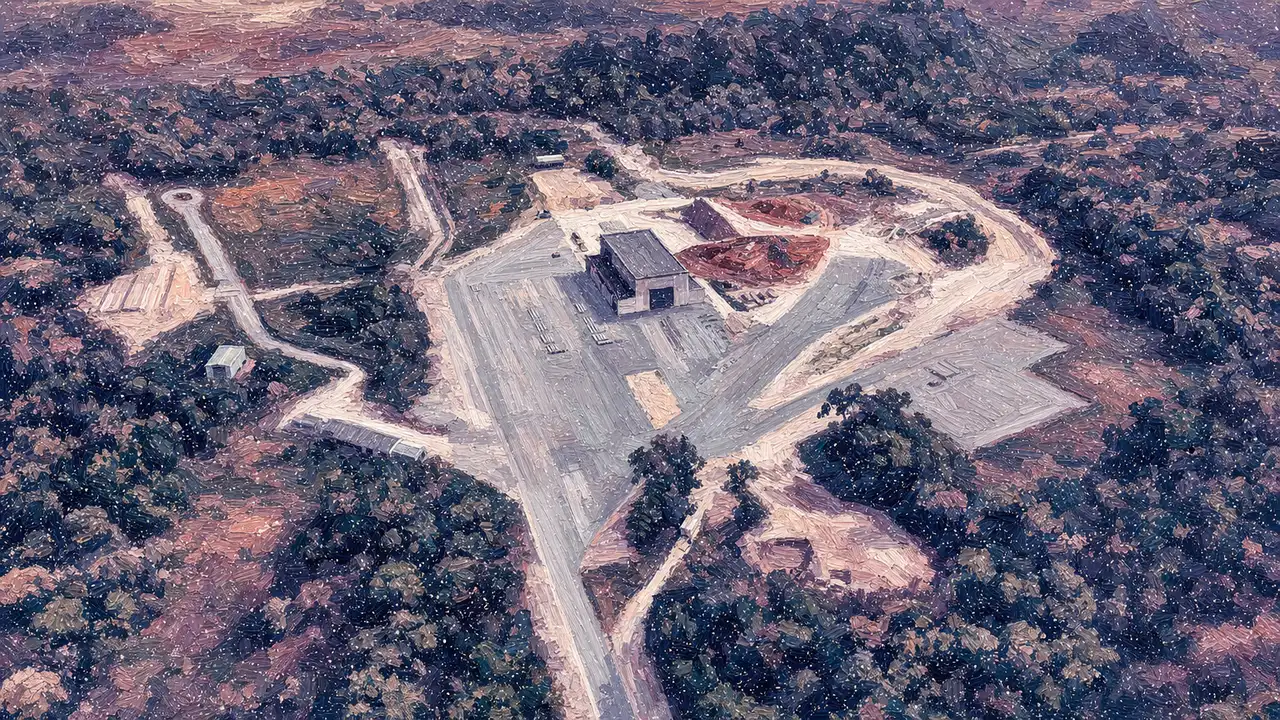
Guiana Space Centre: Europe’s spaceport in French Guiana
The Guiana Space Centre (Centre spatial guyanais, CSG) is the launch base near Kourou and Sinnamary in French Guiana, an overseas region of France on the north coast of South America. It covers about 660 km² along the coast and has launched every Ariane rocket, every Vega and, from 2011 to 2022, the European Soyuz. The French space agency CNES owns the land, runs range safety and keeps the base going, while French troops guard it during launch campaigns.
ESA owns the launch pads of its own rockets: Ariane 6 flies from the ELA-4 complex and Vega C from the ELV complex. Arianespace sells and flies Ariane 6, and Avio does the same for Vega C. An agreement that France and ESA adopted in July 2025 covers the base up to 2035, and a new ESA and CNES contract worth over EUR 1 billion pays for running it from 2026.
For NewSpace companies, CNES is turning two old sites into pads for private rockets: the 1970s Diamant site, now called ELM-Diamant, and the former Soyuz complex, now ELM2. ELM stands for Ensemble de Lancement Multi-lanceurs, a launch complex shared by several rocket companies. CNES says these pads will help the base grow from about 10 launches a year to 40 or more.
History of the Guiana Space Centre
Leaving the Sahara: Diamant and the first launches (1964 – 1975)
France launched its first rockets from Hammaguir in the Algerian Sahara. After Algeria became independent in 1962, CNES had five years to leave and studied 14 other sites, from Gabon to Brazil, before France picked French Guiana. The agreement creating the Guiana Space Centre was signed on April 14th, 1964, and the first rocket, a Véronique sounding rocket, lifted off on April 9th, 1968.
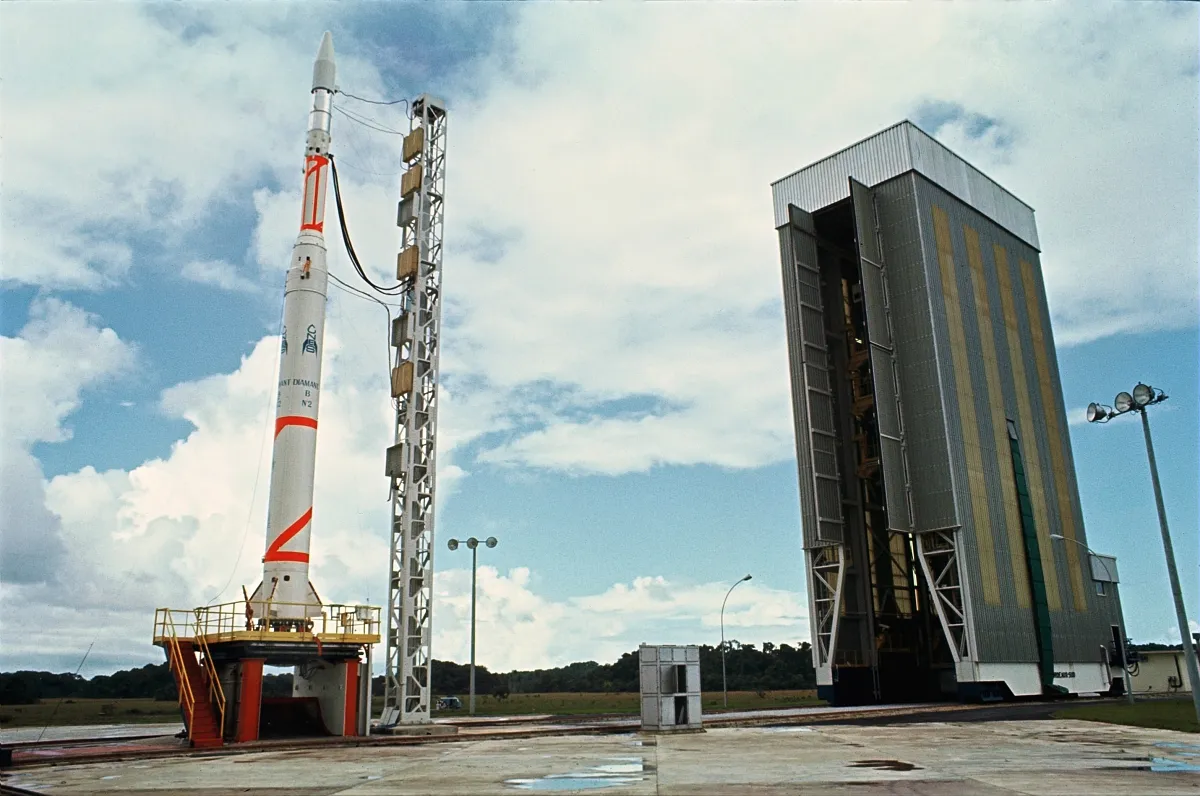
On November 26th, 1965 a Diamant rocket launched from Hammaguir had made France the third country to put a satellite into orbit. Work on the Diamant site in Kourou began in January 1968 and ended in August 1969, and the first Diamant flew from there on March 10th, 1970. According to CNES, the launch went ahead despite a red weather warning because of political pressure to show results. Diamant flew 12 times in all, eight of them from Kourou, before France stopped the programme in 1975 in favour of the European Ariane.
Ariane, Soyuz and Vega (1979 – 2022)
Ariane 1 first flew from Kourou on December 24th, 1979. Ariane 5 followed in 1996 and flew 117 times before its last launch on July 5th, 2023. The small Vega rocket was added in 2012, and in 2011 a Russian Soyuz began flying from its own complex near Sinnamary. ESA budgeted EUR 344 million (in 2002 prices) for the Soyuz complex and promised a first launch in spring 2009 and two to four flights a year. By 2010 the cost had risen to EUR 467.9 million, the first launch came on October 21st, 2011, and Soyuz flew 27 times before Russia withdrew its staff in February 2022.
From 2015 to 2018 the base hosted 11 orbital launches a year. The number then fell to 9 in 2019, 7 in 2020 and 2021 and 6 in 2022. A general strike in French Guiana stopped work for over a month in the spring of 2017, and two Vega failures in 2019 and 2020 grounded the rocket for months each time.
The launch gap (2023 – 2024)
Vega C failed on its second flight on December 21st, 2022 and did not fly again until December 5th, 2024, 715 days later. Ariane 5 retired in July 2023 before Ariane 6 was ready, and the base hosted 3 launches that year against the 5 that CNES had forecast in April 2022. No rocket of any kind left Kourou for 274 days, from October 9th, 2023 to July 9th, 2024. ESA sent the Euclid telescope, four Galileo satellites and the EarthCARE satellite up on SpaceX’s Falcon 9 instead.
Ariane 6, Vega C and new tenants (2024 – 2026)
Ariane 6 first flew on July 9th, 2024 and reached orbit, but a power unit on its upper stage failed and the stage did not make its last burn. ESA had ordered it in 2015 for a first flight in 2020, and its pad, ELA-4, was due in 2019 and opened in September 2021. Arianespace and CNES planned 9 launches for 2025 and 7 flew, and by October 7th the base had hosted 6 launches in 2026.
The small-launcher plans moved in the same years. CNES signed a development contract with PLD Space in June 2025 and laid the first stone of the ELM-Diamant complex on September 17th, 2025. In April 2026 it picked Sirius Space Services for a free slot, and the old Soyuz complex, handed back to CNES in September 2024, went to MaiaSpace.
ELM-Diamant and ELM2: Kourou’s pads for small rockets
From the call to the first stone (2021 – 2025)
CNES opened a call for small-launcher companies at the end of 2021, together with ESA and ArianeGroup. On July 25th, 2022 it named seven: Avio, HyImpulse, Isar Aerospace, MaiaSpace, PLD Space, Rocket Factory Augsburg and Latitude. CNES later took Avio and HyImpulse off the list without giving a reason. Isar signed a binding term sheet with CNES in June 2022, a month before the list came out, followed by RFA in March 2023 and PLD Space in June 2023.
In October 2022 the French government said the shared facilities would be finished in 2024, the year of the first small-launcher flights. France 2030 put EUR 50 million into roads, power, water, fibre, liquid oxygen storage and a shared launch centre, and each company builds its own pad. The public inquiry ran in February and March 2025, the permit came in May 2025 and building started that summer. CNES laid the first stone on September 17th, 2025 and said the complex would be fully working in 2026, with a first launch the same year.
On June 18th, 2026 CNES said it had spent “several tens of millions of euros” on ELM and ELM2 and expected the first flight by the end of the year. That flight was PLD Space’s, and PLD now plans it for the first half of 2027. On the same day CNES named Sirius Space Services, a French start-up, as the fifth tenant, for the slot MaiaSpace left at the end of 2025. CNES has warned that more slots can open if companies with term sheets do not move on to development contracts.
The tenants and their promises
| Company | Rocket | Pad | What it signed with CNES | First Kourou launch promised | Status on October 7th, 2026 |
|---|---|---|---|---|---|
| PLD Space (Spain) | MIURA 5 | ELM-Diamant | Term sheet June 2023, development contract June 17th, 2025 | “In 2024” (2021 and 2022), late 2025 (2024), 2026 (2025), June 2026 (March 2026) | First flight planned for the first half of 2027. EUR 35 million of its own money put into the pad. Second pad under study since October 1st, 2026 |
| Isar Aerospace (Germany) | Spectrum | ELM-Diamant | Term sheet June 2022 | “From 2024 onwards” (2022). A 2025 Isar paper says the pad will be available “from 2027” | No development contract. Isar flies from Andøya in Norway |
| Rocket Factory Augsburg (Germany) | RFA One | ELM-Diamant | Term sheet March 2023 | “Starting in 2025” (2023) | No development contract and no new date. RFA plans its first launch from SaxaVord |
| Latitude (France) | Launcher (formerly Zephyr) | ELM-Diamant | Feasibility pre-contract | First demonstration “from end 2026 from ELM” (2024) | First flight moved to Etlaq in Oman, planned for late 2027. Kourou works paused in July 2026 |
| Sirius Space Services (France) | Sirius 1, later Sirius 13 | ELM-Diamant | Picked April 23rd, 2026 | “March 2025” (2022) | First flight planned for late 2027 or early 2028. Needs about EUR 50 million more |
| MaiaSpace (France) | Maia | ELM2 (old Soyuz pad) | Picked September 2024, occupancy agreement February 2026 | Late 2025 (2024) | First flight planned for the second half of 2027 |
| Callisto (CNES, DLR, JAXA) | Reusable test stage | Diamant area | Agency project | Late 2020 (2018) | Test flights planned for 2027 |
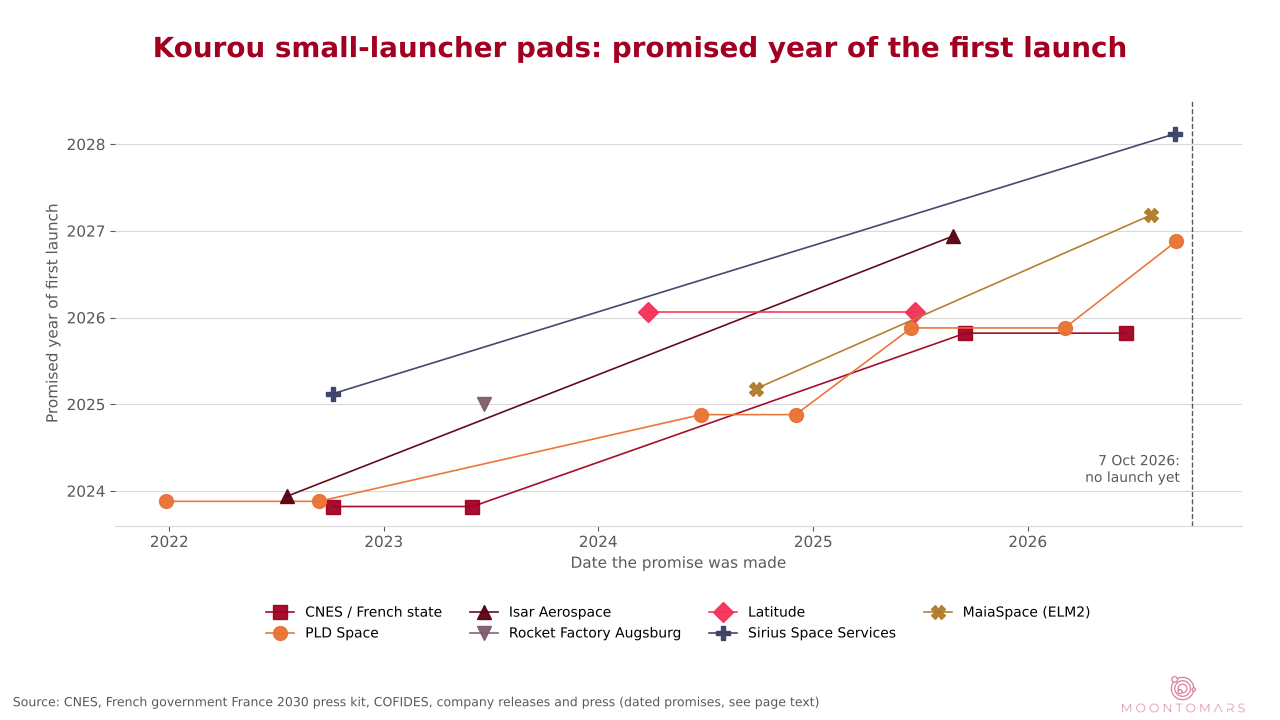
What the company registers show
The French company register shows how far each tenant has come in French Guiana. MaiaSpace has had an office at the old Soyuz pad in Sinnamary since October 2025. PLD Space runs two French companies from a university incubator in Cayenne. One of them opened a site at “ELM Site Diamant” in Kourou on September 1st, 2026, and the register already lists it as closed. Isar’s French company has one or two staff near Paris, and we found no French company for RFA and no site in French Guiana for Latitude or Sirius.
Launches from Kourou: promised and delivered
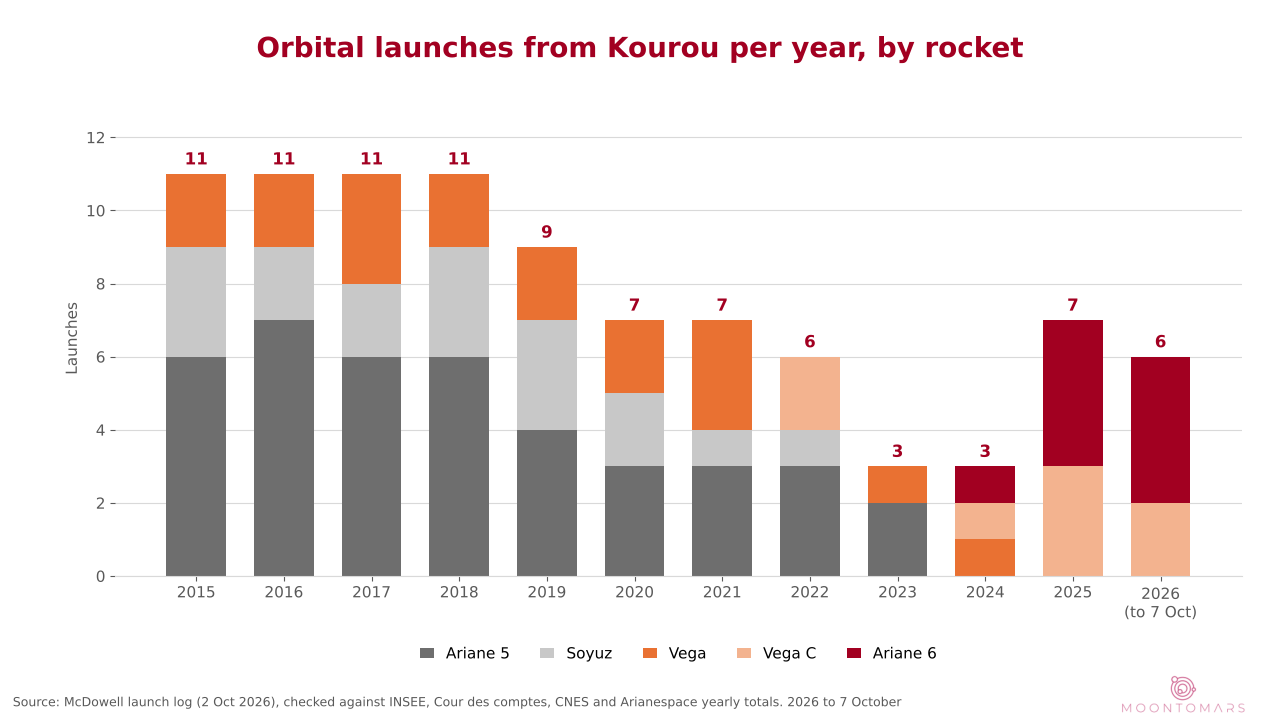
Kourou hosted 92 orbital launches from January 2015 to October 7th, 2026, with 3 failures and 2 partial successes. Up to 2018 it averaged 11 a year, and then the number dropped every year to 3 in 2023 and 3 in 2024. France’s audit court wrote in 2023 that the fall started before the war in Ukraine and was made worse by it.
Plans have run ahead of launches for years: CNES forecast 5 launches for 2023 and the base hosted 3, and Arianespace planned 9 for 2025 and flew 7. For 2026 it planned six to eight Ariane 6 flights, and four had flown by early October. CNES now wants to cut the time between two launches from 8 days to 5 and to grow from about 10 launches a year to 40 or more.
Earlier targets moved in the same way: in the early 2020s CNES aimed to cut the time between launches from 11 days to 2, against 8 to 5 days now. ESA promised in 2020 that renewables would cover 90% of the base’s power by the end of 2025, and the target is now 2030. A new operations centre, due at the end of 2026, is now planned for 2027.
Who pays for the Guiana Space Centre
ESA says it pays two thirds of the base’s yearly budget, with France paying the rest through CNES. France’s audit court looked at the full bill in 2019 and found that France bore 84% of the base’s costs. The shared budget leaves out security and much of the upkeep, and France pays the largest share of ESA’s launcher programmes. Its 2023 report put France’s share of the CSG budget at about 55%.
Some costs sit outside every budget split: the French armed forces guard the base under operation TITAN, at a cost of EUR 37 million a year in 2021. France also carries all third-party liability for Ariane launches. In April 2026 ESA and CNES signed a new contract worth over EUR 1 billion to run the base from 2026, with ESA paying EUR 635 million.
The audit court also found that CNES lost EUR 18.9 million from 2019 to 2022 on its launch-support contract, which it had priced for 11 launches a year. In the same years CNES waived EUR 25.7 million of late-delivery penalties owed by its suppliers. The court wrote in 2023 that the small-launcher project, paid for by France alone, cannot make up for the work the base loses as Ariane 5 gives way to Ariane 6.
Public money at the Guiana Space Centre, promised and delivered
| Item | Public money | Promised | Delivered by October 7th, 2026 |
|---|---|---|---|
| Soyuz complex and rocket changes | EUR 344 million (2003, in 2002 prices) | First launch in spring 2009, two to four flights a year | EUR 467.9 million by 2010. First launch October 21st, 2011, 27 flights until February 2022 |
| Ariane 6 rocket | EUR 2.4 billion (ESA, 2015) | First flight in 2020 | First flight July 9th, 2024, partial success |
| ELA-4, the Ariane 6 pad | EUR 600 million (ESA, 2015) | Works from mid-2015 to mid-2019 | Opened September 2021. The audit court notes a “substantial increase” in the contract and gives no final cost |
| French top-up for Ariane 6 | EUR 165 million (France Relance, 2020 – 2021) | To cover Ariane 6 cost overruns | Paid |
| CSG-NG modernisation | EUR 140 million (ESA, 2019) | Work from 2020 to 2024, 90% renewable power by the end of 2025, a launch every two days | Still running in 2026. Operations centre due in 2027, renewables target moved to 2030 |
| ESA and CNES operating contract | Over EUR 1 billion, ESA EUR 635 million (April 2026) | Running the base from 2026 | Running. EUR 59 million for small-launcher safety and payload work put off to ESA’s 2028 ministerial |
| ELM-Diamant shared facilities | EUR 50 million (France 2030) | Ready in 2024 with the first small-launcher flights | Building since summer 2025, no launch |
| Small-launcher demonstration contracts | Not published per company (France 2030, 2024) | Latitude from ELM by the end of 2026, Sirius and MaiaSpace by the end of 2027 | No flight. Latitude moved its first flight to Oman |
| Military protection (operation TITAN) | EUR 37 million a year (2021) | (none) | Paid by France each year |
| CNES launch-support contract | EUR 18.9 million lost (2019 – 2022) | Priced for 11 launches a year | 9, 7, 7 and 6 launches |
| Late-delivery penalties | EUR 25.7 million waived by CNES (2018 – 2021) | (none) | Not collected |
How Kourou compares: Florida, China’s Hainan and Rocket Lab
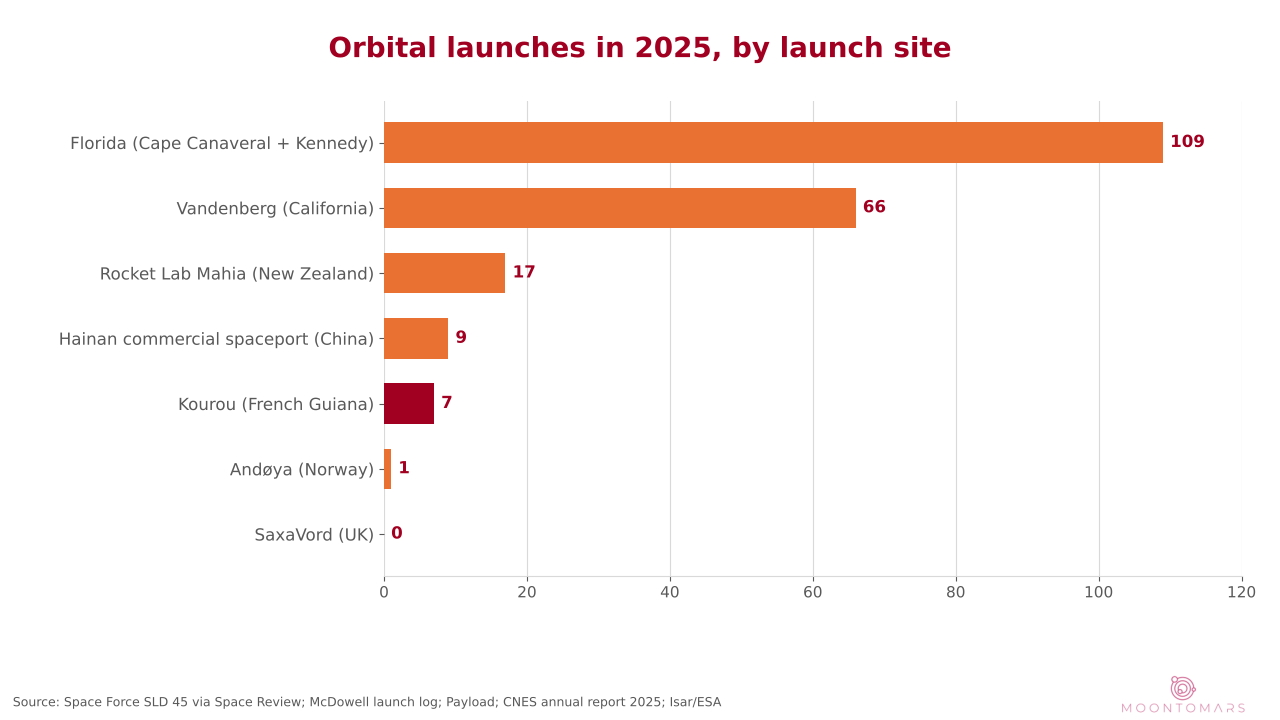
In 2025 Florida’s two launch sites hosted 109 orbital launches and Vandenberg in California 66, most of them SpaceX Falcon 9 flights. Rocket Lab flew 17 times from its own site at Mahia in New Zealand. China launched 92 times from all its sites, and its new Hainan commercial spaceport hosted 9 of those in its first full year, two more than Kourou.
The Hainan site is the closest match to Kourou, because it is also a state project. It is owned by the Hainan provincial government and Chinese state companies, which put over CNY 4 billion into it. Building started in July 2022, its first pad was ready in June 2024 and the first rocket left it on November 30th, 2024, about 29 months later. By October 2nd, 2026 it had hosted 23 launches from two pads.
| Launch site | Owner | Start of work | First launch | Months to first launch |
|---|---|---|---|---|
| ELM-Diamant, Kourou | CNES (French state) | Call December 2021, earthworks 2022 | None by October 7th, 2026 | 58 since the call, and counting |
| Hainan commercial spaceport, China | Hainan province and Chinese state companies | July 2022 | November 30th, 2024 | About 29 |
| Rocket Lab Launch Complex 1, New Zealand | Rocket Lab (private) | December 2015 | May 25th, 2017 | About 17 |
| Rocket Lab Launch Complex 2, Virginia, USA | Rocket Lab, on a NASA range | February 2019 | January 24th, 2023 | About 47, of which over two years waiting for NASA flight-safety software |
| Andøya, Isar Aerospace pad, Norway | Andøya Space (Norwegian state) | Pad agreement April 2021 | March 30th, 2025 | About 47 |
| Diamant, Kourou, the first time | CNES | January 1968 | March 10th, 1970 | 26 |
Slow ranges exist in the United States too: Rocket Lab built its pad in Virginia in 10 months and then waited more than two years for NASA’s software before the first launch. In Europe, Andøya is the fastest case so far: about four years from Isar’s pad agreement to its first launch in March 2025, and orbit in September 2026.
What the equator is worth
Kourou’s position 5° north of the equator gives a rocket going east about 460 m/s of free speed from the Earth’s spin. A French Senate report put the gain at about 17% more payload to geostationary orbit than from Cape Canaveral, which is why Ariane flies from here. Most small rockets aim for sun-synchronous orbits that pass over the poles, and those launches head slightly west of north, where the Earth’s spin helps no site. We estimate that a small rocket going to such an orbit needs about 13 m/s more from Kourou than from Andøya, under 0.2% of what it takes to reach orbit.
Working at the Guiana Space Centre: jobs and the local economy
About 1,600 people work on the base for more than 40 companies, and CNES itself had 254 staff in Kourou at the end of 2025. France’s statistics office INSEE counted about 4,500 jobs in French Guiana linked to space in 2019, one in six private-sector jobs. Space made up 12.6% of the region’s economy that year, down from 28% in 1990, and 83% of its exports.
The switch from Ariane 5 to Ariane 6 was expected to cut about 300 of the 1,600 full-time jobs on the base, according to the audit court. The new tenants promise some back: PLD Space speaks of 56 local jobs by 2030 and Sirius of about 30. We found no published pay scales for jobs at the base.
My opinion on the Guiana Space Centre and why you should keep an eye on it
What I like about the Guiana Space Centre
- The site: Kourou can reach every orbit from one coast, and for geostationary missions it beats Florida by about 17% in payload.
- Room for newcomers: CNES opened its oldest pad to private companies, picked tenants through an open call and gave a freed slot to Sirius in 2026.
- PLD’s money on the ground: PLD Space has put EUR 35 million of its own into its Kourou pad and is studying a second one.
- Flying again: After 3 launches in 2023 and 3 in 2024, the base hosted 7 in 2025 with Ariane 6 and Vega C.
What I don’t like about the Guiana Space Centre
- Dates that slide: The state promised the first small-launcher flight for 2024. Almost five years after the call, the shared facilities are not finished and no small rocket has flown.
- Slots on paper: Isar and RFA signed term sheets in 2022 and 2023 and have no development contract. Isar still advertises launches from Kourou “from 2024 onwards”.
- Who pays: ESA calls the base two-thirds European. France’s audit court found that France pays most of it, plus EUR 37 million a year for troops.
- Old-space speed: Ariane 6 came four years late. Soyuz came two and a half years late and 36% over budget. The new operations centre slipped from 2026 to 2027.
- Slow next to China: A state-owned Chinese site was built and flying in about 29 months. CNES built the first Diamant site in 1968 – 1970 in 26.
Things to watch out for
- PLD Space’s first MIURA 5 flight: planned for the first half of 2027. It will be the first small-launcher flight from Kourou and the first test of the shared facilities.
- Isar and RFA: whether they sign development contracts or give up their slots. CNES has said slots can go to other companies.
- MaiaSpace on the old Soyuz pad: first flight planned for the second half of 2027.
- Ariane 6 cadence: Arianespace planned up to eight Ariane 6 flights for 2026, and four had flown by October.
- 40 launches a year: CNES’s goal for the whole base. Let’s talk again at the end of 2027.
Where to find more information on the Guiana Space Centre
- CNES: the Guiana Space Centre (in French) and the CSG website
- CNES: the ELM multi-launcher complex (June 18th, 2026, in French)
- ESA: Europe’s Spaceport and the ESA and CNES contract (May 2026)
- Cour des comptes: launcher policy (2019, in French)
- French Senate: protecting the Guiana Space Centre (2021, in French)
- INSEE: the space industry’s weight in French Guiana (2022, in French)
- Jonathan McDowell’s launch log, the data behind our launch charts
Updates on the Guiana Space Centre
- October 2026: Page published with the status of the small-launcher complexes, the launch record from 2015 and the public money behind the base.
Structured information on the Guiana Space Centre
| Type | Information |
|---|---|
| Official name | Centre spatial guyanais (CSG), Guiana Space Centre, also called Europe’s Spaceport |
| Location | Kourou and Sinnamary, French Guiana, France |
| Area | About 660 km² |
| Latitude | 5° north |
| Owner and operator | Centre national d’études spatiales (CNES), the French space agency (SIREN 775665912) |
| Director | Philippe Lier |
| Founded | April 14th, 1964 |
| First launch | April 9th, 1968 (Véronique sounding rocket). First satellite launch March 10th, 1970 (Diamant) |
| Launch complexes | ELA-4 (Ariane 6, ESA), ELV (Vega C, ESA), ELM-Diamant (small launchers, CNES), ELM2 (MaiaSpace, CNES), ELA-3 (Ariane 5, retired 2023) |
| Launches | 7 in 2025, 6 in 2026 up to October 7th |
| Small-launcher tenants | PLD Space, Isar Aerospace, Rocket Factory Augsburg, Latitude, Sirius Space Services (ELM-Diamant), MaiaSpace (ELM2) |
| Staff | About 1,600 people on the base, 254 CNES employees (end of 2025) |
| Website | centrespatialguyanais.cnes.fr |
Interested in more space? Read our other reviews and analysis
Kourou’s tenants have their own pages: PLD Space, Isar Aerospace, Rocket Factory Augsburg, Latitude and MaiaSpace. So do Europe’s other launch sites: Andøya Space Center, SaxaVord Spaceport, Esrange Space Center, Space Hub Sutherland, German Offshore Spaceport Alliance and Etlaq Spaceport. Read how ESA pays for private launches in our European Launcher Challenge analysis, and see every site on our European Space Map.
- HyImpulse Technologies
 HyImpulse Technologies builds hybrid paraffin/LOX rockets. SR75-1 flew from Koonibba on 3 May 2024; a UK CAA licence covers SaxaVord for spring 2027. Series A and a Series A Extension above EUR 50 million equity arrived in 2025–26. SL1 targets 600 kg to LEO; HyMOVE is a separate OTV.
 - Andøya Space Center
 Andøya Space Center is a spaceport in northern Norway. Spectrum reached orbit from Andøya on 5 September 2026. Pad 1 is operational and Isar-exclusive; Pad 2 is proposed. Operator Andøya Space AS is 90% Norwegian state and 10% Kongsberg.
 - SkyroraSkyrora is a Scottish new space company developing the Skyrora XL, a three-stage rocket for up to 315 kg to orbit. Our 2026 analysis covers its owners, accounts, public money and launch plans.
- OrbexOrbex (Orbital Express Launch Ltd): UK microlauncher Prime, 180 kg LEO. In administration since 18 February 2026 after GBP 138.5m raised (GBP 76.7m public). Zero launches. Omnidea bought the Forres assets.
- LatitudeLatitude (formerly Venture Orbital Systems) is a French NewSpace company developing a LOX/RP-1 microlauncher (formerly Zephyr). As of October 2026 it has not flown; Series B raised EUR 27 million; an Etlaq Oman LoI targets an experimental late-2027 inaugural that we treat as optimistic. In-depth analysis on moontomars.space.