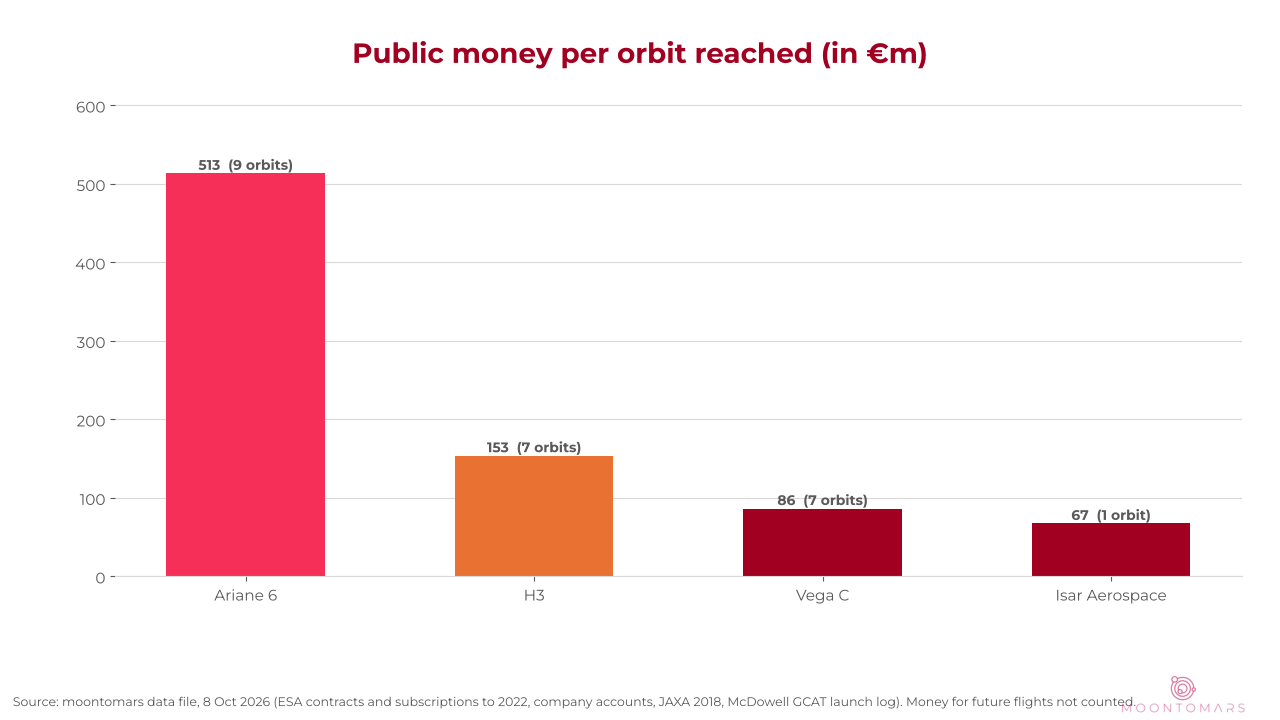

Public money per orbit reached
Public money a rocket has received or been granted, divided by the number of its flights that reached orbit. Money set aside for flights that have not happened yet is shown apart. Figures as of 8 October 2026.
€293m
to European launch firms that have never reached orbit, plus €346m in contracts for future launches
€513m
Ariane 6, per flight to orbit, nine flights since July 2024
€86m
Vega C, per flight to orbit, seven of them
€67m
Isar Aerospace, one orbit, 5 September 2026
Rockets that have reached orbit
For scale: Falcon 9 cost €268m to develop and has reached orbit 678 times, €0.4m of development money per orbit. Part of that money was public: NASA paid USD 396m under its COTS programme for Falcon 9 and the Dragon capsule together, and no split for the rocket alone exists.
Public money, no orbit yet
Firms that have taken public money and have not put anything in orbit. Orbex is in administration since 18 February 2026.
Esrange has had €99m of public money for its launch site since 2018 and has launched nothing into orbit.
How we count
Public money is money from the state: grants, awards, state loans and public development contracts. Equity from state-owned funds sits with the shareholder money and is not counted here. No agency publishes what it has paid out to date, so these are sums granted or signed, not payments.
Money for future flights is left out of the per-orbit figures: the European Launcher Challenge contracts of 27 August 2026, which pay against launches (Isar Aerospace €197.8m, Rocket Factory Augsburg €186.9m, PLD Space €158.9m), and ESA support for Ariane 6 and Vega C flights still to come.
H3 is Japan’s state rocket; its JPY 190bn development was all public (JAXA, 2018). Converted at the ECB rate of 8 October 2026.
An orbit is a flight that reached orbit, from Jonathan McDowell’s launch log, 7 October 2026.
Ariane 6: €4,618m from the 2015 development and pad contracts and the ESA subscriptions of 2019 and 2022. The 2025 subscription adds €1,952m, mostly for flights from 2026 to 2028. With it, the figure would be €730m per flight. The sums are in the prices of the year each was agreed.
Vega C: €86m per flight counts the 2015 development contract and the Vega C lines of the 2019 and 2022 subscriptions. On the development contract alone it is €56m; with ESA’s support for running the rocket it is €111m.
Sources: ESA contracts and subscription documents; company accounts and the German lobby register; the Orbex administrators’ proposals; Swedish government bills and SSC reports; Jonathan McDowell’s GCAT launch log. Every figure is on the page it comes from.