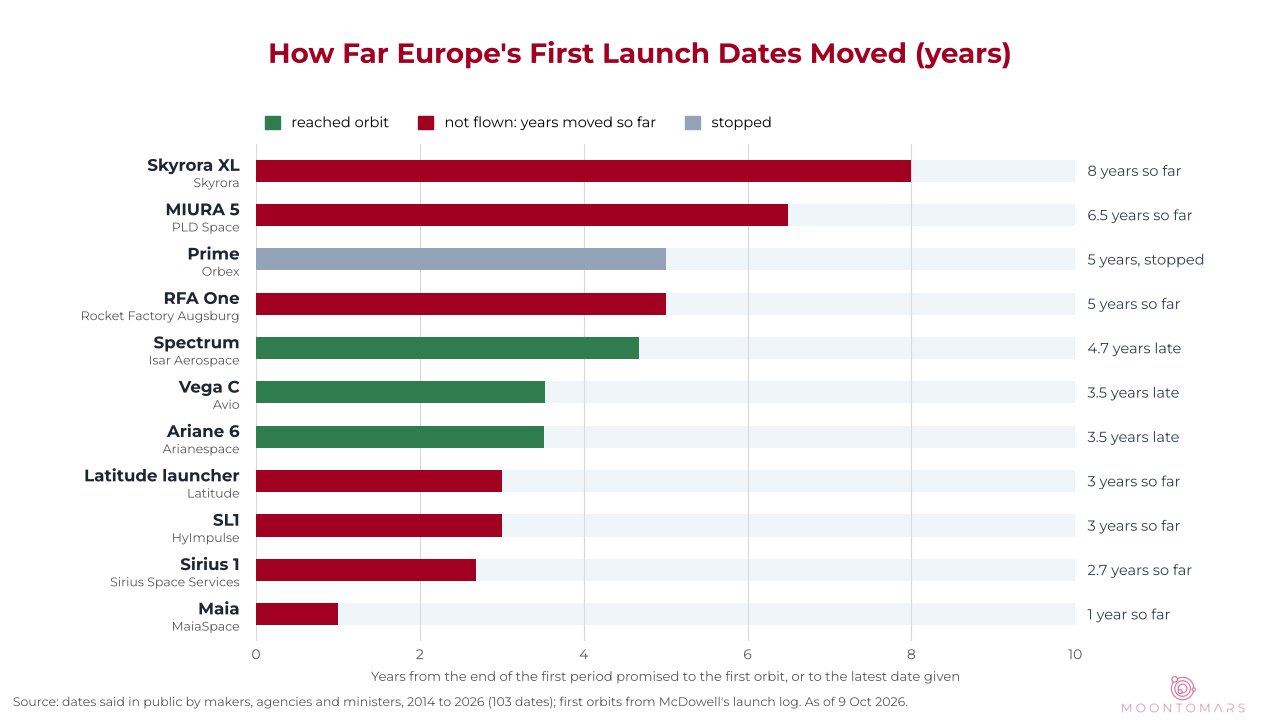

We collected every public date that Europe’s rocket makers, agencies and governments gave for a rocket’s first flight to orbit, and checked what happened next. Each small chart follows one rocket. When the line jumps up, the date moved back.
How far each first flight moved
Years from the end of the first period promised to the first orbit, or to the latest date given for rockets that have not flown.
Every date, rocket by rocket
How to read a chart
- One public date. Tap it for who gave it, when, and the source.
- Time passes and the date stands, so the line falls toward zero.
- A new, later date. The height of the jump is the delay.
- Below zero: the last date passed with no launch and no new date.
- First orbit. A grey ring is a first launch that failed.
- Today, for a rocket that has not flown: the date it has now is still ahead.
- The company stopped, or the last date passed with no new one.
All dates and sources
| Date given on | Given by | Launch date given | Years away | Source |
|---|
How we count
We read each date as the last day of the period given. “2024” means by 31 December 2024, and “late 2021” means by 31 December 2021. This is the most generous reading for each company. “Years away” is that day minus the day the date was given.
Only dates for the first flight to orbit count. We leave out dates for suborbital tests, test vehicles and the first commercial flight, and planning notes with no date. For MIURA 5 the list starts with Arion 2, the earlier name of the same orbital rocket.
Flight dates come from Jonathan McDowell’s launch log and the agencies’ own reports. Promised dates come from company press releases and annual accounts, ESA, CNES, DLR, the UK government, the Orbex administrators’ report and named press (European Spaceflight, Shetland News, SpaceNews, Reuters, Payload, AFP).