

Welcome to our in-depth analysis of the Santa Maria Spaceport in the Azores, first published October 8th, 2026. Make sure to check out our mission statement and why we do what we do. Look at our New Space guide if you want explanations of terms and concepts used in our research. And follow us on X for updates.
October 2026 status: licensed, nothing launched to space
- Launches: No rocket has reached space from Santa Maria as of October 7th, 2026. The highest flight so far reached 5,596 metres: a 3.35-metre GAMA rocket that the site operator launched itself on September 26th, 2024. Four more small rockets followed in August 2026, in what the operator called its first commercial campaign, without naming the customer or the altitude.
- Licence: ANACOM, Portugal’s space authority, licensed the Atlantic Spaceport Consortium (ASC) to run the Malbusca Launch Centre on August 13th, 2025, for five years. The licence covers the site only, and every launch needs a licence of its own.
- Customers: The first booked flight, a Perun suborbital rocket from Polish SpaceForest promised for spring 2026, has not happened, and SpaceForest says the site and date of its next flight are still open. Korean Innospace signed up in January 2026 for an orbital launch at the end of 2026, but its rocket failed in Brazil in December 2025 and its next attempt is now planned for the first half of 2027.
- Money: ASC is a private company with EUR 10,000 of share capital and no announced investment round, and the government’s approval says the state takes on no financial commitment for the site. Separately, Portugal and ESA committed EUR 15 million in November 2025 to a landing hub for ESA’s Space Rider on the island, and the Air Force plans its own launch base with about EUR 15 million of EU recovery money. Neither had started building in the latest reports (June and September 2026).
- Site: One concrete slab with a mobile launch rail on the south coast of the island, and since June 2026 an office in a former primary school. In 2018 the government had promised the first launches from the Azores for 2021.
What you should know about the Santa Maria Spaceport
📰 For space enthusiasts
- Portugal’s only licensed launch site, at Malbusca on Santa Maria, the southernmost island of the Azores, at about 37° North
- No flight to space yet (October 2026). Highest flight 5,596 metres (GAMA, September 2024)
- Three launch corridors planned: polar and sun-synchronous orbits to the south, lower inclinations to the south-east
- Rockets with up to 1,500 kg of payload planned, with no cryogenic fuel at first (ASC)
- Landing site for ESA’s Space Rider, first landing planned for 2028
- Neighbours: an ESA tracking station, the Portugal Space headquarters and the oceanic air traffic control centre
💰 For VCs and industry experts
- Operator: Atlantic Spaceport Consortium, Lda (ASC), EUR 10,000 share capital, owned by Ilex Space and Optimal Structural Solutions
- No investment round announced. ASC puts the cost of the site at EUR 5 – 10 million, to be raised from private investors
- No financial commitment by the state for the site (government approval, July 2025)
- 2018 government promise: launches by 2021 and up to EUR 10 million a year in grants. Never paid out
- New public money on the island: EUR 15 million for an ESA landing hub (2025), about EUR 15 million for an Air Force launch base (PRR)
- Customers: SpaceForest (one suborbital flight), Innospace (agreement to 2030). Neither has flown from Santa Maria
👨💻 For potential employees
- 2 – 10 employees at ASC, by the company’s own LinkedIn listing (October 2026)
- Launch campaign work on Santa Maria (range safety, recovery at sea), office in Vila do Porto
- Other space jobs on the island: Portugal Space headquarters, the ESA tracking station and the teleport
- No job ads on the ASC website in October 2026
- Portuguese is the working language on the island. ASC publishes in English and Portuguese
Santa Maria Spaceport: Portugal’s launch site in the middle of the Atlantic
The Santa Maria Spaceport is a small launch site at Malbusca on the south coast of Santa Maria, the southernmost island of the Azores, about 1,500 km west of Lisbon. It is run by the Atlantic Spaceport Consortium, Lda (ASC), a private Portuguese company founded in 2020, and since August 2025 it has held the first and only licence to operate a launch centre in Portugal.
The idea is much older than the company. The Portuguese government and the Azores regional government started planning a spaceport on Santa Maria in 2017, promised launches for 2021 and ran two tenders that both failed. What stands at Malbusca today is a concrete slab, a mobile launch rail and an office in a former school, and the highest flight from it reached 5.6 km.
Why Santa Maria? An island with an airport, an antenna and a space agency (2008 – 2019)
Santa Maria has about the same latitude as Seville and sits alone in the Atlantic, so rockets can fly south over open sea towards polar and sun-synchronous orbits without passing over other countries. The island already had the space and aviation basics: a long runway, the oceanic air traffic control centre for a large part of the North Atlantic, and an ESA tracking station that has followed Ariane launches since 2008.
In 2017 the government asked the University of Texas at Austin to study where a spaceport in the Azores could go, and the study picked Malbusca. In March 2019 Portugal founded its space agency, Portugal Space, and gave it its headquarters on Santa Maria. The Azores regional government later paid about EUR 1.3 million to restore an old airport building for it, which opened in November 2024.
The government’s spaceport: launches promised for 2021 (2018 – 2021)
In September 2018 the government launched the “Atlantic International Satellite Launch Programme” with ESA’s technical help. The call document offered R&D grants of up to EUR 10 million a year, about EUR 6 million of infrastructure in 2019 and 2020, and the state as an anchor customer. The first launch services were to start “from Azores by 2021”.
Fourteen groups answered by October 2018, among them ArianeGroup (now the owner of MaiaSpace), Avio, Roscosmos, PLD Space, Isar Aerospace and Rocket Factory Augsburg. The plan foresaw a contract in spring 2019. The Azores regional government then ran the tender as a concession, and only two bids came in by January 2021: “RFA Azores” (RFA with the Portuguese firm Edisoft) and the Atlantic Spaceport Consortium.
In April 2021 the jury excluded both. According to ASC, the jury had first proposed to award the concession to ASC and then reversed itself. None of the grants, infrastructure money or launch purchases from the 2018 call were ever paid out.
No tender, no impact study (2021 – 2024)
A second, restricted tender was announced in March 2022. In April 2022 the regional government said an environmental impact study and an economic study would be needed first, and that the tender would slip to the end of the year. It never came. In December 2022 the regional government said suborbital flights would start in October 2023, and in September 2023 the science minister said by the end of 2023.
What came instead was a new law. In February 2024 Portugal changed its space law so that a private company could apply for a licence to run a launch centre, and ANACOM added the detailed rules in October 2024. In May 2024 Portugal Space said it had already rented the land at Malbusca.
A private licence and the first small rockets (2024 – 2026)
ASC did not wait for the licence. On September 26th, 2024 it launched a 3.35-metre, 23 kg rocket called GAMA from a mobile platform at Malbusca, built with a student team from Lisbon’s Instituto Superior Técnico and support from Portugal Space and ESA. It reached 5,596 metres, and a second GAMA flew two days later.
ASC applied for the launch centre licence in December 2024. Two ministers gave their prior approval in July 2025, and ANACOM issued the licence on August 13th, 2025. The approval says in plain words that it “does not create any financial commitment” for the state, that each launch still needs its own licence, and that a protocol must give military operations priority over commercial use of the area.
From August 21st to 28th, 2026 ASC flew four more small “atmospheric” rockets out of five planned, and recovered one from the sea for the first time. ASC called it its first commercial campaign. It did not name the customer or publish the altitudes. Local opposition party Bloco de Esquerda asked under which permit the rockets flew, and we found no public answer.
The Santa Maria Spaceport: This is what you can expect
Location and orbits: south over the open Atlantic
The launch site sits at 36°55′57″ North, 25°04′12″ West, on a meadow above the cliffs of the south coast, close to the hamlet of Malbusca in the parish of Santo Espírito. ASC plans three launch corridors: polar and sun-synchronous orbits to the south, and a lower-inclination corridor to the south-east towards Madeira. The whole flight path stays inside the Santa Maria flight information region, which Portugal’s air navigation service NAV controls from the same island.
For comparison, Andøya in Norway sits at 69° North and SaxaVord in Shetland at about 61° North. Santa Maria is much further south, so it can also reach lower inclinations than the northern sites, and Atlantic weather is milder than Arctic weather for launch campaigns.
What has been built, and what has not
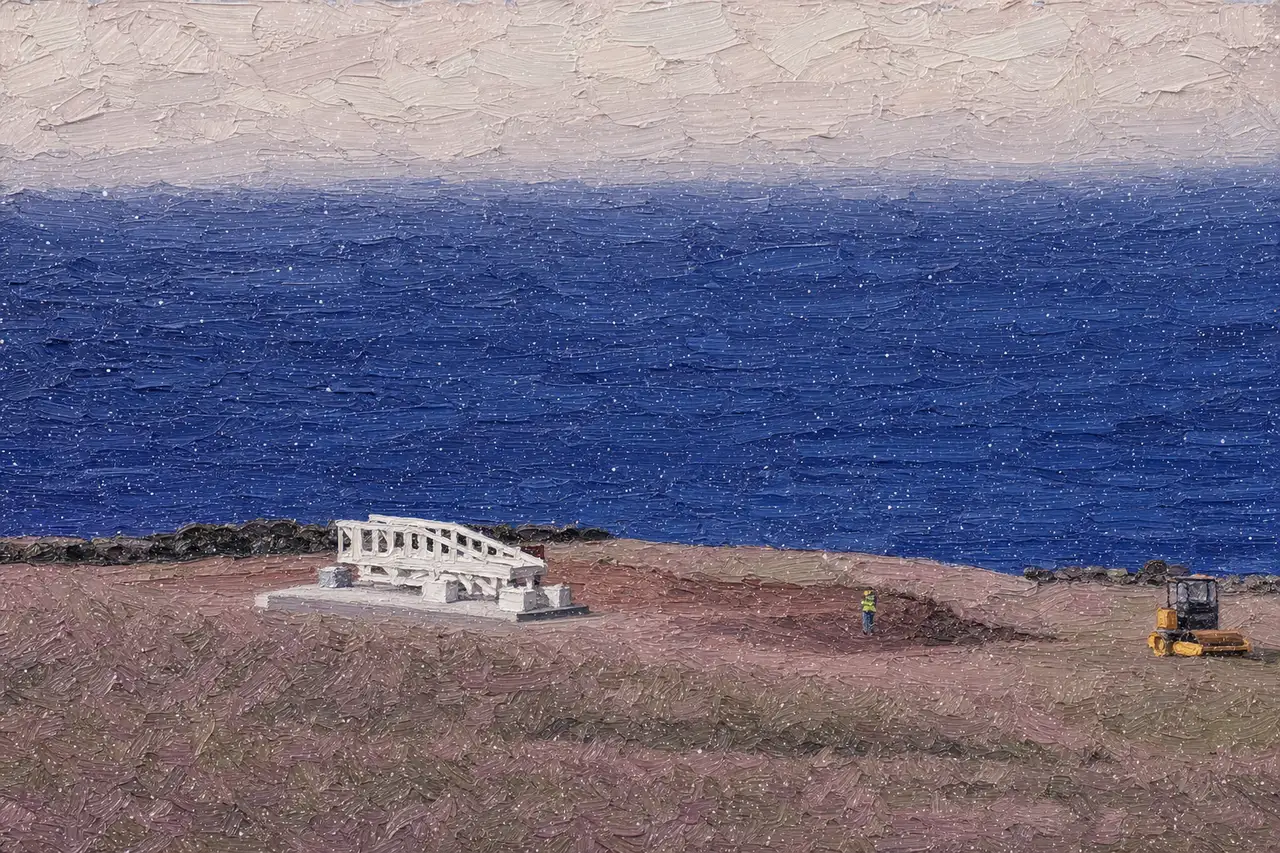
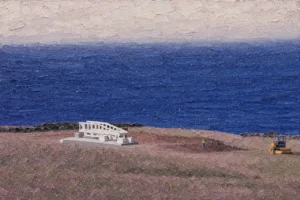
As of October 2026, Malbusca has one concrete slab of roughly 550 square metres and a mobile launch rail on a trailer, built by ASC’s owner Optimal Structural Solutions. Since June 2026 ASC also uses the former Malbusca primary school, handed over by the municipality, as its control room and office. A visit by the Portuguese tech site TEK in September 2025 described the site as “only a large concrete slab” on a big plot of land.
ASC’s plans include two orbital pads, an integration hangar, a mission control room and mobile antennas. Under its January 2026 agreement, Innospace is to build “launch pads, operations and control systems, and testing facilities” at the site step by step. We found no sign that this work has started. We also found no published environmental impact study, although the pad is about 50 metres from two protected geological sites (Calçada do Gigante and Barreiro da Piedade) and the nearest houses are about 800 metres away, according to RTP. The environmental group Amigos dos Açores told RTP in February 2026: “We have never received any environmental impact study. We have always asked for one, and nobody has ever provided it.”
The licence: a site licence, not a launch licence
ANACOM’s licence ANACOM-06/2025-AE runs from August 12th, 2025 to August 12th, 2030. It allows ASC to install, build and operate the launch centre. It does not allow any launch: every rocket operator needs its own launch licence from ANACOM, and the approval says the site licence creates no right to one. ASC also has to agree on the airspace with the civil aviation authority, and sign a protocol with the Armed Forces that gives military operations priority over the site’s commercial work. We found no public record of that protocol being signed.
Launch customers: who has flown, who has signed
| Provider | Agreement | Promised | Status (October 2026) |
|---|---|---|---|
| ASC itself (GAMA) | Own rockets, built with a student team | Atmospheric test flights, September 2024 | Flew September 26th and 28th, 2024. Highest 5,596 m |
| Undisclosed customer (“Starlight” campaign) | Commercial campaign, August 2026 | Five small atmospheric rockets | Four flew, August 21st – 28th, 2026. Customer and altitude not published |
| SpaceForest (Poland), Perun | Contract for one suborbital flight, July 2025, supported by ESA and Portugal Space | Flight to about 100 km in spring 2026, “completed by May 2026” | Not flown from Santa Maria. Flight 4 flew from Ustka, Poland, on August 27th, 2026 and was cut short by the flight termination system. Site and date of Flight 5 open |
| Innospace (South Korea), HANBIT | Contract to 2030 with priority access to a pad, January 2026 | First orbital launch from Santa Maria at the end of 2026 | HANBIT-Nano failed on its first orbital attempt in Brazil in December 2025. Next attempt planned for the first half of 2027 (under review) |
| ESA, Space Rider | Landing site, agreement November 2025 | First landing 2028 (2022 in the 2019 plan) | Spacecraft not launched yet |
HyImpulse has been named by Portuguese media as a possible user from 2027, but we found no statement from HyImpulse itself. The Portuguese group Omnidea, which bought the remains of Orbex in September 2026, says Scotland and the Azores are both options for its rocket, and that an orbital launch is more realistic in 2035 than in 2028.
Launch timeline: promised dates and what happened
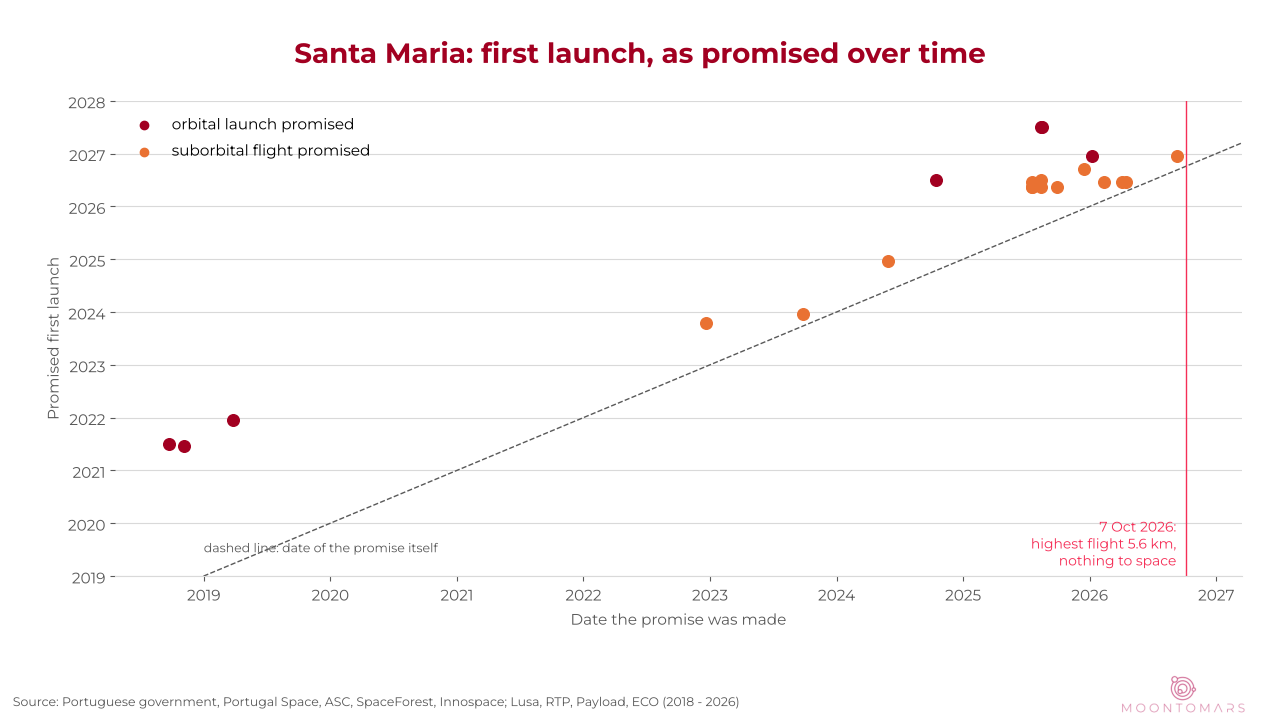
The first promise was orbital launches “by 2021”, made by the government in 2018. After the tenders failed the promises turned into suborbital flights, first for October 2023, then the end of 2023, the first half of 2024, the end of 2024, early 2025 and spring 2026. In October 2026 the only operator with a signed suborbital flight says the site and the date of its next flight are still open.
Money: who paid for what
The operator is small. ASC was set up in 2019 as a consortium of two Portuguese engineering firms, Ilex Space (Oeiras) and Optimal Structural Solutions (Cascais), and incorporated as a limited company (Lda) on September 15th, 2020 with EUR 10,000 of share capital. It has not announced any investment round. Its director Bruno Carvalho told Payload in August 2025 that the site would cost EUR 5 – 10 million and that ASC expected to raise the money from private investors, “without direct funding from ESA or the Portuguese Space Agency”. The mobile launch platform and the GAMA flights did have support from Portugal Space and ESA programmes, and ASC holds a EUR 117,985 share of a European Commission study on launch regulation (2026 – 2027).
ASC’s annual accounts are filed in Portugal, but the figures are only available as paid extracts, so we cannot report revenue, losses or staff costs here.
The public side spent its money elsewhere. Here is every amount we could trace:
| Public money | Programme and date | Promised | Delivered (October 2026) |
|---|---|---|---|
| Up to EUR 10 million a year in R&D grants, about EUR 6 million of infrastructure, state as anchor customer | Atlantic International Satellite Launch Programme, Portuguese government, September 2018 | First launches from the Azores by 2021 | Tender cancelled in April 2021. Nothing paid out |
| EUR 3.5 million | Portugal’s ESA space transportation subscription, November 2019 | Support for a public-private spaceport in the Azores | No public-private spaceport |
| About EUR 1.3 million | Azores regional government | Portugal Space headquarters in Vila do Porto | Opened November 7th, 2024 |
| EUR 275,500 | Legal, design and consulting contracts, 2019 – 2023 | Tender support, headquarters design, space strategy, launch rules | Launch rules in force since 2024. Both tenders failed |
| EUR 122,132 (ESA contract value not public) | Space Rider landing site study, subcontracts, 2023 | Landing site feasibility | Study finished July 2024 |
| EUR 15 million, of which EUR 3 million from the Azores | ESA–Portugal agreement for a Santa Maria Space Hub, November 2025 | Space Rider landing site, works by June 2026, first landing 2028 | Works moved to “after the summer”. No start reported |
| About EUR 15 million (portal: EUR 15.82 million allocated, EUR 4.02 million paid, including an Air Force satellite factory in Alverca) | EU recovery money (PRR), New Space Portugal, to June 2026 | Air Force launch base on Santa Maria, first launches “2027, end of 2028” | Land still being negotiated in May and September 2026 |
| EUR 2.4 million | ESA Boost!, October 2024, to SpaceForest | Four Perun flights, one from Santa Maria in 2026 | No flight from Santa Maria |
| EUR 0 for the site | ANACOM licence, August 2025 | Private build, EUR 5 – 10 million | One slab, mobile rail, office |
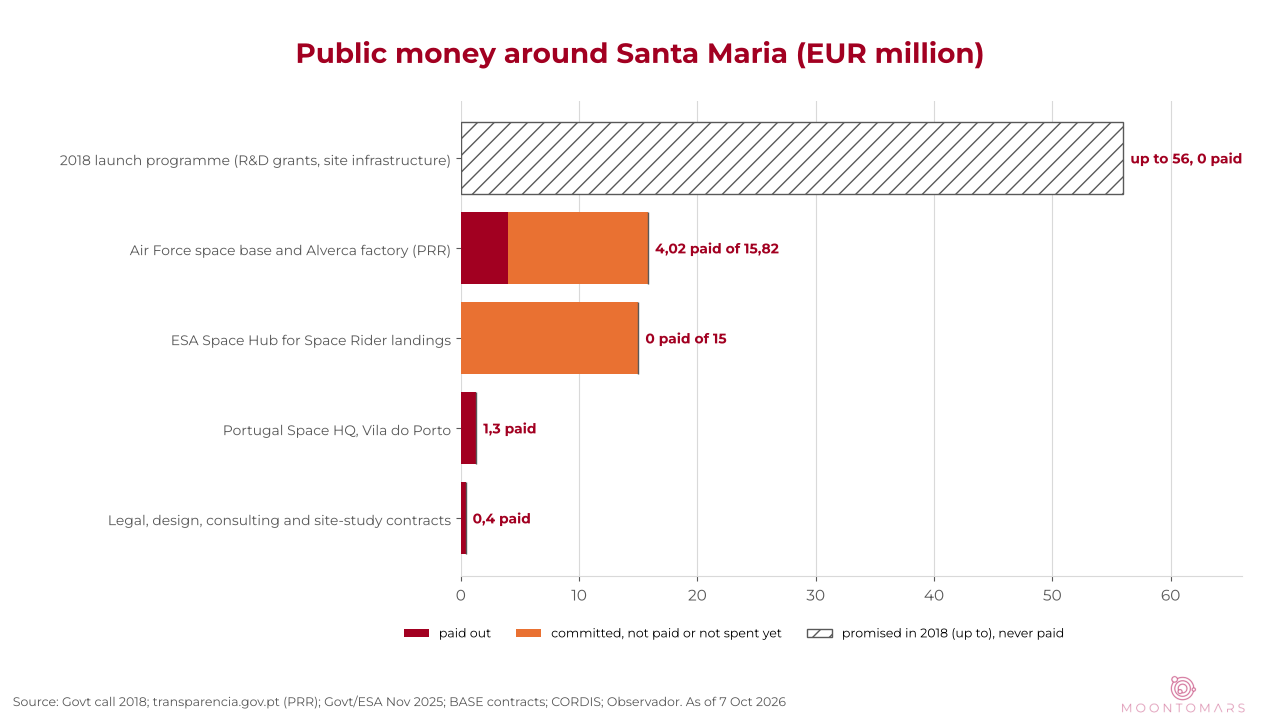
Two of the newest projects do not use ASC’s site at all. The Air Force base is a separate project. In March 2026 the Air Force said the Malbusca site “does not have the requirements” for the rockets in ESA’s European Launcher Challenge, the ones its own base is meant to serve. Space Rider will land on Santa Maria and needs no launch pad.
Santa Maria compared with other European launch sites
| Santa Maria | Andøya | SaxaVord | |
|---|---|---|---|
| Latitude | about 37° N | 69° N | about 61° N |
| Operator | ASC, private Lda | Andøya Space (Norwegian state majority) | Shetland Space Centre Ltd, private |
| Site licence | August 2025 | launch site permit 2024 | December 2023 |
| Built | one slab, mobile rail | one orbital pad (Pad 1) | one pad (“Fredo”) |
| Flights | GAMA and other atmospheric rockets, highest 5.6 km | Spectrum flight 1 (March 2025), orbit on September 5th, 2026 | none |
| Promised first launch | 2021 (government, 2018) | Q3 2022 (2021) | 2022 |
My opinion on the Santa Maria Spaceport and why you should keep an eye on it
What I like about the Santa Maria Spaceport
- They flew something: ASC put six small rockets in the air from Malbusca with a mobile rail and a team of a few people, before and after its licence, while the state was still writing tenders. It is modest, but it is hardware that flew.
- Cheap and private: The state approval explicitly takes on no financial commitment, and ASC says it will raise the EUR 5 – 10 million for the site privately. If that holds, Santa Maria is one of the few European launch sites where the taxpayer does not pay for the pad.
- Geography: About 37° North, open ocean to the south and the east, an airport, an ESA tracking station and its own air traffic control region on the same island. On paper this is a good place to launch small rockets.
What I don’t like about the Santa Maria Spaceport
- Eight years of dates: The government promised launches from the Azores by 2021. Since then the first launch has moved to October 2023, end of 2023, mid-2024, end of 2024, early 2025 and spring 2026. In October 2026 the highest flight is 5.6 km.
- Two tenders, no result: The 2018 call came with up to EUR 10 million a year in grants and an anchor-customer promise. Two tenders later none of it was paid, and the site went ahead only after the law was changed to allow a private licence.
- Public money next door, not on the pad: In 2025 and 2026 the state committed about EUR 30 million on Santa Maria. Half goes to a Space Rider landing hub, half to an Air Force base that the Air Force says the licensed site cannot replace. Neither had broken ground in the latest reports. The licensed site gets none of it.
- Customers who have not flown: SpaceForest’s Perun has not reached 100 km anywhere yet, and Innospace has not reached orbit anywhere yet. Both are the anchor names on Santa Maria’s customer list.
- No impact study: The pad sits about 50 metres from two protected sites, and no environmental impact study has been published.
Things to watch out for
- Perun Flight 5: If SpaceForest flies from Santa Maria, it would be the first suborbital flight from Portuguese soil. SpaceForest says the choice between Portugal and Denmark depends on “administrative and organisational processes”.
- Innospace in Brazil: No HANBIT launch from the Azores before HANBIT-Nano flies successfully in Brazil, now planned for the first half of 2027. Also watch for any pad construction at Malbusca.
- The Air Force base: About EUR 15 million of PRR money was assigned, the PRR period ended in June 2026, and the land was still being negotiated in September 2026.
- ASC’s money: Any outside investor, capital increase or the next accounts would show whether the private build is funded.
- Space Rider: First landing planned for 2028, after a 2022 date in the 2019 agreement.
Structured company information on Atlantic Spaceport Consortium, Lda
| Type | Information |
|---|---|
| Official Company Name | Atlantic Spaceport Consortium, Lda (operator of the Malbusca Launch Centre) |
| Tax number (NIF) | 516101072 |
| Founded in | September 15th, 2020 (consortium formed 2019) |
| Share capital | EUR 10,000 |
| Owners | Ilex Space, Lda and Optimal Structural Solutions, Lda |
| Management | Bruno Carvalho (director) |
| Licence | ANACOM-06/2025-AE, launch centre operation, August 12th, 2025 – August 12th, 2030 |
| Headquarter | Incuba+, Rua de Ponta Delgada, 9580-425 Vila do Porto, Santa Maria, Azores, Portugal |
| Launch Site | Malbusca, Santo Espírito, Santa Maria (36°55′57″ N, 25°04′12″ W) |
| [email protected] | |
| Website | spaceport.pt |
| Atlantic Spaceport Consortium | |
| YouTube | Atlantic Spaceport Consortium |
| Not available | |
| X | Not available |
More information on the Santa Maria Spaceport
- The government’s prior approval of the launch centre: Despacho n.º 8325/2025, Diário da República, July 18th, 2025 (in Portuguese)
- Portugal Space on the first launch centre licence: ptspace.pt
- ASC’s missions page: spaceport.pt
- RTP’s feature on the island, “A Ilha do Espaço” (February 2026, in Portuguese): rtp.pt
Update from October 2026 on the Santa Maria Spaceport
- First published. Covers the licence, the site, the six flights so far, the SpaceForest and Innospace agreements, the 2018 – 2021 tenders and the public money on the island.
Read our reviews of other European launch sites and the companies that want to fly from them: Andøya Space Center, SaxaVord Spaceport, Space Hub Sutherland, German Offshore Spaceport Alliance, Etlaq Spaceport, Esrange Space Center, MaiaSpace, Isar Aerospace, Rocket Factory Augsburg, HyImpulse, PLD Space, Orbex.
Want to read more about the European NewSpace industry?
- Middle East launch
 Iran and Israel are the only Middle East states that have put satellites in orbit on their own rockets. Turkey, the UAE, Saudi Arabia and Oman build satellites, spaceports and engines and buy launches abroad. Promises, launches and public money, country by country.
 - Vega C and AvioVega C was ordered in 2014 to fly in 2018 and first flew in July 2022. Eight flights, one failure, 715 days on the ground, EUR 87.4 million of public money per successful flight and never more than three launches a year. How Avio and its rocket compare with Electron, Falcon 9 rideshare and China’s small rockets.
- Santa Maria Spaceport
 Santa Maria in the Azores holds Portugal’s only launch site licence. We look at who runs it, what has flown, who paid and what was promised since 2018.
 - Ariane 6Ariane 6 was ordered in 2014 to fly in 2020 and first flew in July 2024. Nine flights, about EUR 6.6 billion of public commitments, up to EUR 340 million a year in operating support, no published price and no reuse. How it compares with Falcon 9, Vulcan, H3 and China’s rockets.
- Guiana Space Centre (Kourou)Europe’s spaceport in French Guiana flew 7 launches in 2025, against 11 a year a decade ago. Its new small-launcher pads were promised for 2024 and have hosted no launch. Who holds the slots, who pays for the base, and how it compares with Florida, China’s Hainan and Rocket Lab.

For any questions, feedback or information on sources, feel free to contact us at [email protected] or on X.