
Welcome to our in-depth analysis of launch in the Middle East, originally published October 8th, 2026. Make sure to check out our mission statement and why we do what we do. Look at our New Space guide if you want explanations of terms and concepts used in our research. And follow us on X for updates.
Middle East launch in October 2026
- Who reaches orbit: Only two countries in the region have put a satellite in orbit on their own rocket. Israel has done it 11 times in 13 tries since 1988, Iran 11 times in 21 tries since 2008.
- Iran: No Iranian rocket has reached orbit since December 6th, 2024. In the Iranian year to March 2026 all five Iranian satellites flew on Russian rockets, and nothing has launched from the new Chabahar site that was promised for March 2026.
- Turkey: The 2021 space programme promised Turkish rockets to orbit by 2028. Its Moon craft, first promised for 2023, now flies on a SpaceX rocket in the first half of 2027. All 49 Turkish satellites launched since 2020 went up on American rockets.
- Turkish money: The Turkish Space Agency had a budget of TRY 2.3 billion for 2025 and spent TRY 4.5 billion (EUR 101.5 million). Turkey is building a spaceport in Somalia and has published no cost for it.
- UAE: The Hope probe has orbited Mars since February 2021. In 2022 the UAE set up a AED 3 billion (EUR 806 million) National Space Fund, and Aspire Space is developing the reusable Oryx rocket with Dubai engine designer LEAP 71, aiming for a first launch in 2030.
- Oman: Etlaq, the region’s only commercial spaceport, promised five test launches for 2025. One was tried and did not ignite. Its latest launch, on October 2nd, 2026, was a 26 kilogram rocket that was not meant to reach space.
- Rivals: Galactic Energy, a private Chinese firm founded in 2018, has made 23 orbital launch attempts since 2020 with 21 successes. That is more attempts than Iran’s state programmes have made since 2008.
What you should know about launch in the Middle East
📰 For space enthusiasts
- Israel’s Shavit: solid-fuel, three stages, fired west over the Mediterranean from Palmachim, military Ofeq satellites only
- Iran’s launchers: Safir and Simorgh from the civil space agency, Qased and Qaem-100 from the military
- Iran’s new site at Chabahar on the Indian Ocean: promised for 2025, then March 2026, no launch yet
- Turkey’s rockets: Roketsan Simsek-1 (first test said for 2027) and Simsek-2 (1,500 kg to sun-synchronous orbit, by 2029)
- Planned in the UAE: Aspire Space’s reusable Oryx, first launch targeted for 2030
- Oman’s Etlaq: two small suborbital-class flights from Duqm, orbital launches targeted for 2027
💰 For VCs and industry experts
- Turkish Space Agency: TRY 4.5 billion spent in 2025 (EUR 101.5 million)
- UAE National Space Fund: AED 3 billion (2022) for the national space sector, first project a radar-satellite constellation
- Saudi space spending: SAR 8 billion to 2030, announced in 2020
- Israel’s civil space line: ILS 14 million in 2026, with Shavit paid from the defence budget
- Etlaq is private: owned 75% by NASCOM, with OMR 0.25 million of registered capital
- Who earns: American rockets launched 49 Turkish, 28 Israeli and 22 Emirati satellites since 2020, nearly all of them on SpaceX’s Falcon 9
👨💻 For potential employees
- Rocket work is mostly state work: Roketsan in Turkey, Israel Aerospace Industries and Iran’s state bodies build the launchers
- Private teams are small: Aspire Space planned 20 staff in the UAE (2025)
- Engines by software: LEAP 71 in Dubai designs engines with computational tools and hot-fired a 5 kN aerospike in 2024
- Turkish private hybrid rockets: DeltaV flies sounding rockets from Sinop on the Black Sea
Middle East launch: who flies, who builds, who pays
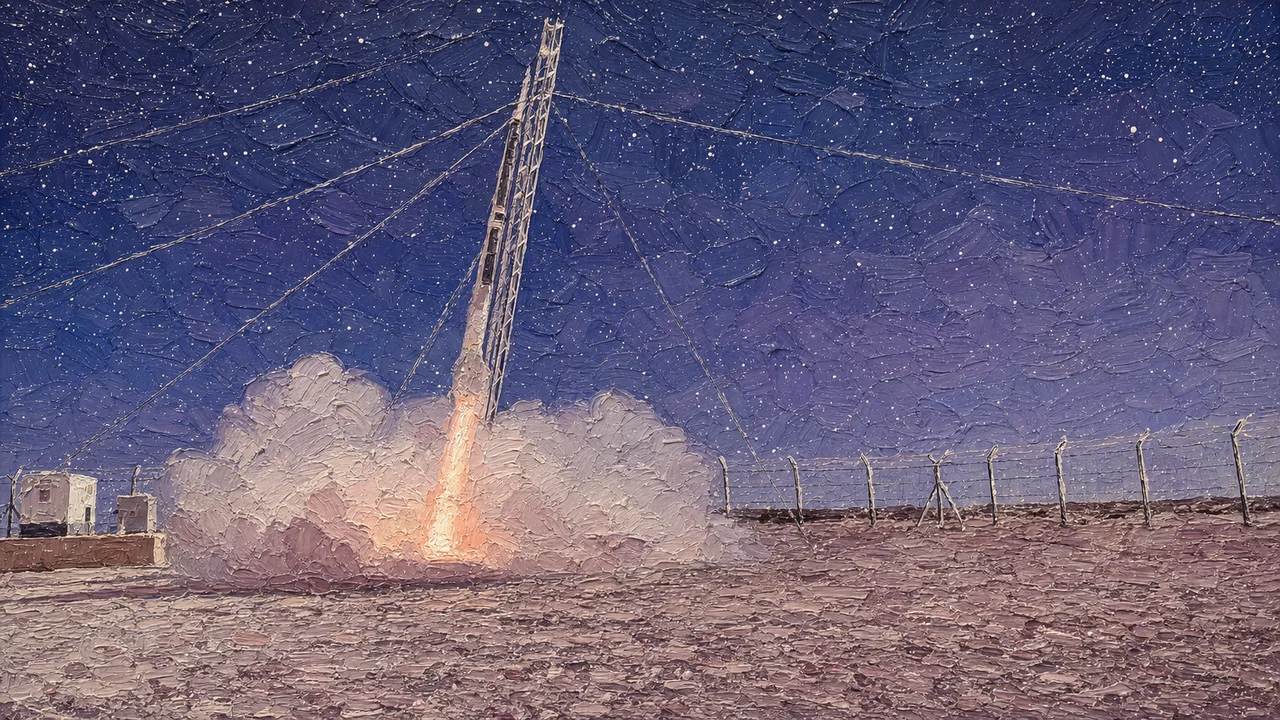
The Middle East has two countries that launch satellites on their own rockets, Israel and Iran, and both use state-run military launchers. Turkey, the UAE, Saudi Arabia and Oman have space agencies, satellite programmes and plans of their own, and they buy launches from American, Russian, Chinese and Japanese providers while their own launch projects develop.
This page goes country by country, and for each one we put the promise next to the date it was made, the launch record from Jonathan McDowell’s launch log, and the public money we could find. At the end we compare the region with two private small-rocket firms, one American and one Chinese.
| Country | Orbital attempts on own rocket | Reached orbit | First promised | Delivered |
|---|---|---|---|---|
| Israel | 13 since 1988 | 11 | n/a | Ofeq-19 in orbit, September 2025 |
| Iran | 21 since 2008 | 11 | Simorgh “ready in 2010” | Simorgh reached orbit in January 2024 |
| Turkey | 0 | 0 | own rockets to orbit by 2028 (said in 2021) | Simsek-1 first test said for 2027 |
| United Arab Emirates | 0 | 0 | Oryx first launch in 2030 (said in 2025) | no hardware test confirmed |
| Saudi Arabia | 0 | 0 | no launcher announced | satellites launched abroad |
| Oman | 0 | 0 | orbital operations from Etlaq in 2027 | two small suborbital-class flights |
Iran: 21 tries, 11 orbits
The Iranian Space Agency flies Safir and Simorgh from the Imam Khomeini Spaceport near Semnan, and a separate military programme flies Qased and Qaem-100 from a site near Shahroud. Together they made 21 orbital attempts from August 2008 to October 2026, and 11 reached orbit.
Simorgh: promised for 2010, in orbit in 2024 (2010 – 2024)
Simorgh was shown to President Ahmadinejad in February 2010, and officials said it would be ready that year, and later that it would first launch in 2012. After a test flight in July 2017, its first orbital attempt in January 2019 failed, and three more failed in 2020 and 2021. On January 28th, 2024, Simorgh put three small satellites in orbit, 14 years after it was unveiled.
The military rockets account for the rest of the record: Qased has made three orbital flights since April 2020, and Qaem-100 made three from 2023 to 2024, with one failure.
Promises by the Iranian year (2023 – 2026)
Iranian officials set yearly targets for satellite launches, and the Iranian year runs from late March to late March.
| Iranian year | Promised | What flew |
|---|---|---|
| March 2023 to March 2024 | 6 satellites (deputy defence minister, April 2023) | 6 satellites, 5 of them on Iranian rockets |
| March 2024 to March 2025 | 5 to 8 satellites (space agency, April and July 2024) | 5 satellites, 3 on Iranian rockets |
| March 2025 to March 2026 | 4 satellites and a first launch from Chabahar (space agency, September 2025) | 5 satellites, all on Russian rockets, and nothing from Chabahar |
| since March 2026 | Pars-2 and 3 Soleimani satellites by March 2027 | none to October 2nd, 2026 |
The last Iranian rocket to reach orbit was a Simorgh on December 6th, 2024, and a new three-stage rocket, Zuljanah, failed a few kilometres up on its first orbital attempt in September 2025. A test of an upgraded Simorgh in February 2025 has no entry in the launch log, and outside analysts listed it as a failure.
Chabahar: “completed” without a launch (2023 – 2026)
Iran started building a second civil site at Chabahar on the Indian Ocean coast in 2023, and its first phase was to open in 2025. In September 2025 the head of the space agency promised the opening and a first satellite launch by mid-March 2026, and in February 2026 he called the site completed. Satellite images analysed by Sam Lair for Arms Control Wonk that same month showed no launch tower, no rails and unpaved roads. Nothing has launched from Chabahar, and the current official target is “this year”, which ends in March 2027.
The 2026 strikes
US and Israeli strikes on Iran began on February 28th, 2026, eight months after an earlier round of fighting in June 2025. Satellite images showed the Shahroud plant that makes solid rocket motors destroyed in June 2025 and rebuilt by November 2025. It was hit again in March 2026, and Lair wrote that “more or less every building in the solid motor production lines was damaged, many destroyed”. The Israeli military also said it struck the Iranian Space Research Center in Tehran in mid-March. We found no report of damage to the Semnan launch pads, and since March 2026 Planet Labs has withheld new images of Iran.
Who pays in Iran
Iran publishes its budgets in rials, so the dollar figures here are conversions. Iranian press reported a civil space budget of 60.3 trillion rials in the bill for the year from March 2026, about USD 46 million at the open-market rate by our calculation. The bill was rejected by parliament in December 2025, and the final figure is not public. Iran has paid Russia’s Glavkosmos to launch ten Iranian satellites since 2005, and no price has been published.
Israel: a working rocket that nobody can buy
Israel Aerospace Industries (IAI), a state-owned company, builds the Shavit rocket and the Ofeq reconnaissance satellites it carries. Shavit launches from Palmachim air base south of Tel Aviv and flies west over the Mediterranean, against the Earth’s spin, so that its spent stages fall into the sea and not over neighbouring countries. Flying west costs payload, and Israel accepts that cost for security.
Shavit has made 13 orbital attempts since September 1988, and 11 reached orbit, with the two failures in 1998 and 2004. The latest launch put Ofeq-19 in orbit on September 2nd, 2025. Since 2016 Shavit has flown four times, in 2016, 2020, 2023 and 2025, and only for the Ministry of Defense.
Israel has never published a price for a Shavit launch. The civil “space programme” line in the 2026 state budget is ILS 14.0 million (EUR 4.1 million), and the military spending on Ofeq and Shavit is not shown. Israel also buys launches abroad: 28 of the 35 Israeli satellites that reached orbit since 2020 flew on American rockets, and we found no Israeli private launch company.
Turkey: a spaceport in Somalia and satellites on SpaceX
President Erdoğan presented Turkey’s National Space Programme on February 9th, 2021. Phase one was a Turkish craft reaching the Moon by the end of 2023, with a national hybrid engine and a foreign launch. Phase two, in 2028, was to launch to orbit on Turkey’s own rockets. The Moon craft did not fly in 2023, and in October 2026 its target was the first half of 2027, on a SpaceX rocket.
Roketsan, the missile maker owned mostly by the Turkish Armed Forces Foundation, builds the launchers. Its product page says the MSLV project for small satellites is to be completed in 2026. In June 2025 the head of the defence industry agency moved the first test of the Simsek-1 launch system to 2027. A larger Simsek-2, shown in July 2025, is to carry 1,500 kg to sun-synchronous orbit and be tested by 2029. Roketsan’s sounding rocket SR-0.1 reached 136 km in October 2020, and Turkey has not yet made an orbital launch attempt.
The Somalia spaceport (2021 – 2026)
Turkey’s own coast is too far north and too crowded for orbital launches, so it is building a site in Somalia, close to the equator. Construction of the first phase started in December 2025, with first readiness promised for the first months of 2027. No official cost has been published, and Middle East Eye reported in 2021, from an anonymous source, more than USD 350 million to build and run it, and Turkish media have mentioned much larger sums.
Who pays in Turkey
The Turkish Space Agency (TUA) had TRY 1.70 billion in its 2024 budget and spent TRY 1.76 billion (EUR 49.4 million). For 2025 it got TRY 2.34 billion and spent TRY 4.55 billion (EUR 101.5 million), after TRY 2.2 billion of extra transfers during the year. The 2026 budget bill gave TUA TRY 5.9 billion. The agency does not show how much of this goes to launchers, and no contract value for Simsek-1 has been published. All 49 Turkish satellites launched since 2020 flew on American rockets.
A private company, DeltaV, flies hybrid sounding rockets from Sinop on the Black Sea. It says its SORS rocket passed 100 km in 2023 and a two-stage rocket passed 200 km in June 2025, and neither flight appears in Jonathan McDowell’s launch log.
United Arab Emirates: Mars, a national space fund and a reusable rocket in development
The UAE runs the region’s best-known space missions. Its Hope probe reached Mars orbit in February 2021, the first Arab mission to another planet, after a launch on a Japanese H-IIA rocket. The government put the total cost of the mission at AED 735 million (about USD 200 million). KhalifaSat also flew on an H-IIA in 2018, MBZ-SAT on a SpaceX rideshare in January 2025, and the asteroid-belt mission is booked on Japan’s H3 for 2028. The UAE buys its launches from established providers: of the 28 Emirati satellites that reached orbit since 2020, 22 flew on American rockets.
In July 2022 the UAE set up a National Space Fund of AED 3 billion (EUR 806 million), run by the UAE Space Agency. Its first project is Sirb, a constellation of radar satellites for Earth observation.
The UAE’s launcher effort is private: Aspire Space, founded in Luxembourg in 2023 by former Sea Launch engineers, moved its operations to the UAE in 2025. It is developing Oryx, a two-stage reusable methane rocket for up to 15 tonnes to low Earth orbit, with engines from LEAP 71 in Dubai. In June 2025 its chief executive called a first launch in 2030 “a very ambitious timeline”. No launch site has been chosen yet, and LEAP 71 has named Oman’s Etlaq as one option.
Oman: a private spaceport with small rockets
Etlaq Spaceport near Duqm is the region’s only commercial launch site. It is run by Etlaq Services, 75% owned by the National Aerospace Services Company (NASCOM), a Muscat company with OMR 0.25 million of registered capital. Oman’s transport ministry supports the project through its National Space Programme, and we found no published amount of state money.
The first launch, Duqm-1, was a sounding rocket on December 5th, 2024. In February 2025 Etlaq promised five test launches for that year, and one was tried: Duqm-2 in July 2025, whose engine did not ignite. The second successful launch came on October 2nd, 2026, a 4.3 metre, 26 kilogram rocket that the Omani government said was “not intended to reach space”. Etlaq says orbital operations start in 2027, and PLD Space and Latitude have named Etlaq for future launches, as our Etlaq review explains in detail.
Saudi Arabia and the wider region
Saudi Arabia’s Space Commission announced in October 2020 that it would spend SAR 8 billion (EUR 1.82 billion) on space up to 2030. In May 2024 the Public Investment Fund set up Neo Space Group for satellite communications, Earth observation and navigation services. Four Saudi satellites have reached orbit since 2020, two on Russian rockets and two on SpaceX, and a Saudi cubesat flew on NASA’s Artemis II in April 2026.
Egypt’s 2017 space agency law speaks of launching satellites “from Egyptian lands”, and no launch site has been built yet. In Kuwait a private team, Kuwait Space Rocket, planned small flights of 15 to 20 km from Etlaq.
Who launches the region’s satellites
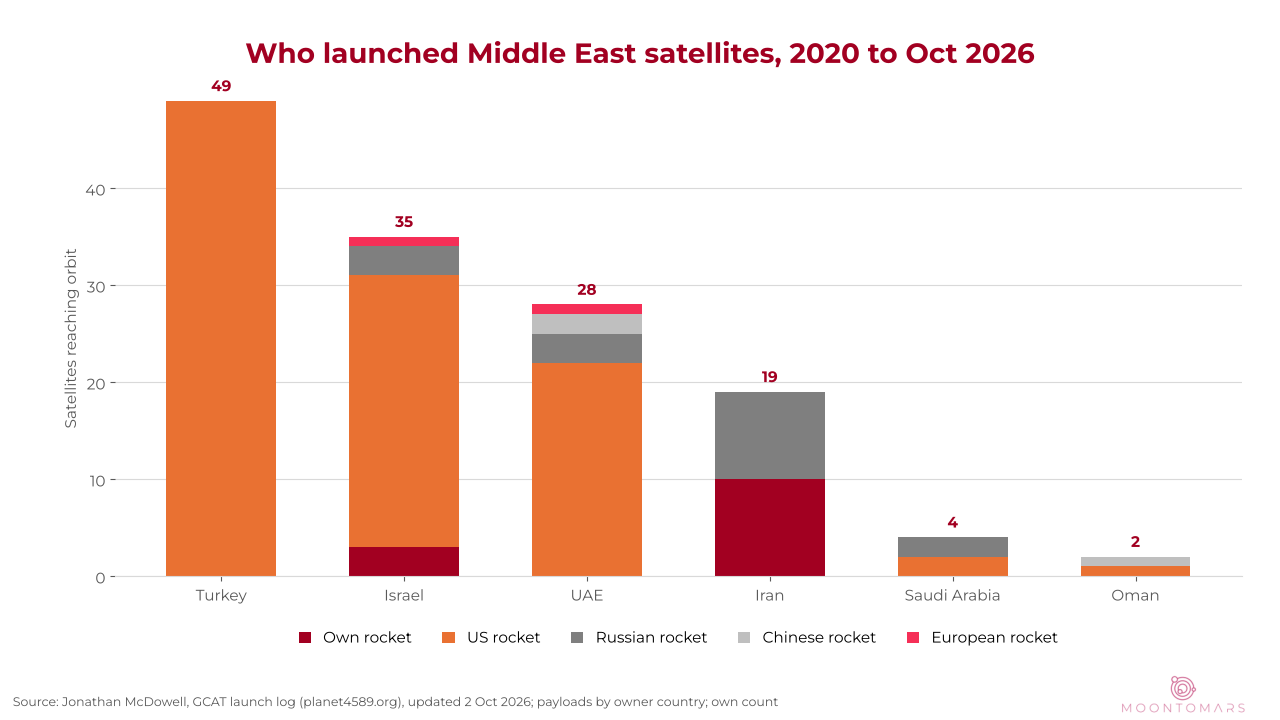
From 2020 to October 2026, 137 satellites owned by Turkey, Israel, the UAE, Iran, Saudi Arabia and Oman reached orbit. Of those, 102 went up on American rockets, almost all on Falcon 9, and only 13 flew on rockets built in the region, 10 Iranian and 3 Israeli. Iran is the only country here that mostly flies its own satellites, and even Iran sent 9 to orbit on Russian rockets.
Measured against the rivals
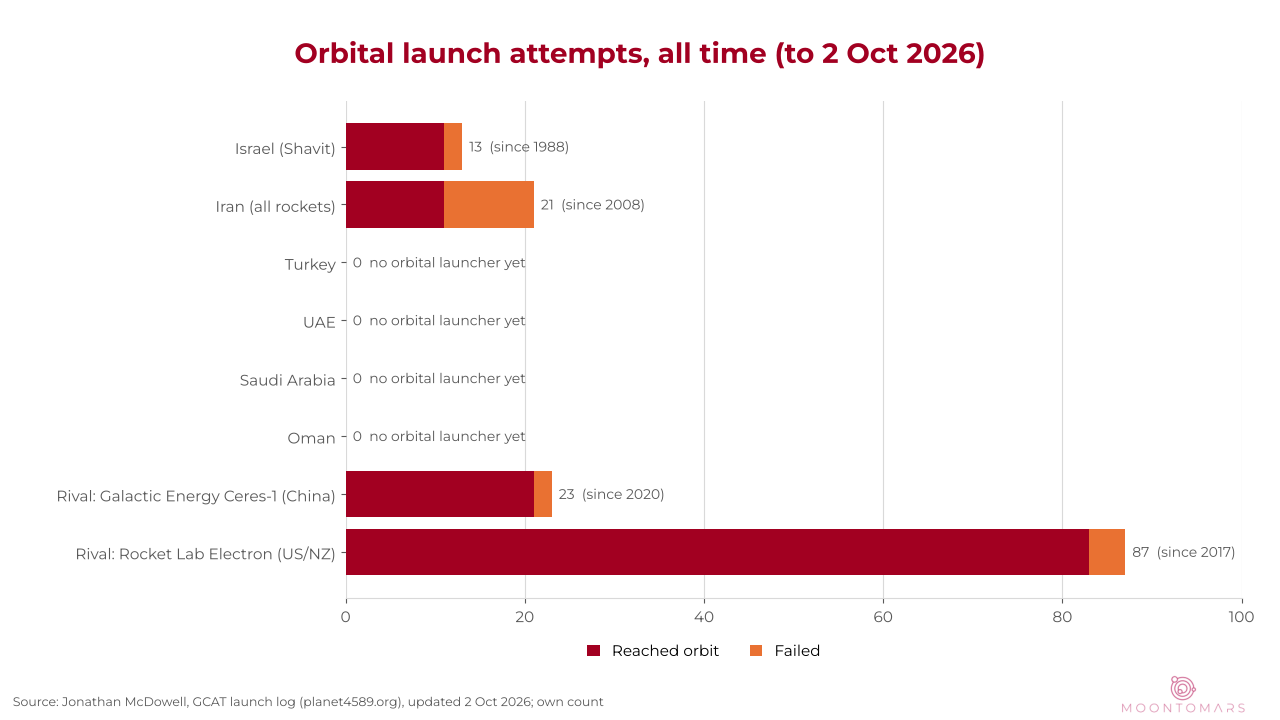
Shavit and Iran’s rockets are small launchers, in the same class as Rocket Lab’s Electron and Galactic Energy’s Ceres-1. Electron flew 18 times to orbit in 2025 alone. Galactic Energy was founded in Beijing in 2018 as a private company and reached orbit in November 2020, less than three years later. It has made 23 attempts with 21 successes, more than Iran’s two state programmes made in 18 years.
In 2025 the United States had 174 successful orbital launches and China 89, while Israel had one and Iran had none. The next dated steps in the region are Etlaq’s first orbital launches and Turkey’s first Simsek-1 test, both planned for 2027, and the UAE’s Oryx in 2030.
Want to read more?
Our reviews of Etlaq Spaceport, PLD Space and Latitude cover the companies that plan to launch from Oman. For Europe’s own record, read our Ariane 6 analysis, the European Launcher Challenge and the European Space Launch Companies Ranking 2026. Launch counts on this page come from Jonathan McDowell’s launch log.
All information in this analysis was obtained from public sources and we encourage you to do your own due diligence. Feel free to contact us for corrections or share our content. Attribution is always welcome.
- HyImpulse Technologies
 HyImpulse Technologies builds hybrid paraffin/LOX rockets. SR75-1 flew from Koonibba on 3 May 2024; a UK CAA licence covers SaxaVord for spring 2027. Series A and a Series A Extension above EUR 50 million equity arrived in 2025–26. SL1 targets 600 kg to LEO; HyMOVE is a separate OTV.
 - Andøya Space Center
 Andøya Space Center is a spaceport in northern Norway. Spectrum reached orbit from Andøya on 5 September 2026. Pad 1 is operational and Isar-exclusive; Pad 2 is proposed. Operator Andøya Space AS is 90% Norwegian state and 10% Kongsberg.
 - SkyroraSkyrora is a Scottish new space company developing the Skyrora XL, a three-stage rocket for up to 315 kg to orbit. Our 2026 analysis covers its owners, accounts, public money and launch plans.
- OrbexOrbex (Orbital Express Launch Ltd): UK microlauncher Prime, 180 kg LEO. In administration since 18 February 2026 after GBP 138.5m raised (GBP 76.7m public). Zero launches. Omnidea bought the Forres assets.
- LatitudeLatitude (formerly Venture Orbital Systems) is a French NewSpace company developing a LOX/RP-1 microlauncher (formerly Zephyr). As of October 2026 it has not flown; Series B raised EUR 27 million; an Etlaq Oman LoI targets an experimental late-2027 inaugural that we treat as optimistic. In-depth analysis on moontomars.space.