
Welcome to our in-depth analysis of Sirius Space Services, first published October 9th, 2026 (key facts highlighted in blue). Make sure to check out our mission statement and why we do what we do. Look at our New Space guide if you want explanations of terms and concepts used in our research. And follow us on X for updates.
🚀 Update from October 2026
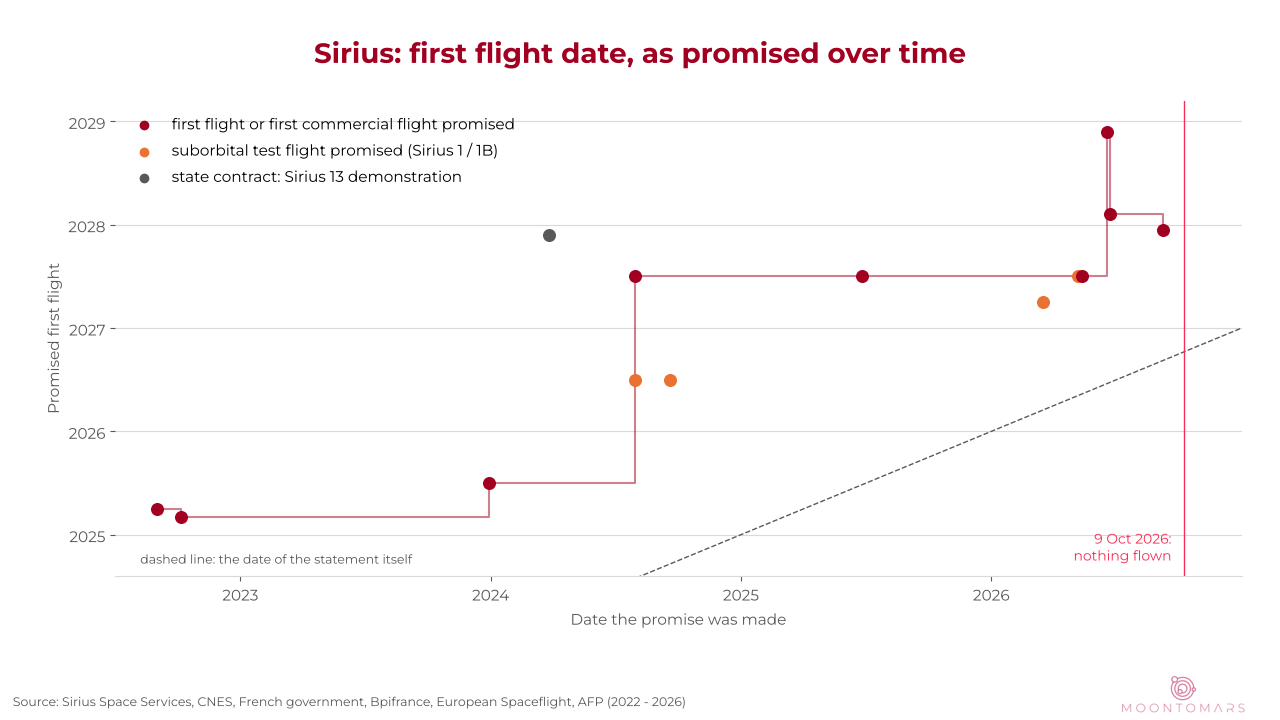
- No flight yet. Sirius has not flown a rocket and has not fired a rocket stage. The CEO now gives the first flight “within 12 to 18 months”, the end of 2027 or early 2028, after a promise of March 2025 made in 2022.
- Engine. Sirius fired its first complete STAR-1 engine in the summer of 2026 at a test site in southern England, about a year after the date it had given.
- Money. No funding round has been announced with an amount or investors. In September 2026 the CEO said about EUR 50 million was still missing to build rockets in series. The accounts are filed as confidential.
- Public money. Sirius holds a France 2030 contract, run by CNES, for a Sirius 13 demonstration flight by the end of 2027. The state has not published its value.
- Launch site. CNES picked Sirius on 23 April 2026 for the last free slot at the Diamant complex in Kourou, French Guiana. A 2024 deal to fly from Arnhem in Australia lapsed after the site’s operator said in December 2024 that it would stop operations there.
- Company. Head office in Nanterre near Paris, three factories bought in 2025 and 2026 out of other firms’ losses or insolvency, and about 300 staff in the group, most of them outside the space work.
Sirius Space Services – A young French launch company with a state contract and no flight
Sirius Space Services is a French company developing a family of small rockets that burn methane and liquid oxygen. Before we continue you should know: Sirius has never flown, its funding is not public, and its first flight has moved from March 2025 to the end of 2027 at the earliest.
Antoine Fourcade co-founded the company in Paris in April 2020, and it has grown quickly since. It won French state money twice under France 2030, fired its own engine at test sites in France, Germany and England, and bought three factories in two years. In April 2026 CNES gave it a launch pad slot in Kourou, next to Isar Aerospace, Rocket Factory Augsburg, PLD Space and Latitude.
This review measures Sirius the way we measure every other company on this site: years, euros and flights. Without further ado: Sirius Space Services.
What you should know about Sirius Space Services
📰 For space enthusiasts
- No flight yet (October 2026). First flight planned for the end of 2027 or early 2028 (CEO, September 2026)
- Sirius 1: two stages, about 175 to 180 kg to low Earth orbit (company figures)
- Sirius 13 and Sirius 15: Sirius 1 cores with two or four side boosters, for up to about 800 kg and 1,100 kg
- STAR-1 engine: methane and liquid oxygen, 3D-printed, about 55 kN of thrust
- First complete engine fired in summer 2026 in England. No stage test yet
- Launch pad slot at the Diamant complex in Kourou, French Guiana, since April 2026
💰 For VCs and industry experts
- No funding round announced with an amount or investors. Accounts filed as confidential
- 2024: no revenue and a net profit of about EUR 1.5 million (French company register)
- About EUR 50 million missing to build rockets in series, with a round under way (CEO, September 2026)
- France 2030 demonstration contract for a Sirius 13 flight by the end of 2027. Value not published
- Not in ESA’s European Launcher Challenge
- No valuation: no published round, no share price
👨💻 For potential employees
- About 300 people in the group (2026, press), with 50 to 99 employees at Sirius Space Services in 2024 (register)
- Head office in Nanterre near Paris. Factories at Le Coudray-Montceaux (Essonne), Champdieu (Loire) and Blois (Loir-et-Cher)
- About 30 jobs planned in French Guiana
- French is useful

Sirius Space Services: From an office near Paris to three factories and a pad in Kourou
Sirius has its head office in an office building in Nanterre, west of Paris, since August 2025, after earlier addresses in Paris, Orsay, Puteaux and Colombes. In June 2025 it bought the precision machining business of AddUp, a Fives and Michelin company, at Le Coudray-Montceaux south of Paris, for one euro, with 30 staff and two metal 3D printers. In 2026 it took over two plants of the insolvent car-parts supplier ACI Group: AMM-42 at Champdieu near Saint-Étienne in March, with 35 staff, and Enerflux at Blois in May, a site of 15,000 square metres.
In Kourou, Sirius must build its own launch table and assembly building on the Diamant complex, while CNES builds the shared road, power and liquid oxygen supply. A soil survey on the site was planned for September 2026. In early October 2026 the French register showed no Sirius establishment in French Guiana.
Sirius Space Services – A closer look at its history
From Strato Space System to Sirius (2020 – 2022)
Antoine Fourcade registered Strato Space System in Paris on 14 April 2020 with EUR 1,000 of capital. The company changed its plan and its name in December 2021, when it became Sirius Space Services, with François Maroquène, who came from Arianespace, as managing director. Capital increases followed in November 2020 and June 2021, without any published amounts or investors.
In June 2022 Sirius was one of the first two winners of the France 2030 call for small rockets, run by Bpifrance and CNES, in the seed category. In September 2022 a Sirius paper for the International Astronautical Congress put the first flight of Sirius 1 in the first half of 2025. In October 2022 the government’s France 2030 press kit listed two Sirius projects, one with Air Liquide and Safran Data Systems. It gave a price target of USD 10,000 to 15,000 per kg and a first launch from the Guiana Space Centre “planned in March 2025”.
First engine tests and a state contract (2023 – 2024)
In May 2023 Sirius fired its STAR-1 engine for the first time, for 8 and 10 seconds on an ArianeGroup test bench at Vernon. At the end of 2023 a second, 3D-printed version fired for 60 seconds at the German space agency’s test site at Lampoldshausen. Sirius then gave 2025 for Sirius 1, 2026 for Sirius 13 and 2027 for Sirius 15.
On 26 March 2024 President Emmanuel Macron named Sirius one of four winners of a France 2030 contest to buy demonstration launches, next to HyPrSpace, Latitude and MaiaSpace. Sirius promised a Sirius 13 flight with 700 kg to a 600 km sun-synchronous orbit by the end of 2027. The four contracts total about EUR 250 million, and up to EUR 400 million with options, with less than half paid up front and the rest on success. One of the winners said Sirius had the second largest share after MaiaSpace, and the state has not published the amounts.
In July 2024 Fourcade said Sirius aimed to raise EUR 150 million and planned a suborbital flight in 2026 and a first orbital flight in 2027. In September 2024 Sirius signed a deal with Equatorial Launch Australia to build its own pad at the Arnhem Space Centre, with a ballistic Sirius 1 flight there in 2026. On 10 December 2024 ELA announced it would stop operations at Arnhem after a dispute over the land lease, and it went into liquidation in February 2026. Sirius did not comment on the end of the deal. In October 2024 Sirius completed two more 60-second firings of the thrust chamber at Lampoldshausen and set the first test of a complete engine for the second quarter of 2025.
Factories and a pad (2025 – 2026)
In June 2025 Sirius bought AddUp’s machining business at Le Coudray-Montceaux, and Fourcade spoke of a “first commercial lift-off in 2027”. ESA picked five companies for its European Launcher Challenge in July 2025, and Sirius was not one of them. In August 2025 Sirius filed its 2023 and 2024 accounts, late and as confidential. They show no revenue in 2024 and a net profit of about EUR 1.5 million.
In January 2026 Fourcade set up a new holding company, SIRIUS Group. In February 2026 Sirius fired four different 3D-printed combustion chambers eight times at Lampoldshausen, for 80 seconds in total. In March it took over AMM-42 and put a ballistic Sirius 1B demonstrator in the first half of 2027. In May it took over Enerflux at Blois, where 72 employees, a third of the staff, lost their jobs the week before. Fourcade then put the first flight, bought by the French state, in mid-2027.
On 23 April 2026 a CNES committee picked Sirius for the slot at the Diamant complex that MaiaSpace had left, and CNES announced it on 18 June. Sirius then spoke of a first commercial flight in late 2028, and local media of a first lift-off in early 2028. In the summer of 2026 Sirius fired a complete STAR-1 engine, with its turbopumps, for the first time, at Airborne Engineering in southern England, and announced it on 12 September without giving durations or thrust. On 9 September Fourcade said the first flight would come “within 12 to 18 months” and that about EUR 50 million was still missing. On 29 September Sirius signed a memorandum with the Austrian start-up Tumbleweed to study flying its microgravity capsules on Sirius 1B.
The Sirius rockets: what they carry
Sirius builds its rockets around one engine, the STAR-1, and one core. Sirius 1 is a two-stage rocket, and Sirius 13 and Sirius 15 add two or four boosters made from the same core. The company presents the family as reusable, but has not published how it would recover its stages. Sirius 1B, the first vehicle planned to fly, is a ballistic demonstrator that will not reach orbit.
| Rocket | Payload as stated | Status, October 2026 |
|---|---|---|
| Sirius 1B | Ballistic test flight, no orbit | Planned for 2027, launch site not announced |
| Sirius 1 | About 175 to 180 kg to low Earth orbit | First orbital flight planned for the end of 2027 or 2028 |
| Sirius 13 | 600 to 800 kg, depending on the source and orbit. CNES contract: 700 kg to a 600 km sun-synchronous orbit | State demonstration due by the end of 2027 |
| Sirius 15 | About 1,000 to 1,100 kg | No date |
The payload figures for Sirius 13 differ between the company, the press and CNES. We use the CNES contract figure where we compare. In 2022 Sirius gave a target price of USD 10,000 to 15,000 per kg, close to China’s Ceres-1 today and well below Rocket Lab’s Electron.
Investing in Sirius Space Services: Funding and Financials
Private money
Sirius has never announced a funding round with an amount, a date and named investors. The register shows capital increases in November 2020, June 2021 and June 2023, which took the share capital from EUR 1,000 to EUR 37,073, and none since. The filings around the 2021 increases cite several French investment firms, among them a Bpifrance fund, but do not show who holds the shares today. In 2026 the trade magazine Usine Nouvelle wrote that the company belongs to “discreet French investors”.
In July 2024 Fourcade said Sirius aimed to reach EUR 150 million of financing. In March 2026 Le Journal des Entreprises wrote that Sirius had raised more than EUR 100 million since its creation, including its France 2030 money. The same article said a round of several tens of millions was planned for the second quarter of 2026. No closed round has been reported since. In September 2026 Fourcade said about EUR 50 million was missing to build rockets in series, and that Sirius could make its first flight without it.
What the accounts show
Sirius files its annual accounts with a confidentiality declaration, which French law allows smaller companies, so the full figures are not public. The accounts for 2023 and 2024 were filed together in August 2025, months after the legal deadline. The French statistics office’s open data show no revenue for 2024 and a net profit of about EUR 1.5 million. For a company without sales, that points to income from grants or contracts, and the accounts do not say which.
Public money in, promised vs delivered
The French state has not published what it pays Sirius. Here is what we found:
| Programme | To | Type | Amount | Signed | Promised at the time | Status, October 2026 |
|---|---|---|---|---|---|---|
| France 2030 small-rocket call, seed category (Bpifrance, CNES) | Sirius | Grant | not published | 06/2022 | First launch from Kourou in March 2025 | No flight |
| France 2030 small-rocket call, “SIRIUS Phase 2” with Air Liquide and Safran Data Systems | Sirius and partners | Grant | not published | 10/2022 | Same | No flight |
| France 2030 demonstration launch (CNES) | Sirius | Purchase of a launch, paid on milestones | not published. The four winners share about EUR 250 million, up to EUR 400 million with options | 03/2024 | Sirius 13 with 700 kg to a 600 km sun-synchronous orbit by the end of 2027 | First flight planned for the end of 2027 or 2028, on Sirius 1B or Sirius 1 |
| Innov’up (Région Île-de-France) | Sirius | Regional support | EUR 400,000 | not dated | Awarded, year not published | |
| Diamant small-rocket complex (CNES, France 2030) | Shared by five companies | Public works | EUR 50 million for the shared facilities | 2022 – 2026 | First small-rocket flights in 2024 | Building since 2025, no launch |
Every date on this list that has passed was missed. The largest item depends on a Sirius 13 flight by the end of 2027, and Sirius 13 is built from Sirius 1 cores, which have not flown.
Sirius Space Services against the competition
Sirius competes for small satellites with other European start-ups, and with rockets that already fly elsewhere. Here is where it stands.
| Rocket | Company | Payload | Orbital flights to October 2026 | Money raised (press) |
|---|---|---|---|---|
| Electron | Rocket Lab, United States and New Zealand | about 300 kg to low Earth orbit | 97 launches | listed company |
| Ceres-1 | Galactic Energy, China | about 400 kg to low Earth orbit | 23 launches | not public |
| Spectrum | Isar Aerospace, Germany | 700 kg to sun-synchronous orbit | 2, in orbit in September 2026 | about EUR 870 million |
| MIURA 5 | PLD Space, Spain | up to 540 kg to low Earth orbit | 0, first flight planned for the first half of 2027 | about EUR 488 million |
| RFA One | Rocket Factory Augsburg, Germany | up to 1,300 kg to low Earth orbit | 0 | not public |
| Maia | MaiaSpace, France | 1.5 t to sun-synchronous orbit, expended | 0, planned for the second half of 2027 | owned by ArianeGroup |
| Latitude | Latitude, France | about 100 kg to sun-synchronous orbit | 0, planned for late 2027 from Oman | about USD 55 million |
| Sirius 1 | Sirius Space Services, France | about 175 to 180 kg to low Earth orbit | 0, planned for the end of 2027 or 2028 | not public |
Rocket Lab’s Electron has flown 97 times since 2017 and China’s Ceres-1 23 times, so the market Sirius targets is served today. In Europe, Isar Aerospace reached orbit from Andøya in September 2026. ESA’s launcher challenge gives Isar, PLD Space and RFA contracts worth up to EUR 544 million in total, and Sirius is not part of it. Of the five companies with a slot on Kourou’s Diamant complex, Sirius arrived last.
My opinion on Sirius Space Services and why you should keep an eye on them
What I like about Sirius Space Services
- Hardware on test stands: Sirius designs its own engine, fired it in France, Germany and England, and fired a complete STAR-1 with its turbopumps in 2026. For a company founded in 2020, that is a lot of testing.
- Factories: Sirius bought machine shops and a 15,000 square metre plant instead of building from scratch, and plans to make almost every part itself. If it works, that is a fast way to production capacity.
- A seat at the table: the French state picked Sirius twice under France 2030 and CNES gave it a pad in Kourou. Few European start-ups without a flight hold both.
What I don’t like about Sirius Space Services
- Dates: March 2025 from Kourou in 2022, then 2025, then a suborbital flight in 2026, then the first half of 2027, then mid-2027, then late 2028, then “within 12 to 18 months”. The first flight moved by about three years, and none of it moved because a test went wrong in flight, since nothing has flown.
- Money in the dark: no round has been announced with figures, the accounts are confidential and late, and the state has not published what its contract pays. Readers can’t see how much Sirius has, who owns it or how long the money lasts.
- Australia: Sirius announced a pad at Arnhem in 2024 and never said what happened after the site’s operator stopped work there three months later. The first vehicle, Sirius 1B, still has no announced launch site.
- A car-parts group: most of the new staff and revenue come from automotive and machining plants bought out of insolvency, and 72 people at Blois lost their jobs in the takeover. That builds capacity, but it also ties a rocket start-up to a car-parts market in trouble.
Things to watch out for
- The funding round: about EUR 50 million was missing in September 2026. Watch for the amount, the investors and whether SIRIUS Group, the new holding company, raises it.
- The first stage test: a firing of a full Sirius stage would be the first test above engine level.
- Sirius 1B: where and when it flies. Kourou’s Diamant complex has not hosted a launch yet.
- The France 2030 deadline: the contract asks for a Sirius 13 flight by the end of 2027. Watch whether CNES keeps the date, changes the vehicle or stops the contract.
Sirius Space Services: Jobs and career
Sirius Space Services had between 50 and 99 employees in 2024, according to the French statistics office, and about 70 in mid-2025, according to the company. With the plants at Le Coudray-Montceaux, Champdieu and Blois the group counted about 300 people in 2026, according to the press, most of them in machining and automotive work. Sirius speaks of about 30 jobs in French Guiana once its pad is built.
The head office is in Nanterre, west of Paris, and the plants are in Essonne, the Loire and the Loir-et-Cher. We found no published salary ranges. French is useful.
Structured company information on Sirius Space Services (Sirius Space Services SAS)
| Type | Information |
|---|---|
| Official Company Name | Sirius Space Services SAS (SIREN 883 112 971, RCS Nanterre) |
| Founded in | April 2020, as Strato Space System |
| Owner | Not public. Holding company SIRIUS Group SAS set up in January 2026 |
| Management | Antoine Fourcade (Président), François Maroquène (Directeur général) |
| Auditor | Comptabilité Finance Gestion Audit |
| Locations | |
| Headquarter | Immeuble Bahia, 1 rue Noël Pons, 92000 Nanterre, France |
| Factories | Le Coudray-Montceaux (Essonne), Champdieu (Loire), Blois (Loir-et-Cher) |
| Engine tests | Airborne Engineering, southern England, and DLR Lampoldshausen, Germany |
| Launch Site | Guiana Space Centre, Diamant complex, Kourou, French Guiana (slot since April 2026) |
| Contact | |
| Sirius Space Services LinkedIn | |
| Web | sirius-space.com |
Updates on Sirius Space Services
October 2026: First version of this review, with the French register record, a table of public money against what it promised, the history of first-flight promises and a comparison with Isar Aerospace, PLD Space, RFA, MaiaSpace, Latitude, Rocket Lab and Galactic Energy.
If you find incorrect information or want to know more about our sources, feel free to contact us on X or via Email.
Interested in more space companies? Read our other reviews and analysis
Kourou’s other small-rocket tenants have their own pages: PLD Space, Isar Aerospace, Rocket Factory Augsburg, Latitude and MaiaSpace. See also the Guiana Space Centre, our European launch companies ranking and the European Space Map.
- HyImpulse Technologies
 HyImpulse Technologies builds hybrid paraffin/LOX rockets. SR75-1 flew from Koonibba on 3 May 2024; a UK CAA licence covers SaxaVord for spring 2027. Series A and a Series A Extension above EUR 50 million equity arrived in 2025–26. SL1 targets 600 kg to LEO; HyMOVE is a separate OTV.
 - Andøya Space Center
 Andøya Space Center is a spaceport in northern Norway. Spectrum reached orbit from Andøya on 5 September 2026. Pad 1 is operational and Isar-exclusive; Pad 2 is proposed. Operator Andøya Space AS is 90% Norwegian state and 10% Kongsberg.
 - SkyroraSkyrora is a Scottish new space company developing the Skyrora XL, a three-stage rocket for up to 315 kg to orbit. Our 2026 analysis covers its owners, accounts, public money and launch plans.
- OrbexOrbex (Orbital Express Launch Ltd): UK microlauncher Prime, 180 kg LEO. In administration since 18 February 2026 after GBP 138.5m raised (GBP 76.7m public). Zero launches. Omnidea bought the Forres assets.
- LatitudeLatitude (formerly Venture Orbital Systems) is a French NewSpace company developing a LOX/RP-1 microlauncher (formerly Zephyr). As of October 2026 it has not flown; Series B raised EUR 27 million; an Etlaq Oman LoI targets an experimental late-2027 inaugural that we treat as optimistic. In-depth analysis on moontomars.space.