
Welcome to our in-depth analysis of Ariane 6, originally published October 7th, 2026. Make sure to check out our mission statement and why we do what we do. Look at our New Space guide if you want explanations of terms and concepts used in our research. And follow us on X for updates.
Ariane 6 in October 2026
- Flights: Ariane 6 has flown nine times since its first launch on July 9th, 2024. Eight flights did everything they were meant to do. On the first, the upper stage could not make its last burn and stayed in orbit.
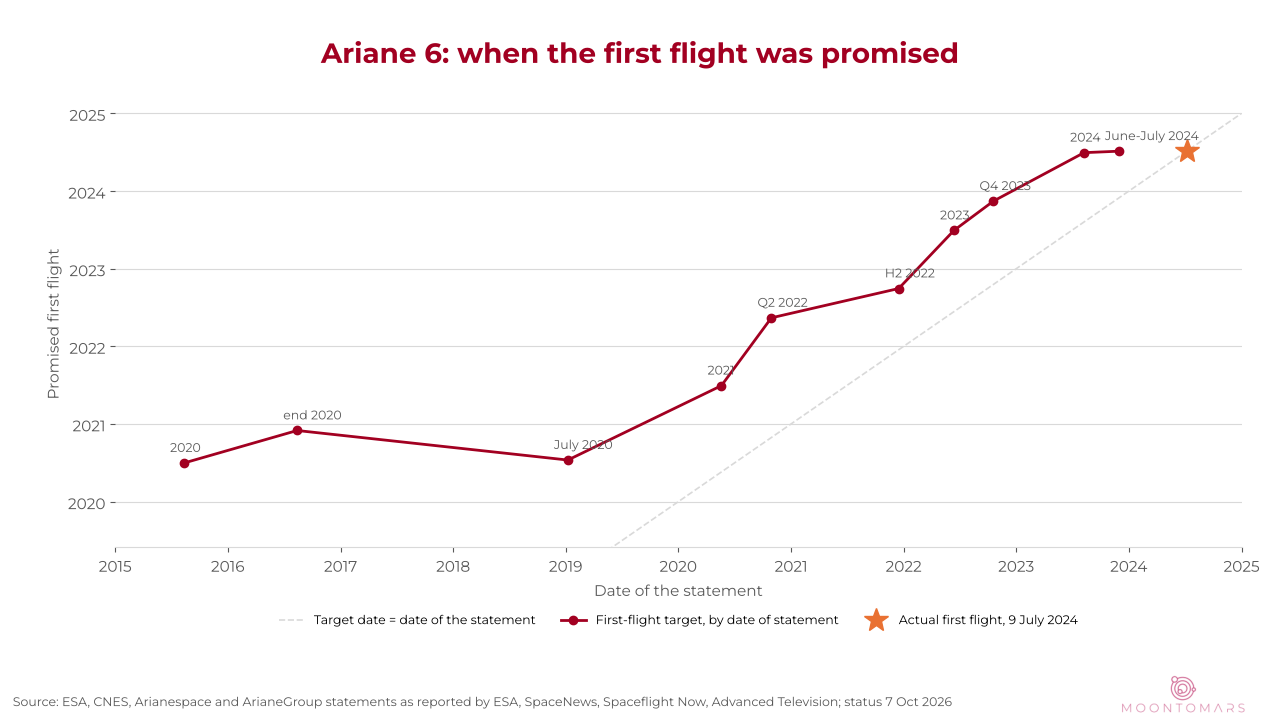
- Delay: ESA member states ordered the rocket in December 2014 for a first flight in 2020. It flew about 42 months late, after at least seven target dates had passed.
- Cadence: The plan was 11 to 12 launches a year by 2023. Ariane 6 flew once in 2024, four times in 2025 and four times in 2026 up to October 7th. Falcon 9 flew 165 times in 2025.
- Public money: ESA’s development contracts of 2015 came to EUR 3 billion. Since 2019 member states have committed about EUR 3.6 billion more for completion, upgrades and operation, by our sum of ESA’s own tables.
- Operating support: France, Germany and Italy agreed in November 2023 to pay ArianeGroup up to EUR 340 million a year to run Ariane 6 from 2026. In 2014 the plan was that industry would carry the commercial risk without state support.
- Price: No price has ever been published. ArianeGroup’s first estimate was about EUR 70 million for an Ariane 62, and in March 2024 the head of the French space agency CNES said “we are too expensive, including on Ariane 6”.
- Reuse: Ariane 6 is fully expendable. In November 2025 member states paid for only 48% of the money ESA asked for Ariane 6 upgrades, and in August 2026 ESA confirmed it had shelved the Block 3 upgrade.
What you should know about Ariane 6
📰 For space enthusiasts
- Europe’s heavy rocket, successor to Ariane 5, launched from Kourou in French Guiana
- Two versions: Ariane 62 with two boosters (10.3 t to low Earth orbit) and Ariane 64 with four (21.6 t)
- Hydrogen engines: Vulcain 2.1 on the core stage, Vinci on the restartable upper stage
- Nine flights from July 2024 to October 2026, the first one a partial failure
- First Ariane 64 on February 12th, 2026, with 32 Amazon Leo satellites
- Fully expendable, no booster landing planned
💰 For VCs and industry experts
- EUR 3 billion in development contracts (2015), with a first flight promised for 2020
- About EUR 3.6 billion more committed by ESA states from 2019 to 2025 (our sum)
- Up to EUR 340 million a year in operating support from 2026
- No public price, and no figure on what the support has paid out so far
- ArianeGroup (Airbus and Safran, 50/50) builds it and now owns 100% of Arianespace, which sells it
- ArianeGroup’s profit: EUR 84 million on EUR 18.6 billion of sales, 2019 – 2025
👨💻 For potential employees
- ArianeGroup says it has nearly 8,700 staff in France and Germany
- Main sites: Les Mureaux (core stage), Vernon (engines), Bremen (upper stage), Lampoldshausen (engine tests), Kourou (launch)
- ArianeGroup GmbH, the German arm, employed 1,195 people on average in 2025
- Arianespace has 100 to 199 employees according to the French register
- ESA says several hundred companies in 13 countries work on the rocket
Ariane 6: Europe’s heavy rocket, measured against its promises
Ariane 6 is the heavy launch vehicle of the European Space Agency (ESA), built by ArianeGroup, the joint venture of Airbus and Safran, and sold by its subsidiary Arianespace. It is a three-stage rocket (two or four solid boosters, a hydrogen core stage and a restartable hydrogen upper stage) that stands more than 60 metres tall and carries up to 21.6 tonnes to low Earth orbit (LEO, where most satellites and the ISS are) or 11.5 tonnes to geostationary transfer orbit (GTO, the path towards the fixed orbit of TV and weather satellites).
This page does not rank Ariane 6 among Europe’s NewSpace launch companies. It is a programme ordered and paid for by ESA member states, and we use it as the benchmark the newer rockets get measured against. We look at what was promised in 2014 and 2015, what it cost the taxpayer, what was delivered by October 2026, and how that compares with rockets from the US, China and Japan.
How Ariane 6 came about
The decision: a cheaper Ariane, built by industry (2014 – 2016)
ESA ministers met in Luxembourg on December 2nd, 2014 and put the cost of completing Ariane 6 and the smaller Vega C at EUR 3.8 billion, with Ariane 6 serving the launch market “as from 2020”. France took about half of the Ariane 6 bill and Germany a little over a fifth. The resolution, as SpacePolicyOnline quoted it at the time, said the industrial joint venture would bear all commercial market risks during operation “without support from Member States”.
On August 12th, 2015 ESA signed the development contracts for a maiden flight in 2020. Airbus Safran Launchers (renamed ArianeGroup in 2017) got EUR 2.4 billion for the rocket, and the French space agency CNES got EUR 600 million for the launch pad in Kourou. ESA called it “an important change of governance”, with industry as design authority “committing to deliver them to ESA and the European institutional actors at specified competitive prices”. Arianespace’s then CEO Stéphane Israël said an Ariane 64 would cost “$90 to $100 million”, against around $200 million for an Ariane 5.
Seven target dates (2017 – 2024)
The 2020 date held on paper until 2019. In January 2019 Arianespace still planned the first flight for July 2020. A month later France’s audit court, the Cour des comptes, wrote that even on time Ariane 6 would be “a transitional answer” to SpaceX, with “a significant risk” that it would not stay competitive. In its reply to the court, France’s budget ministry wrote that CNES already put the coming overruns at nearly EUR 600 million, from costs “underestimated” at the start, after EUR 265 million extra in June 2018. In 2020 ESA moved it to 2021 and then to the second quarter of 2022, and asked member states for EUR 230 million more. The French Senate later put the total overrun at about EUR 600 million, “20% of the initial envelope”. France paid EUR 165 million of its share from its post-COVID recovery plan, France Relance.
In December 2021 Israël said: “There will be no delay in Ariane 6 because we are now in the very last mile leading to the launch.” Six months later ESA’s Director General Josef Aschbacher moved the first flight to 2023. In October 2022 the target became the fourth quarter of 2023, in August 2023 it became 2024, and Ariane 6 lifted off on July 9th, 2024. The payloads reached orbit, but the auxiliary power unit of the upper stage shut down, the third burn of the Vinci engine never came, and the stage stayed in orbit with two reentry capsules that were never released. ESA’s press release of the same evening said the rocket had performed “wonderfully at the first attempt”.
Europe on Falcon 9 (2023 – 2025)
The last Ariane 5 flew on July 5th, 2023. Europe had already lost Soyuz launches from Kourou after Russia’s invasion of Ukraine, and Vega C was grounded after its failure in December 2022. For 610 days, until the first operational Ariane 6 flight on March 6th, 2025, Europe had no heavy rocket in service. ESA launched Euclid, EarthCARE and Hera on SpaceX’s Falcon 9. The European Commission bought two Falcon 9 launches for four Galileo navigation satellites, for EUR 180 million according to Politico. EUMETSAT moved its MTG-S1 weather satellite from Ariane 6 to Falcon 9 on June 28th, 2024, eleven days before the Ariane 6 debut.
From the first flight to nine (2024 – 2026)
The second flight was promised for the end of 2024 and flew on March 6th, 2025 with the French military satellite CSO-3. Three more Ariane 62 flights followed in 2025 (MetOp-SG-A1, Sentinel-1D and two Galileo satellites). The first Ariane 64 flew on February 12th, 2026 with 32 satellites for Amazon’s Leo constellation, which had ordered 18 launches “over a period of three years” in April 2022. Two more Amazon flights followed in April and June 2026, the second with the stronger P160C boosters, and an Ariane 62 put the MTG-I2 weather satellite on its way to geostationary orbit on August 27th, 2026.
Public money in Ariane 6, promised and delivered
| Decision | Who pays | Amount | Type | Promised | Delivered by October 7th, 2026 |
|---|---|---|---|---|---|
| CM14, Luxembourg, December 2014 | ESA member states | EUR 3.8 billion for Ariane 6 and Vega C | Development budget | Ariane 6 in service “as from 2020” | First flight July 9th, 2024 |
| Contracts, August 2015 | ESA | EUR 2.4 billion (rocket, ArianeGroup) and EUR 600 million (launch pad, CNES) | Development contracts | Maiden flight in 2020, “specified competitive prices” | Flew in 2024, no price published |
| EU loan, January 2020 | European Investment Bank | EUR 100 million | Loan repaid only if Ariane 6 sells, for ArianeGroup’s share of development | Commercial success | Repayment not public |
| Overrun, 2020 – 2022 | ESA member states, France partly from France Relance (EUR 165 million) | About EUR 600 million | Top-up | First flight in the second quarter of 2022 (October 2020) | Flew in July 2024 |
| CM19, Seville, November 2019 | ESA member states | EUR 775.9 million | Competitiveness, transition from Ariane 5, operating support 2020 – 2022 | First flight in the second half of 2020 | No flight until 2024 |
| CM22, Paris, November 2022 | ESA member states | EUR 842.0 million | Upgrades, transition, operating support 2023 – 2025 | First flight at the end of 2023 | First flight July 2024, one flight in 2024 |
| Seville summit, November 2023 | France, Germany, Italy | Up to EUR 340 million a year from 2026 | Operating support | Industry cuts costs by 11%, at least four European institutional missions a year | Cost cut not published |
| CM25, Bremen, November 2025 | ESA member states | EUR 1,952 million, of which EUR 1,020.6 million to carry out the Seville support | Operating support, early operation 2023 – 2028, transition top-up, upgrades | 9 to 10 flights a year by 2027 | Four flights in 2026 up to October 7th |
| Galileo on Falcon 9, 2024 | European Commission | EUR 180 million (reported by Politico) | Two SpaceX launches bought while Ariane 6 was late | (none) | Both flew in 2024 |
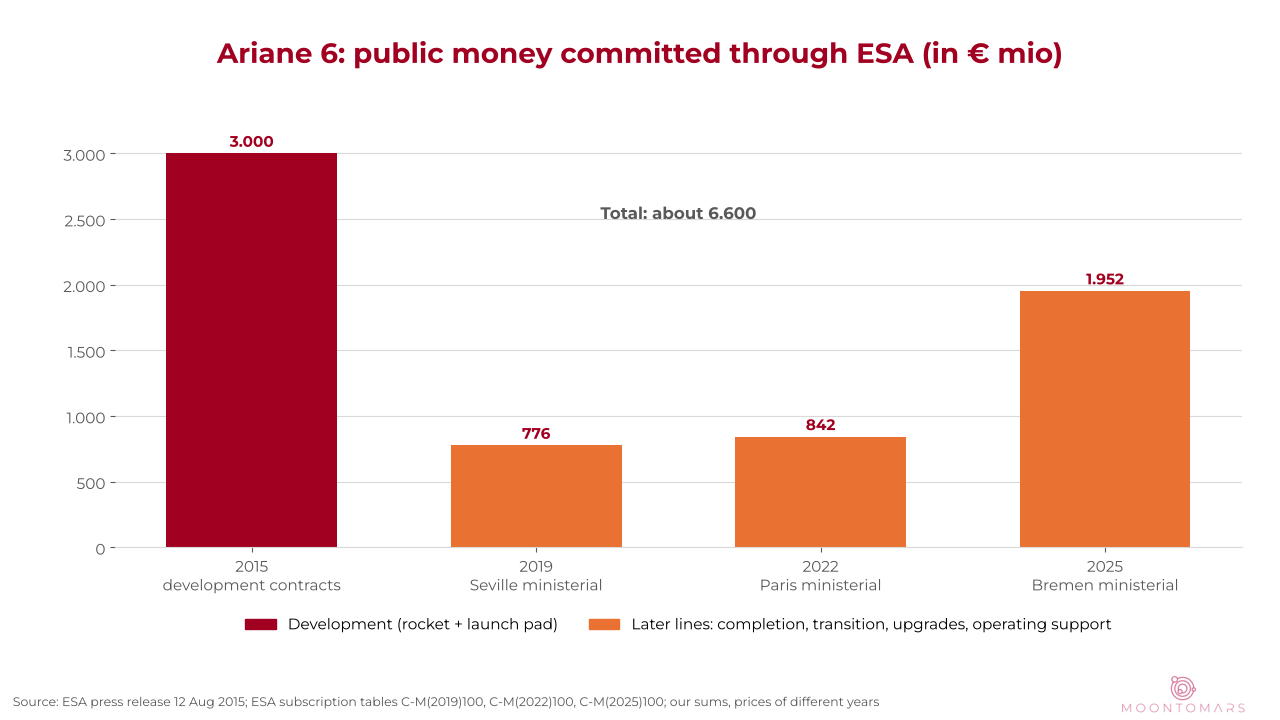
Added up, ESA’s development contracts and the Ariane 6 lines in the three later ministerial councils come to about EUR 6.6 billion of public commitments by our calculation. About EUR 2.8 billion of the later money is support for operating the rocket and for the move from Ariane 5, the part that in 2014 was meant to come without state support. The audit court made the same point in 2019: Ariane 6 was meant to be competitive enough to end the balancing subsidies paid to Arianespace.
The support has a price per flight. In November 2025 the French Senate wrote that EUR 290 to 340 million a year would still be needed to balance the Ariane 6 business plan, even after a cost cut of about 40% per kilogram against Ariane 5. At nine flights a year that is EUR 32 to 38 million of public money for each launch, a range Ars Technica reported ESA’s Director General had confirmed in August 2026.
Upgrades get less. At the Bremen ministerial in November 2025, member states covered EUR 145.9 million of the EUR 304.4 million ESA asked for Ariane 6 product adaptations. In August 2026 ESA said the Block 3 upgrade with a lighter upper stage had “no programme need or justification”.
Who builds and sells Ariane 6: ArianeGroup and Arianespace
ArianeGroup is owned 50/50 by Airbus and Safran through ArianeGroup Holding SAS in Les Mureaux near Paris. It is the prime contractor and design authority of Ariane 6. Its CEO since April 1st, 2026 is Christophe Bruneau, who followed Martin Sion. The French state has call options on the holding’s shares and must approve any sale of them, according to Safran’s annual report.
Arianespace sells the launches. Until 2025 other European suppliers such as Avio, MT Aerospace and SABCA held about a quarter of its holding company. They left its board between December 2025 and January 2026, and ArianeGroup now owns 100%. Arianespace moved its registered office from Évry into ArianeGroup’s headquarters in Les Mureaux on July 1st, 2025, and raised its share capital from EUR 0.37 million to EUR 10 million in January 2026. Its CEO since January 2025 is David Cavaillolès.
ArianeGroup does not publish group accounts of its own. Airbus and Safran do, in their audited annual reports:
| Year | ArianeGroup revenue | ArianeGroup profit or loss | Arianespace SAS turnover | Arianespace SAS net result |
|---|---|---|---|---|
| 2019 | EUR 3,069 million | EUR 133 million | EUR 999 million | EUR 2 million |
| 2020 | EUR 2,718 million | EUR -6 million | EUR 983 million | EUR 0.2 million |
| 2021 | EUR 3,129 million | EUR -39 million | EUR 1,268 million | EUR 4 million |
| 2022 | EUR 2,357 million | EUR 19 million | EUR 635 million | EUR -47 million |
| 2023 | EUR 2,298 million | EUR -32 million | EUR 399 million | EUR -26 million |
| 2024 | EUR 2,475 million | EUR 3 million | EUR 152 million | EUR -24 million |
| 2025 | EUR 2,561 million | EUR 6 million | EUR 509 million | EUR -15 million |
Over seven years ArianeGroup made EUR 84 million of profit on EUR 18.6 billion of revenue, a margin of about 0.5%. Safran has received no dividend from it since 2019. Safran wrote down the assets of the Ariane 6 programme in its own books by EUR 146 million in 2021 and wrote off the rest (EUR 58 million) on June 30th, 2022. The German arm, ArianeGroup GmbH, lost EUR 114 million in 2022 and 2023, booked EUR 34.6 million of extra cost from the Ariane 6 delay in 2023, and received EUR 50 million of fresh capital from its owner in both 2023 and 2025.
How Ariane 6 compares with rockets from the US, China and Japan
Late, but not alone
| Rocket | Country | Decided or announced | Promised first flight | First flight | Late by at least | Launches in 2025 | Reusable first stage |
|---|---|---|---|---|---|---|---|
| Ariane 6 | Europe | December 2014 | 2020 | July 2024 | 42 months | 4 | No |
| Vulcan Centaur | US (ULA) | April 2015 | 2019 | January 2024 | 48 months | 1 | No |
| New Glenn | US (Blue Origin) | September 2016 | 2020 | January 2025 | 48 months | 2 | Yes, first landing November 2025 |
| H3 | Japan | 2014 | Japanese fiscal year 2020 | February 2024 (first attempt failed in March 2023) | 35 months | 3 | No |
| Falcon 9 | US (SpaceX) | September 2005 | 2007 | June 2010 | 35 months | 165 | Yes, since December 2015 |
| Long March 5 | China (state) | 2007 | 2014 | November 2016 | 22 months | 4 | No |
| Zhuque-3 | China (private, LandSpace) | (not public) | 2025 | December 2025 | on time | 1 | Yes, first landing August 2026 |
New heavy rockets are late almost everywhere. ULA’s Vulcan and Blue Origin’s New Glenn came later against their own targets than Ariane 6 did, and Japan’s H3 lost its first rocket. Where Ariane 6 stands out is the time from decision to first flight: 9.6 years for an expendable rocket that reuses the Vulcain engine family of Ariane 5. Falcon 9 took 4.7 years from announcement to first flight.
Launch rate
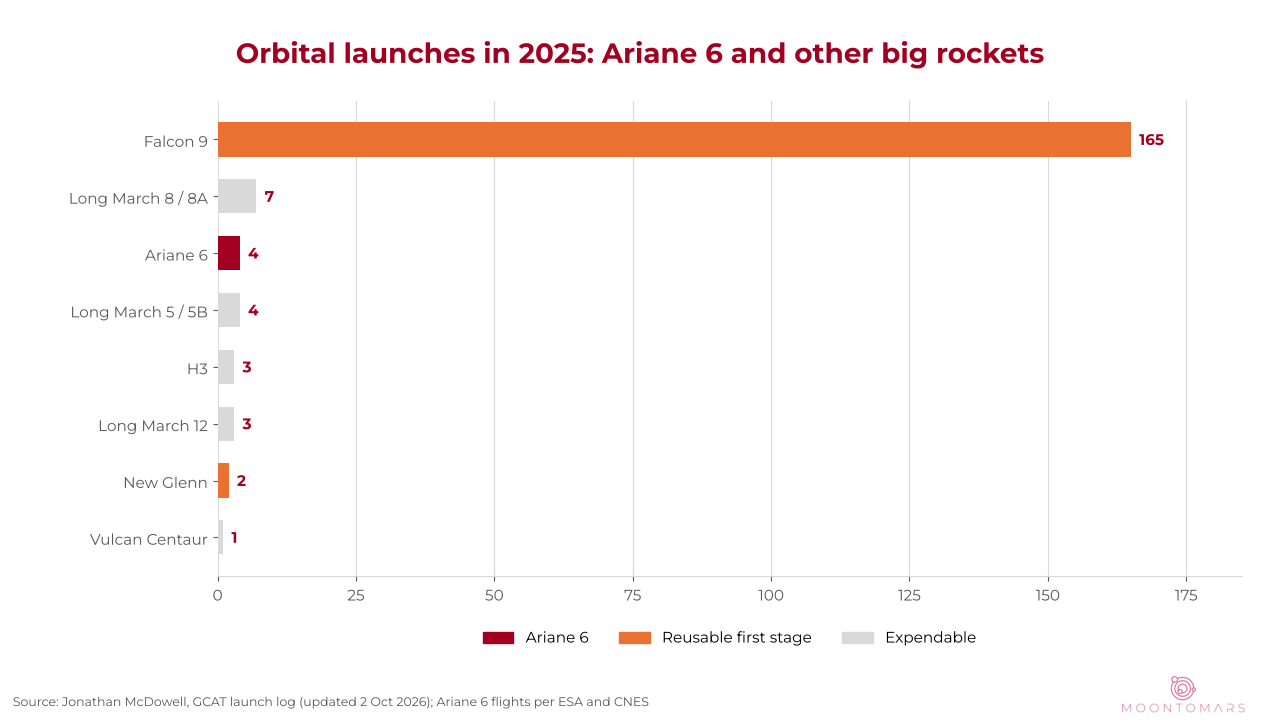
In 2025 Ariane 6 flew four times. In the same year Falcon 9 flew 165 times, about half of all 329 orbital launches in the world, and China’s new Long March 8 family flew seven times. European rockets (Ariane 6, Vega C and Isar’s Spectrum) made 8 of the 329 launches, or 2.4%.
Price per kilogram
| Rocket | Price | Payload to low Earth orbit | Price per kg (our calculation) |
|---|---|---|---|
| Falcon 9 | USD 74 million (SpaceX list price, 2026) | 22,000 kg | About USD 3,400 |
| Ariane 62 | About EUR 70 million (ArianeGroup’s first estimate), “well over EUR 100 million” (European Spaceflight, 2024) | 10,300 kg | About EUR 6,800 to more than EUR 9,700 |
| Ariane 64 | EUR 115 million (what ESA expected to pay, 2014) | 21,600 kg | About EUR 5,300 |
To low Earth orbit a kilogram on Falcon 9 costs about half of what it costs on Ariane 6, even on Ariane 6’s own early estimates. To geostationary transfer orbit the gap is smaller: Ariane 64 at EUR 115 million for 11.5 tonnes comes to about EUR 10,000 per kilogram, and Falcon 9’s list price covers up to 5.5 tonnes, about USD 13,500 per kilogram. That is the market Ariane 6 was designed for in 2014, with two big satellites per launch. Most new demand is in low Earth orbit, where constellations need many launches a year.
China’s state rocket maker CASC publishes no prices. The private Chinese companies give targets: LandSpace aims below CNY 20,000 per kilogram (about EUR 2,700) with Zhuque-3, and CAS Space said it charges CNY 50,000 per kilogram (about EUR 6,700) on its small Lijian-1.
What the public money bought
| Programme | Public money | What it delivered |
|---|---|---|
| Ariane 6 (Europe) | EUR 3 billion development contracts (2015), about EUR 3.6 billion more since 2019, up to EUR 340 million a year to operate | Expendable heavy rocket, first flight July 2024, nine flights |
| Falcon 9 and Dragon (US) | USD 396 million from NASA’s COTS programme (2006 – 2011). SpaceX put in USD 454 million | Falcon 9 and the Dragon cargo capsule. Falcon 9 was later made reusable with SpaceX’s own money |
| Vulcan (US) | USD 967 million from the US Air Force (2018) | Expendable heavy rocket, first flight January 2024, four flights, grounded after a booster problem in February 2026 |
| OmegA (US, Northrop Grumman) | USD 531.7 million paid by the US Air Force | Cancelled, never flew |
| H3 (Japan) | About JPY 190 billion development budget | Expendable heavy rocket, first success February 2024 |
The US also paid for expendable rockets that came late, and for one that never flew. The difference is the model. NASA paid fixed sums for milestones and bought a rocket and a cargo capsule for USD 396 million. ESA paid for development and then kept paying to operate the rocket.
Reuse
By October 2026 first stages had landed on Falcon 9 (since 2015), New Glenn (November 2025) and LandSpace’s Zhuque-3 (August 2026), and the state’s Long March 10B had its first stage caught by a net at sea (July 2026). Ariane 6, Vulcan and H3 are expendable. ESA’s reusable engine Prometheus and the Themis hop demonstrator have not flown, and MaiaSpace, the ArianeGroup subsidiary meant to bring reuse to Europe, plans its first orbital flight for the second half of 2027.
Reliability
Since the partial failure of its first flight, every Ariane 6 has reached the planned orbit: eight in a row, including the first Ariane 64, the first P160C boosters and the first flight to geostationary transfer orbit. Over the same period Vulcan was grounded after a second booster problem, a New Glenn exploded on its pad in a test in May 2026, and H3 lost a second rocket in December 2025.
What about Vega C?
Vega C, Europe’s smaller rocket built by Avio in Italy, came out of the same 2014 decision and the same 2015 contracts (EUR 395 million, for a first flight in 2018). It shares its P120C first stage with the Ariane 6 boosters and gets up to EUR 21 million a year of operating support under the same 2023 deal. Its own record (first flight July 2022, failure December 2022, return to flight December 2024) is on our Vega C and Avio page.
My opinion on Ariane 6 and why you should keep an eye on it
What I like about Ariane 6
- It flies: Eight flights in a row reached their orbit, and the four-booster version, the new P160C boosters and the first flight to geostationary transfer orbit all worked the first time.
- Late like the others: Vulcan and New Glenn missed their own dates by more, and H3 lost its first rocket. A new heavy rocket four years late is normal, if not good.
- European payloads on a European rocket again: The French military, Galileo, Copernicus and EUMETSAT fly on Ariane 6, after two years in which ESA and the EU had to buy Falcon 9 launches.
What I don’t like about Ariane 6
- Ten years from decision to orbit: 9.6 years from the Luxembourg ministerial to the first flight, for an expendable rocket built on Ariane 5’s engine family. Falcon 9 took 4.7 years.
- “Without support from Member States”: That was the 2014 plan. Since 2019 member states have committed about EUR 2.8 billion to operation and transition, plus up to EUR 340 million a year from 2026.
- No price: ESA promised “specified competitive prices” in 2015. Eleven years later nobody has published one, and the head of CNES says Ariane 6 is too expensive.
- Four a year: 11 to 12 launches a year were promised for 2023. Ariane 6 managed four in 2025, while Falcon 9 flew 165 times.
- Expendable in 2026: Three rockets in the US and China landed boosters by October 2026. Europe’s member states did not even fund half of the Ariane 6 upgrade budget.
Things to watch out for
- The rest of 2026: Arianespace aimed at seven to eight flights this year and had four by October 7th. Three more are on the manifest.
- Nine to ten a year by 2027: That is the rate the EUR 340 million a year was sized for. Let’s count again in January 2028.
- The 11% cost cut: Industry promised it in November 2023 in exchange for the support. Nobody has published whether it happened.
- What the support pays out: ESA states have subscribed EUR 1,020.6 million for it. How much has been drawn is not public.
- Amazon: Amazon ordered 18 launches in 2022 “over a period of three years” and six more in September 2026, now running to 2031. Three have flown.
- Arianespace’s accounts: Four years of losses from 2022 to 2025 and a capital increase in January 2026. The 2026 accounts are due in 2027.
Where to find more information on Ariane 6
- ESA: Ariane 6 and Vega C begin development (August 2015), the contracts and the promises
- ESA: Europe’s new Ariane 6 rocket powers into space (July 2024)
- ESA: subscriptions at the 2025 ministerial council (PDF, via the Swedish National Space Agency)
- Cour des comptes: launcher policy (February 2019, in French)
- French Senate: report on the 2026 space budget (in French)
- European Spaceflight: ArianeGroup to receive EUR 340 million per year (November 2023)
- NASA: cost study of COTS and commercial cargo (2017)
- Our page on the European Launcher Challenge, ESA’s other way of buying launches
Updates on Ariane 6
- October 2026: Page published with nine flights, the public money from 2014 to 2025 and the comparison with US, Chinese and Japanese rockets.
Structured information on Ariane 6
| Type | Information |
|---|---|
| Official name | Ariane 6 (versions Ariane 62 and Ariane 64) |
| Ordered by | European Space Agency, ministerial council in Luxembourg, December 2nd, 2014 |
| Prime contractor | ArianeGroup SAS, 51-61 Route de Verneuil, 78130 Les Mureaux, France (Airbus 50%, Safran 50%) |
| Launch services | Arianespace SAS, Les Mureaux, France (100% ArianeGroup) |
| Launch site | ELA-4, Guiana Space Centre, Kourou, French Guiana |
| First flight | July 9th, 2024 (VA262) |
| Flights to October 7th, 2026 | 9 (6 Ariane 62, 3 Ariane 64) |
| Payload | Ariane 62: 10.3 t to LEO, 4.5 t to GTO. Ariane 64: 21.6 t to LEO, 11.5 t to GTO |
| Engines | Vulcain 2.1 (core stage), Vinci (upper stage), P120C or P160C solid boosters |
| Reusable | No |
| Websites | esa.int, arianespace.com, ariane.group |
Interested in more space companies? Read our other reviews and analysis
The rockets meant to follow Ariane 6 have their own pages: Isar Aerospace, Rocket Factory Augsburg, PLD Space, Orbex, Skyrora, Latitude and HyImpulse. So do the launch sites: Andøya Space Center, SaxaVord Spaceport, Space Hub Sutherland, German Offshore Spaceport Alliance and Etlaq Spaceport. Our European Space Map shows them all.
- HyImpulse Technologies
 HyImpulse Technologies builds hybrid paraffin/LOX rockets. SR75-1 flew from Koonibba on 3 May 2024; a UK CAA licence covers SaxaVord for spring 2027. Series A and a Series A Extension above EUR 50 million equity arrived in 2025–26. SL1 targets 600 kg to LEO; HyMOVE is a separate OTV.
 - Andøya Space Center
 Andøya Space Center is a spaceport in northern Norway. Spectrum reached orbit from Andøya on 5 September 2026. Pad 1 is operational and Isar-exclusive; Pad 2 is proposed. Operator Andøya Space AS is 90% Norwegian state and 10% Kongsberg.
 - SkyroraSkyrora is a Scottish new space company developing the Skyrora XL, a three-stage rocket for up to 315 kg to orbit. Our 2026 analysis covers its owners, accounts, public money and launch plans.
- OrbexOrbex (Orbital Express Launch Ltd): UK microlauncher Prime, 180 kg LEO. In administration since 18 February 2026 after GBP 138.5m raised (GBP 76.7m public). Zero launches. Omnidea bought the Forres assets.
- LatitudeLatitude (formerly Venture Orbital Systems) is a French NewSpace company developing a LOX/RP-1 microlauncher (formerly Zephyr). As of October 2026 it has not flown; Series B raised EUR 27 million; an Etlaq Oman LoI targets an experimental late-2027 inaugural that we treat as optimistic. In-depth analysis on moontomars.space.


All information in this analysis was obtained from public sources and we encourage you to do your own due diligence. Feel free to contact us for corrections or share our content. Attribution is always welcome.